
Commercial HVAC inspections prevent emergency breakdowns by identifying failing components — worn contactors, refrigerant leaks, clogged drain lines — before they cause full system failure. For commercial properties in Boca Raton, Fort Lauderdale, and across Palm Beach County, a single missed inspection can convert a routine $395 service visit into an emergency repair costing many times more.
South Florida’s year-round heat load puts commercial HVAC systems under stress that accelerates component wear faster than in most U.S. markets. Scheduled inspections — conducted by NATE-certified technicians — are the primary mechanism facility managers use to control both equipment lifespan and unplanned capital expenditure. Aspen AC has delivered commercial HVAC inspections and preventative maintenance across Southeast Florida since 1983, and the operational data is consistent: inspected systems break down less, cost less to operate, and last longer.
Schedule your commercial HVAC inspection in Palm Beach County.
The Business Case for Scheduled Commercial HVAC Inspections
Commercial property owners and facility managers operate under dual pressure: maintain occupant comfort while controlling operating costs. HVAC is consistently the largest single energy expenditure in a commercial facility — the U.S. Department of Energy puts heating and cooling at roughly 35% of a building’s total energy consumption, the largest share of any end use. When those systems fail without warning, the financial impact extends well beyond the repair invoice.
Emergency commercial AC repair in South Florida commands premium pricing: after-hours labor surcharges, expedited parts procurement, and potential lost business revenue during downtime. A compressor replacement that costs far less during a scheduled visit than when it fails mid-summer and requires same-day emergency dispatch.
Beyond direct repair costs, unplanned HVAC failures in commercial spaces create secondary exposures:
- Lease covenant liability — landlords may be contractually obligated to maintain habitable temperatures
- Regulatory exposure — Florida building codes impose specific environmental standards for commercial occupancies
- Reputational damage — customer-facing businesses cannot absorb visible comfort failures
Scheduled inspections neutralize all three risk vectors simultaneously.
What a Commercial HVAC Inspection Covers: A South Florida Checklist
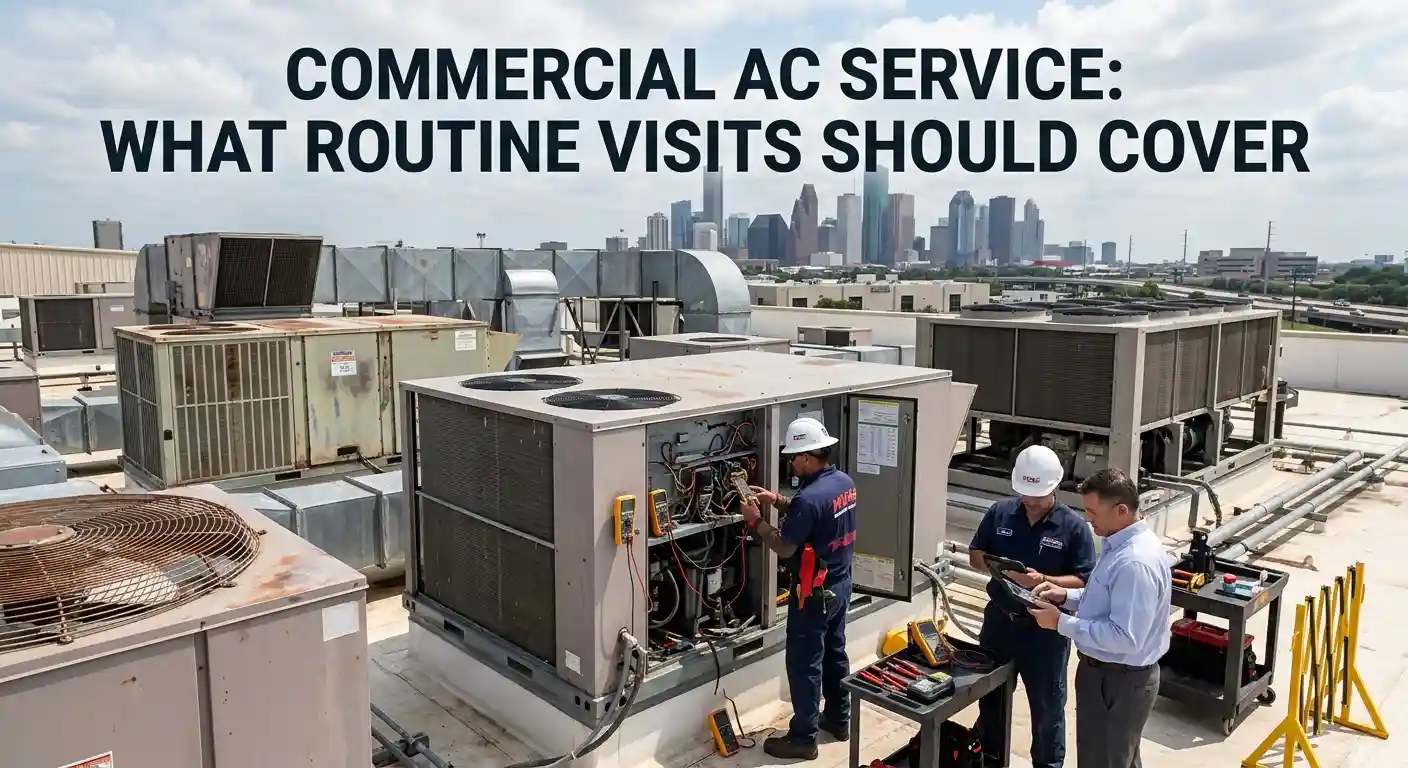
A professional commercial HVAC inspection in South Florida is a systematic evaluation of every mechanical, electrical, and pneumatic component in the system. The following checklist reflects the standard scope performed by NATE-certified technicians on commercial properties across Palm Beach and Broward Counties.
Mechanical Components — compressor operation and amperage draw, condenser and evaporator coil condition, fan motor bearings and belt tension, refrigerant charge and leak detection, drain pan and condensate line integrity.
Electrical Systems — contactor and capacitor condition, disconnect and breaker inspection, control board and wiring integrity, thermostat calibration and sequencing accuracy.
Airflow & Filtration — static pressure measurement, filter condition and MERV rating verification, duct integrity check for leaks or blockages, blower wheel condition and RPM.
IAQ & Safety — carbon monoxide emission testing (where applicable), UV light system verification, humidity level assessment, exhaust system integrity.
Inspection scope varies by system type. Packaged rooftop units, split systems, VRF/VRV configurations, and PTACs each have component-specific inspection protocols. Aspen AC technicians are trained across all commercial system types deployed in Southeast Florida.
Preventative vs. Emergency HVAC Repair Costs: What South Florida Businesses Are Actually Paying
The cost differential between scheduled maintenance and emergency repair is the most direct argument for inspection contracts. The figures below reflect general commercial HVAC service pricing benchmarks in the South Florida market — actual costs vary by system size and site conditions.
Scheduled inspection visit — from the $395 minimum commercial service invoice per visit, on a quarterly cadence.
Refrigerant top-off (scheduled) — priced by refrigerant type, quantity and system requirements.
Refrigerant leak repair (emergency) — within the typical $395–$2,500+ commercial repair range, with weekend and extended hours at 1.5x the regular rate.
Capacitor replacement (scheduled) — a low-cost fix when caught during a routine inspection.
Compressor failure (emergency) — at the top of the commercial repair range — $2,500 and up — frequently traceable back to an undetected failing capacitor.
Full system replacement (premature) — in the $10,000–$30,000-and-up replacement range, typically accelerated by deferred maintenance.
The pattern is consistent: components that fail catastrophically during peak season are rarely a surprise to a technician who has seen the system recently — capacitors degrade measurably before failure, refrigerant levels drop gradually before a leak becomes a full-charge loss, and contactors pit and burn before they fail open.
Inspection protocols are designed specifically to catch components in that degradation window — before they cross into failure territory.
Commercial HVAC Inspections in Boca Raton, Fort Lauderdale & Palm Beach County
South Florida’s climate profile creates HVAC demands that are categorically different from most U.S. commercial markets. With average annual temperatures exceeding 75°F and humidity levels that routinely reach 80–90% during summer months, commercial HVAC systems in this region run at high load for 10–11 months per year. That operational intensity accelerates wear on every mechanical component.
Boca Raton — Commercial properties in Boca Raton, from the high-rise condominiums along Federal Highway to the office parks of the Arvida Parkway corridor, operate complex multi-zone HVAC systems that require structured inspection programs. Aspen AC is headquartered in Boca Raton and maintains the fastest dispatch times in the market for local commercial clients.
Fort Lauderdale & Broward County — Fort Lauderdale’s commercial real estate landscape includes hospitality properties, healthcare facilities, and a dense retail and restaurant sector, all of which face heightened HVAC compliance requirements. Broward County commercial operators benefit from Aspen AC’s Broward service infrastructure, including same-day emergency dispatch and ongoing maintenance contract programs.
Palm Beach County — From West Palm Beach and Jupiter in the north to Delray Beach and Boca Raton in the south, Palm Beach County commercial properties represent one of the highest concentrations of commercial HVAC infrastructure in Southeast Florida. Aspen AC has operated continuously across Palm Beach County since 1983, building a service history across high-rise residential, medical office, industrial, and retail sectors.
Frequently Asked Questions
How often should a commercial HVAC system be inspected?
Commercial HVAC systems in South Florida should be inspected a minimum of twice per year — typically in spring before peak cooling season and in fall as cooling demand decreases. High-load environments such as healthcare facilities, restaurants, and data centers may require quarterly inspections due to elevated operational intensity.
How long does a commercial HVAC inspection take?
Inspection duration depends on system type and facility size. A single rooftop packaged unit typically requires 60–90 minutes. Multi-unit properties or facilities with complex VRF/VRV or chilled water systems may require 3–6 hours for a full inspection cycle.
What is the cost of a commercial HVAC inspection in Palm Beach County?
Commercial HVAC inspection costs in Palm Beach County typically start from the published $395 minimum commercial service invoice, with diagnostics from $195 per hour. Facilities enrolled in annual maintenance contracts with Aspen AC receive structured pricing and priority dispatch scheduling.
Can a commercial HVAC inspection prevent compressor failure?
Yes. Compressor failures are rarely instantaneous — they are almost always preceded by detectable precursor conditions: low refrigerant charge, elevated amperage draw, capacitor degradation, or inadequate airflow. A qualified inspection identifies these conditions before they trigger compressor failure, which is the single most expensive component replacement in any commercial system.
Does Aspen AC serve Fort Lauderdale and Broward County?
Yes. Aspen AC provides commercial HVAC inspections, emergency repair, and maintenance contracts across both Palm Beach and Broward Counties, including Fort Lauderdale, Coral Springs, Pompano Beach, Plantation, Hollywood, and Pembroke Pines.
How can I tell if my commercial HVAC system needs an immediate inspection?
Watch for weak airflow, uneven cooling, strange noises, frequent cycling, water leaks from the unit, or higher energy bills—all signs the system should be inspected soon.
Do I need a different type of inspection for rooftop units in South Florida?
Yes; rooftop units here need extra attention to coil cleaning, drain‑pan clearing, weather‑sealing, and corrosion checks because they face constant sun, wind, rain, and salt air.
What are the most common causes of emergency HVAC breakdowns in South Florida?
Top causes include dirty coils, clogged drains, failing capacitors or contactors, worn belts, refrigerant leaks, and thermostat or control failures due to heat and humidity stress.
How do inspections help prevent roof water damage from commercial AC units?
Inspectors clean drain pans, flush condensate lines, and check overflow safety, which prevents water backup and leaks that can damage ceilings, insulation, and roofing.
Should I schedule inspections even if my commercial HVAC system has not broken down yet?
Yes; preventive inspections are meant to catch problems before failure, so scheduling them regularly is how South Florida businesses avoid surprise emergencies and costly downtime.
FAQs: Commercial HVAC Inspections in South Florida
How often should a commercial HVAC system be inspected?
Commercial HVAC systems in South Florida should be inspected a minimum of twice per year — typically in spring before peak cooling season and in fall as cooling demand decreases. High-load environments such as healthcare facilities, restaurants, and data centers may require quarterly inspections due to elevated operational intensity.
How long does a commercial HVAC inspection take?
Inspection duration depends on system type and facility size. A single rooftop packaged unit typically requires 60–90 minutes. Multi-unit properties or facilities with complex VRF/VRV or chilled water systems may require 3–6 hours for a full inspection cycle.
What is the cost of a commercial HVAC inspection in Palm Beach County?
Commercial HVAC inspection costs in Palm Beach County typically start from the published $395 minimum commercial service invoice, with diagnostics from $195 per hour. Facilities enrolled in annual maintenance contracts with Aspen AC receive structured pricing and priority dispatch scheduling.
Can a commercial HVAC inspection prevent compressor failure?
Yes. Compressor failures are rarely instantaneous — they are almost always preceded by detectable precursor conditions: low refrigerant charge, elevated amperage draw, capacitor degradation, or inadequate airflow. A qualified inspection identifies these conditions before they trigger compressor failure, which is the single most expensive component replacement in any commercial system.
Does Aspen AC serve Fort Lauderdale and Broward County?
Yes. Aspen AC provides commercial HVAC inspections, emergency repair, and maintenance contracts across both Palm Beach and Broward Counties, including Fort Lauderdale, Coral Springs, Pompano Beach, Plantation, Hollywood, and Pembroke Pines.
How can I tell if my commercial HVAC system needs an immediate inspection?
Watch for weak airflow, uneven cooling, strange noises, frequent cycling, water leaks from the unit, or higher energy bills—all signs the system should be inspected soon.
Do I need a different type of inspection for rooftop units in South Florida?
Yes; rooftop units here need extra attention to coil cleaning, drain‑pan clearing, weather‑sealing, and corrosion checks because they face constant sun, wind, rain, and salt air.
What are the most common causes of emergency HVAC breakdowns in South Florida?
Top causes include dirty coils, clogged drains, failing capacitors or contactors, worn belts, refrigerant leaks, and thermostat or control failures due to heat and humidity stress.
How do inspections help prevent roof water damage from commercial AC units?
Inspectors clean drain pans, flush condensate lines, and check overflow safety, which prevents water backup and leaks that can damage ceilings, insulation, and roofing.
Should I schedule inspections even if my commercial HVAC system has not broken down yet?
Yes; preventive inspections are meant to catch problems before failure, so scheduling them regularly is how South Florida businesses avoid surprise emergencies and costly downtime.
Why Aspen AC for Commercial HVAC Inspections in Southeast Florida
- NATE-certified technicians on every inspection — the highest field certification in the HVAC industry
- 40+ years of continuous operation in South Florida’s commercial market since 1983
- Under 4-hour emergency response guarantee across Palm Beach and Broward Counties
- All commercial system types — packaged units, split systems, VRF/VRV, PTACs, VPACs, and chilled water
- Fully licensed, bonded, and insured — background-checked staff, 7-day availability
- Customized maintenance contracts structured around your facility’s operational schedule and budget cycle
Don’t allow deferred maintenance to become an emergency capital event. Contact Aspen AC to schedule a commercial HVAC inspection for your Boca Raton, Fort Lauderdale, or Palm Beach County property.
Disclaimer: Cost ranges and energy figures cited in this article are general estimates, not a quote for any specific property. Actual costs depend on system size, equipment age, and site conditions. Contact Aspen AC for a scope-based assessment of your facility.