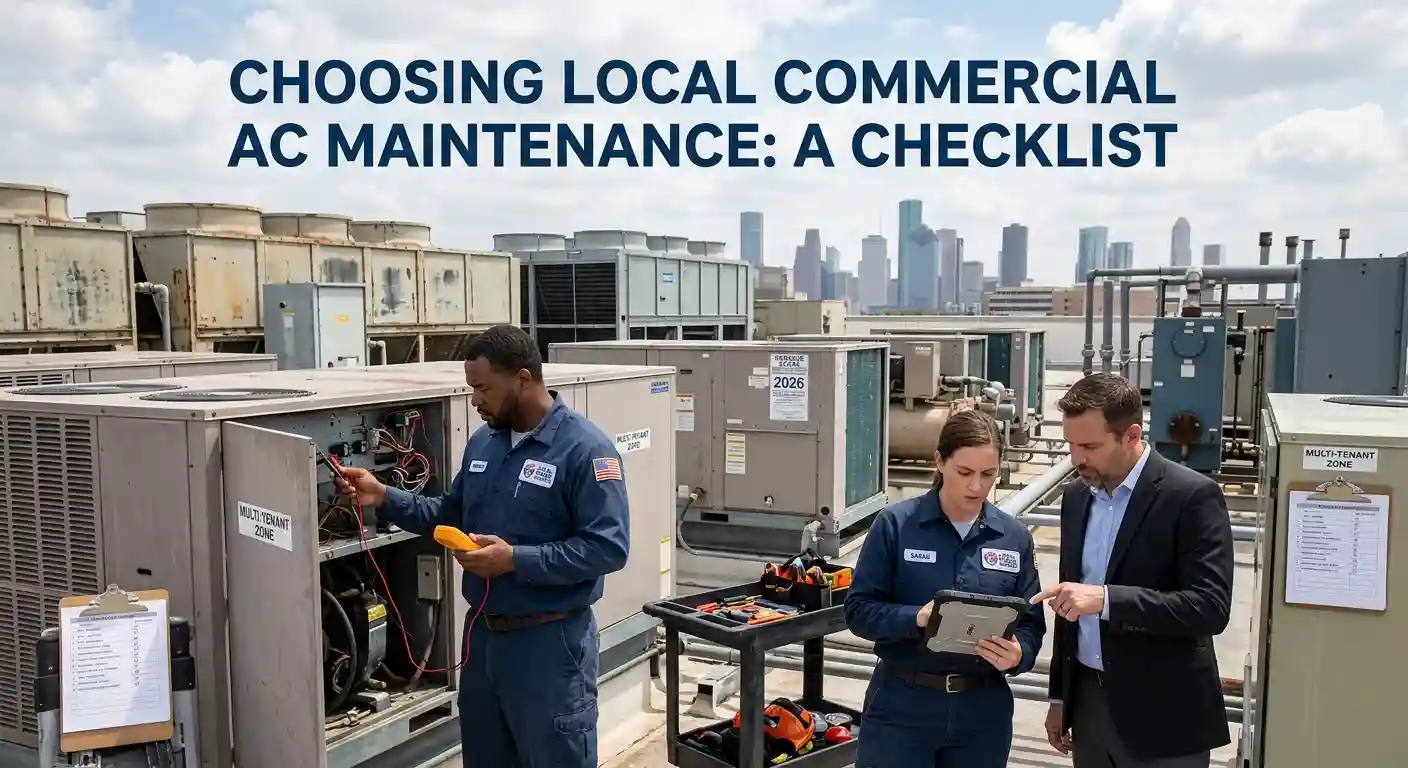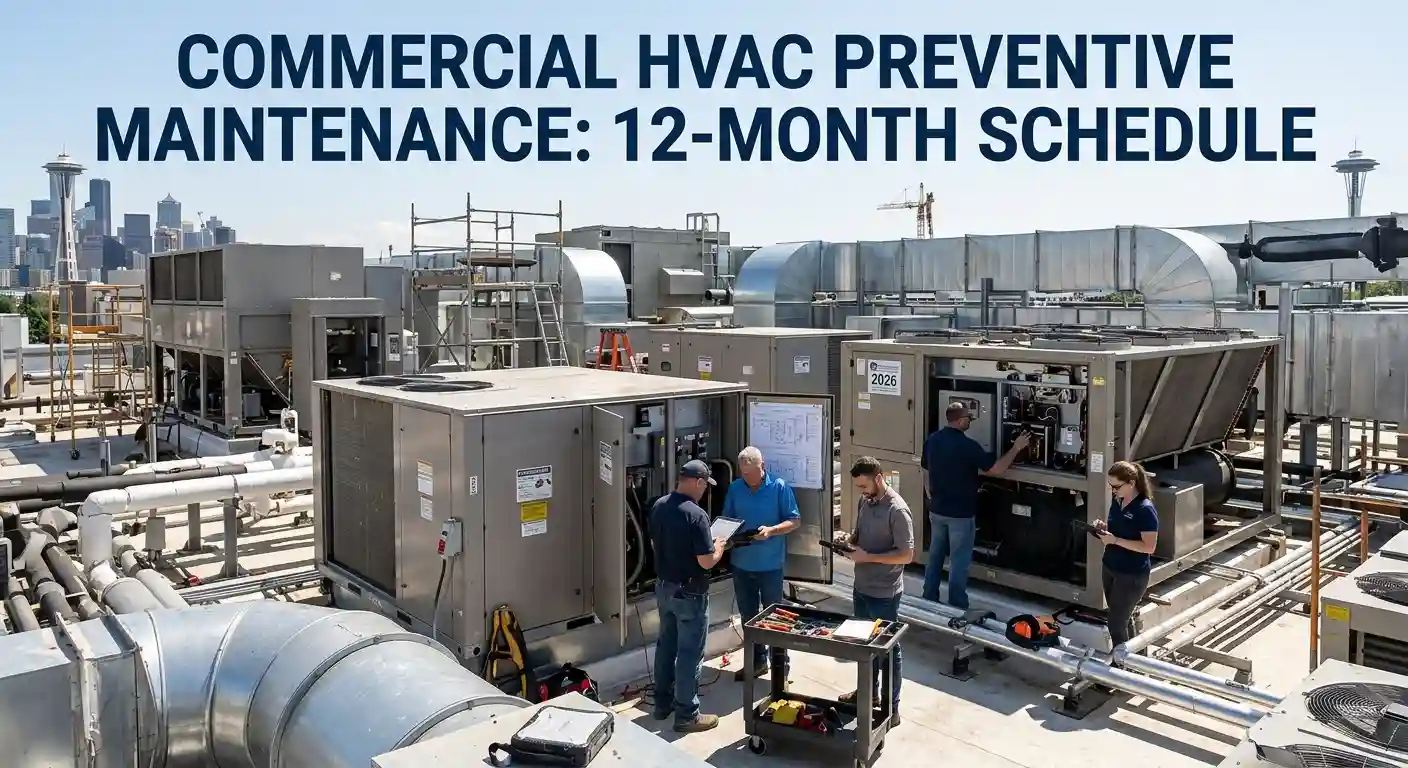

A routine commercial AC service visit should cover coil condition, refrigerant charge, electrical components, condensate drainage, filters and controls — with each item inspected and its condition documented, not just glanced at. In South Florida, that checklist runs on a quarterly cadence for most commercial equipment, driven by year-round run hours and coastal exposure.
Knowing what a proper visit actually covers matters because it’s the difference between a service that catches problems early and one that’s essentially a drive-by. This guide breaks down what should happen at every routine visit, how often it should happen, and how to tell a thorough visit from a superficial one.
What Should Every Routine Commercial AC Visit Include?
A complete visit works through eight core items on every unit: coil inspection and cleaning, refrigerant charge verification, electrical component testing, condensate system service, filter check, airflow verification, controls testing, and a documented written report with actual readings.
| Task | What it catches |
|---|---|
| Coil inspection/cleaning | Fouling and corrosion that quietly reduce capacity |
| Refrigerant charge check | Slow leaks before they become compressor damage |
| Electrical testing | Capacitors and contactors degrading before they fail outright |
| Condensate service | Clogs and algae before they cause water damage |
| Filter check | Airflow restriction that stresses the whole system |
| Airflow verification | Delivered capacity versus what the system should provide |
| Controls testing | Setpoints and schedules that have drifted from intent |
| Written documentation | Trend data for the next visit and for warranty claims |
How Do Technicians Check Coil Condition?
Coil inspection combines a visual check for fouling, corrosion and physical damage with a measurement of the system’s actual heat-transfer performance — because a coil that looks acceptable can still be losing meaningful capacity to buildup a glance won’t catch.
In South Florida, condenser coils face a particular threat from salt-laden air within a couple of miles of the coast, where corrosion accelerates well beyond what inland equipment experiences. A thorough visit checks for the early signs — chalky oxidation, pitted fins, rust at panel seams — because catching corrosion early is a maintenance conversation, while catching it late is a replacement conversation.
What Does Refrigerant Charge Verification Involve?
Charge verification measures system operating pressures and temperature splits against manufacturer specifications, checking that the refrigerant charge matches what the system needs to run efficiently — not simply topping off refrigerant without diagnosing why it might be low.
A charge that’s found low on a routine visit should trigger a leak investigation, not just a top-off, since refrigerant handling is regulated under EPA Section 608 and repeated top-offs on an unfound leak cost more over time than finding and fixing the leak once. A system running on the correct charge also runs more efficiently and puts less stress on the compressor, which is where charge problems eventually show up as expensive failures.
What Electrical Components Get Tested?
Electrical testing checks capacitors against their rated microfarads, inspects contactors for pitting and burn marks, verifies connections are tight under load, and confirms disconnects and breakers are functioning — because these components fail more often in South Florida’s heat than almost anything else in a commercial system.
Capacitors in particular degrade under sustained heat exposure on rooftop equipment, and a capacitor reading below its rated value is a hard-start event waiting for the next hot day. This category of check is also the highest-value item on the visit in pure dollar terms: catching a weak capacitor costs a few dollars and a few minutes, while the compressor failure it can trigger costs thousands.
How Is the Condensate System Serviced?
Condensate service clears and treats drain lines, inspects the drain pan for corrosion and proper pitch, and tests the float switch by actually tripping it — a safety device that only matters if it’s confirmed to work, not assumed to work.
South Florida’s humidity means condensate flows daily, year-round, and drain lines accumulate algae and sludge in that warm, wet environment faster than almost anywhere else in the country. A blocked drain doesn’t damage the HVAC equipment directly — it damages the building around it, in the form of ceiling stains, wet drywall and mold conditions that cost far more to remediate than the maintenance visit that would have prevented them.
How Often Should Routine Commercial AC Service Happen?
Most commercial equipment in South Florida benefits from quarterly service visits, with the interval adjusted for equipment age, coastal exposure and how critical the equipment is to the business — newer inland equipment can sometimes run on three visits a year, while older or coastal equipment often needs the full quarterly cadence.
The reasoning behind quarterly service in this climate is straightforward: equipment runs essentially year-round with no true off-season, salt air accelerates coil degradation continuously near the coast, and condensate systems work daily rather than seasonally. Annual service that would be adequate in a milder climate under-serves equipment running these conditions. Our maintenance agreements structure visit frequency around exactly this reasoning.
How Do You Tell a Thorough Visit From a Superficial One?
The clearest tell is documentation — a thorough visit produces a written report with actual readings (pressures, amp draws, capacitor values) that can be compared to the previous visit, while a superficial one produces a checklist with boxes ticked and no numbers behind them.
Ask to see a sample service report before signing a maintenance agreement. A report that shows trending data — this quarter’s capacitor reading against last quarter’s — demonstrates the technician is actually measuring rather than glancing. A report that’s identical every visit, or that never flags anything, is a red flag rather than good news; equipment in continuous commercial service in this climate has something worth noting virtually every quarter, even if that note is simply confirming a reading held steady.
What Does Routine Service Cost Compared to Emergency Repair?
Routine commercial AC service is priced by agreement — customized to equipment type, tonnage and visit frequency — while the repairs it prevents typically run $395 to $2,500 and up when they happen anyway, and considerably more when they escalate into emergency after-hours calls billed at 1.5x the regular rate.
Full detail on published maintenance and repair pricing is on our commercial HVAC pricing page. The core economic argument for routine service isn’t abstract: a year of quarterly visits on a typical commercial unit costs meaningfully less than one avoided compressor failure, and that math holds even before counting the downtime a failure causes or the after-hours premium an emergency repair carries on top of the parts and labor.
What Happens If Routine Service Is Skipped?
Deferred maintenance doesn’t eliminate the cost of the items a routine visit would have caught — it converts small, planned expenses into larger, unplanned ones, usually discovered at the least convenient moment rather than a scheduled visit.
A capacitor that would have been swapped for a few dollars during a routine visit instead takes the compressor with it when it finally fails, turning a minor line item into a major one. A slow refrigerant leak left unfound runs the compressor stressed for months before anyone notices reduced cooling. Our commercial AC maintenance team sees this pattern constantly: the emergency call in July is almost always a routine-visit item that went unaddressed since the previous winter.
Frequently Asked Questions
What should be included in a commercial AC maintenance visit?
Coil inspection and cleaning, refrigerant charge verification, electrical component testing, condensate system service, filter check, airflow verification, controls testing, and a written report with actual readings — not just a visual walk-through.
How long does a routine commercial AC service visit take?
A thorough visit on a single rooftop unit typically runs 45 minutes to an hour when done properly, longer for larger or more complex systems. A visit completed in ten minutes per unit is unlikely to be checking everything this guide describes.
Why does South Florida need quarterly service instead of annual?
Year-round run hours, coastal salt exposure, and continuous condensate flow all compress the intervals that would be adequate in milder climates. Equipment running these conditions on annual-only service tends to show accelerated wear compared to equipment on a quarterly cadence.
What’s the difference between a service visit and a repair?
A service visit is scheduled preventive work covered under a maintenance agreement. A repair addresses something that has already failed or been found failing, quoted and billed separately at standard rates — routine service exists specifically to catch problems before they require repair.
Aspen Air Conditioning provides documented commercial AC service across Palm Beach and Broward Counties on a quarterly cadence built for this climate. Call 561-464-5010.