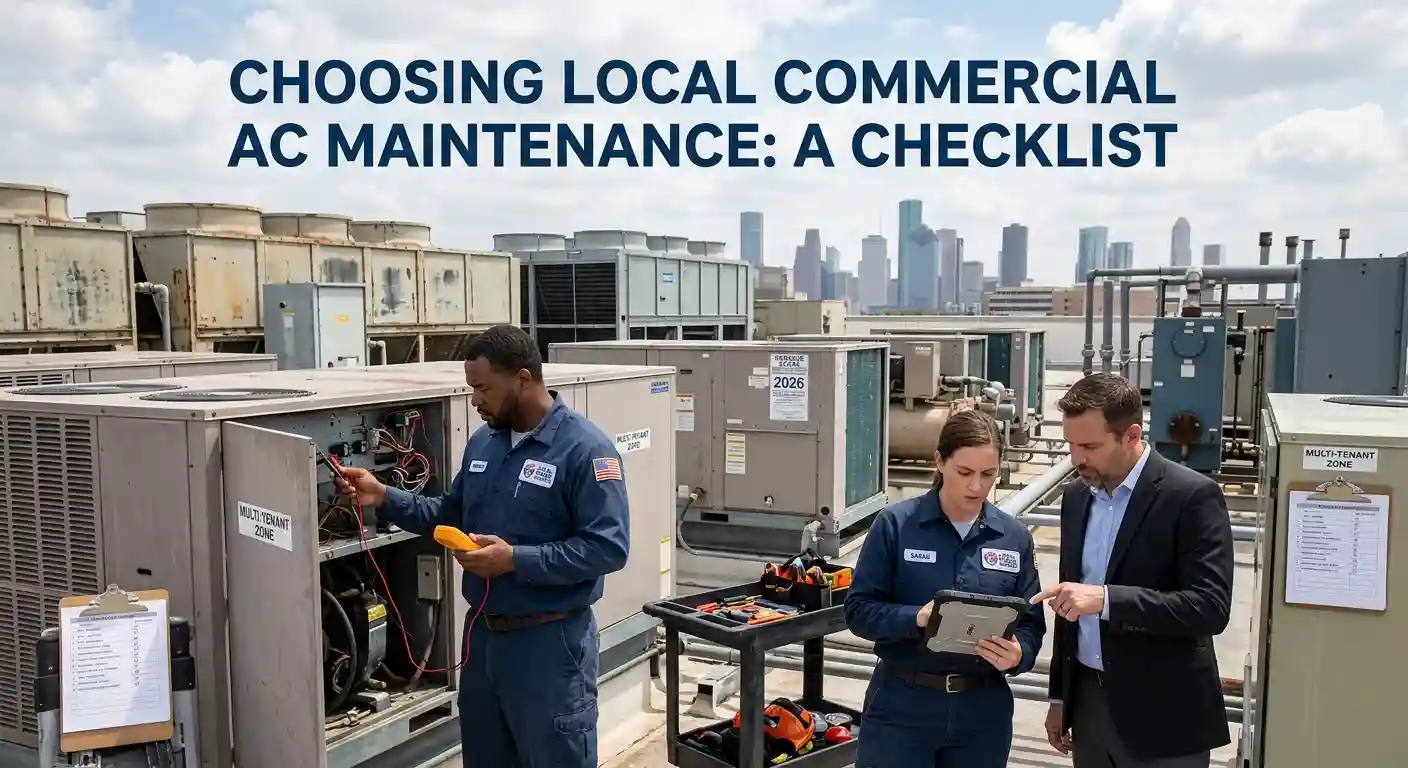

Choosing local commercial AC maintenance comes down to five checks: a verified Florida license and adequate insurance, genuine commercial experience rather than primarily residential work, a written checklist describing exactly what each visit covers, transparent published pricing, and response terms that match how quickly your business actually needs help when something fails.
Most commercial maintenance agreements look similar on the surface — quarterly visits, a service fee, a phone number to call. The differences that actually matter show up in the details this checklist covers, and they’re differences a property manager can verify before signing rather than discovering after a bad service experience.
Is the Provider Properly Licensed and Insured?
Verify an active Florida contractor license directly on the state’s public license database, confirm general liability and workers’ compensation insurance at a level appropriate to your property, and don’t rely on a certificate the contractor hands you — search their name or license number independently.
| Check | How to verify |
|---|---|
| Active license | Search directly on Florida DBPR license portal |
| General liability insurance | Request certificate naming your property |
| Workers’ compensation | Confirm coverage protects you from injury claims |
| Bonding | Ask the bonded amount for commercial-scale work |
A contractor who hesitates to provide this documentation, or whose license search turns up lapsed status or disciplinary history, has answered the question before you finish asking it — take the answer at face value and move to the next candidate.
Does the Provider Have Real Commercial Experience?
Ask directly what share of the company’s work is commercial versus residential, and ask about specific commercial properties similar to yours — a company that’s primarily residential with occasional commercial work often lacks the equipment knowledge and crew training that dedicated commercial maintenance requires.
Commercial HVAC differs meaningfully from residential in equipment type, controls complexity and the operational stakes of a failure, and a maintenance provider without deep commercial experience tends to reveal that gap during an actual emergency rather than during the sales conversation. Our contractor selection guide covers this vetting process in more depth for any commercial HVAC decision, not just maintenance.
Is There a Written Checklist for What Each Visit Covers?
A legitimate maintenance agreement should specify exactly what tasks happen at each visit — coil inspection, refrigerant check, electrical testing, condensate service, filter change, controls verification — rather than a vague promise of “routine maintenance” that leaves scope entirely to the technician’s discretion on the day.
Ask to see a sample completed service report before signing. A report with actual readings — capacitor values, refrigerant pressures, amp draws — demonstrates the technician is measuring rather than glancing. A provider who can’t produce a sample report, or whose sample is a generic checkbox sheet with no numbers, is telling you what your actual visits will look like.
Is Pricing Transparent and Published?
Look for a provider willing to publish or clearly state their rate structure — minimum service invoice, diagnostic hourly rate, after-hours multiplier — before you’re a customer, rather than discovering rates for the first time on an invoice after work is already complete.
Transparency here is as much a quality signal as a pricing convenience: a contractor comfortable showing rates in daylight is planning to defend the value behind them, while one who won’t tends to have something in the pricing structure worth hiding. Our commercial HVAC pricing page publishes exactly this kind of structure as a reference point for what transparent commercial pricing should look like.
What Response Terms Should the Agreement Include?
Confirm written response-time targets for both scheduled maintenance and emergency calls, priority queue position for agreement customers during peak demand, and after-hours availability that matches your actual operating hours — a maintenance agreement with vague response language provides little real protection when you actually need fast help.
The response terms matter most in the moment you’re least able to negotiate them — during an active emergency, with a hot building and impatient tenants or customers. Confirming these terms in writing before signing, rather than assuming reasonable response is implied, is what separates an agreement that performs under pressure from one that only sounds good in the sales conversation before the first real emergency tests it.
What Red Flags Should End the Conversation?
A handful of signals disqualify a provider outright: no verifiable license or a vague “we work under someone else’s” arrangement, pressure tactics like today-only pricing on a maintenance agreement, refusal to provide a written quote or sample service report, and no genuine local presence — which predicts poor response times before you ever need emergency help.
Softer warnings deserve weight too. A quote dramatically below every other bid usually means something is missing from the scope, not that the provider found genuine efficiency competitors somehow missed. Reluctance to name which technicians will actually service your property, or vague answers about certifications, often predicts the same vagueness will show up in service quality once the agreement is signed. None of these signals guarantee a bad experience on their own, but two or more together are worth treating as a real answer rather than a coincidence worth ignoring.
How Should You Compare Multiple Local Providers?
Compare providers on scope and terms before comparing price — request the same information from each (license verification, sample service report, published rates, response terms) and evaluate whether a lower quote reflects genuine efficiency or simply less coverage than a competing proposal.
A meaningfully cheaper quote usually means something is missing: fewer visit items, a longer response window, or coverage gaps that only surface when something goes wrong. The provider whose proposal answers every item on this checklist clearly, even if not the cheapest number on the page, is generally the safer choice for equipment that keeps a commercial property running — and the one whose invoice you’re least likely to be surprised by a year from now.
What Should You Ask Before Signing an Agreement?
Ask what’s included versus billed separately, how repair quotes are approved during the agreement term, what happens if you’re unsatisfied with service quality, and whether the agreement renews automatically. Clear, specific answers to all four indicate a provider confident in their own service quality, while vague or evasive answers on any of them indicate the opposite and deserve to be taken seriously before signing rather than discovered after.
Renewal terms deserve particular attention, since an agreement that auto-renews with unfavorable cancellation notice can trap a property with underperforming service longer than intended. A provider willing to earn renewal on service quality, rather than relying on renewal friction or a hard-to-cancel contract, is generally the better long-term partner for a relationship you’ll depend on for years.
What Does Local Commercial AC Maintenance Typically Cost?
Maintenance agreements are customized based on equipment type, tonnage, unit count and visit frequency rather than priced as a flat rate, and the published structure — including agreement labor rates — is available on our commercial HVAC pricing page as a benchmark when comparing local proposals.
Price comparison across providers only works when the scope is genuinely comparable — ask each provider to quote against the same equipment inventory and visit frequency, then compare the resulting numbers, rather than comparing headline prices for agreements that may cover very different actual work under a similar-sounding label.
Frequently Asked Questions
How do I verify a commercial AC maintenance company’s license in Florida?
Search the company’s name or license number directly on Florida’s DBPR public license portal rather than relying on a certificate they provide. This confirms active status and reveals any disciplinary history the company might not volunteer.
What should a commercial maintenance visit report include?
A proper report includes actual readings — refrigerant pressures, capacitor values, amp draws — not just checked boxes. Ask to see a sample report before signing; a provider who can’t produce one is showing you what your visits will actually look like.
Why do maintenance quotes vary so much between local providers?
The spread usually reflects scope differences — fewer visit items, longer response windows, less documentation — rather than pure efficiency. Comparing providers against the same equipment inventory and visit frequency reveals whether a lower price means less coverage.
Should a maintenance agreement include emergency response terms?
Yes — written response-time targets and priority scheduling during peak demand should be part of the agreement, not assumed. Confirming these terms before signing matters most because you’re least able to negotiate them during an actual emergency.
Aspen Air Conditioning provides commercial AC maintenance across Palm Beach and Broward Counties with published pricing and documented service. Call 561-464-5010.