
Choosing among the best commercial HVAC companies near you starts with verifying four things: a valid Florida Mechanical License, adequate liability insurance, NATE certification, and genuine commercial-system experience — not just a residential company that also takes commercial calls. Everything else, from pricing to response time, matters less if those basics aren’t confirmed first.
What to Verify Before You Hire a Commercial HVAC Contractor
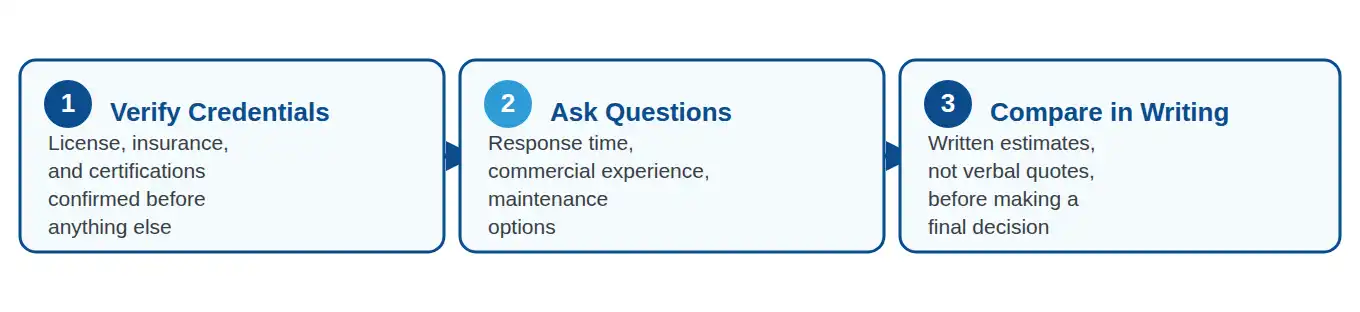
Before comparing pricing or reading a single review, verify three categories: licensing and insurance, technician certifications, and genuine commercial-system experience. These are the non-negotiables that every legitimate contractor should be able to confirm without hesitation.
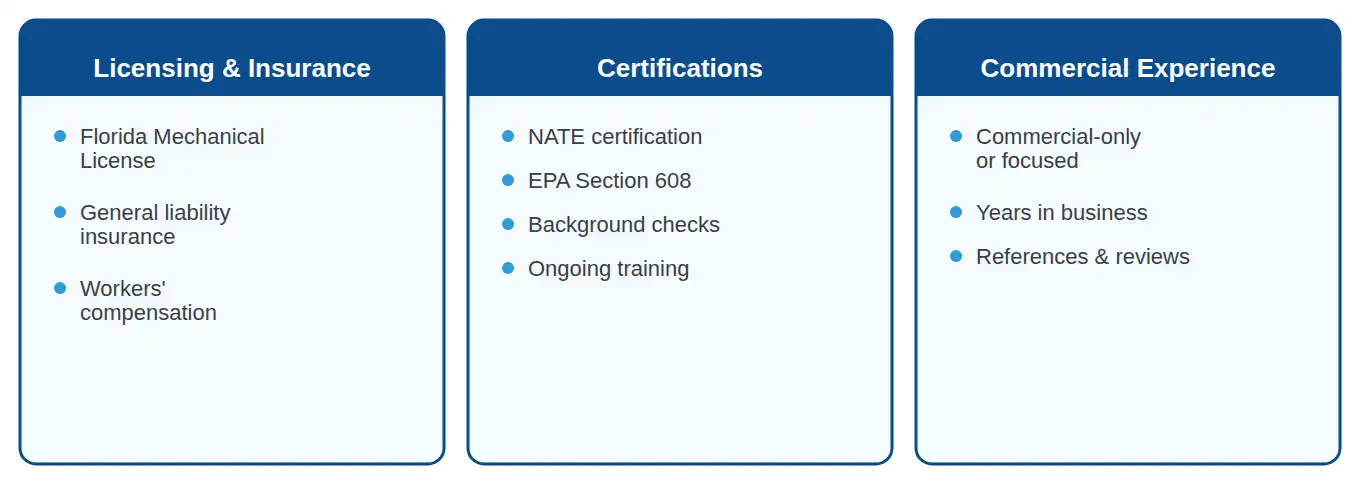
- Licensing and insurance — a valid Florida Mechanical License, general liability insurance, and workers’ compensation coverage
- Certifications — NATE certification and EPA Section 608 compliance for any technician handling refrigerants
- Commercial experience — a track record with commercial-scale systems specifically, not just residential work that occasionally extends to small commercial jobs
A contractor who can’t produce proof of any of these on request is a red flag, not a negotiating point.
Verify Licensing and Insurance First
Verifying licensing and insurance means confirming a valid Florida Mechanical License along with adequate liability and workers’ compensation coverage — Florida requires a minimum of $100,000 in liability coverage plus $25,000 in property damage coverage for HVAC companies, and a reputable contractor won’t hesitate to show proof.
- Ask for the contractor’s active license number and confirm it independently rather than taking their word for it
- Confirm general liability insurance covers work at the scale of your property, not just a minimum policy
- Verify workers’ compensation coverage — without it, an on-site injury could become your liability, not theirs
- Treat any hesitation to provide documentation as a disqualifying red flag, not a minor inconvenience
Look for NATE Certification and EPA 608 Compliance
NATE certification and EPA Section 608 compliance are the two credentials worth asking about by name — EPA 608 is a federal legal requirement for anyone handling refrigerants, while NATE is the industry’s most widely recognized voluntary standard for technician competency.
NATE-certified technicians have passed exams covering both general HVAC knowledge and real-world application, and eligibility requires at least two years of field experience first — it’s not a credential handed out casually. A contractor’s willingness to talk specifically about technician certifications, rather than giving a vague “our team is fully qualified,” is itself a useful signal.
Confirm Commercial-Specific Experience
Commercial HVAC systems are meaningfully more complex than residential systems — different equipment, larger scale, and different failure patterns — so confirming a contractor’s specific commercial experience matters more than confirming HVAC experience in general.
- Ask how much of the contractor’s business is commercial versus residential, not just whether they “do commercial too”
- Ask about experience with your specific property type — high-rise, healthcare, warehouse, and retail systems all present different challenges
- Request references from commercial clients specifically, since a strong residential reputation doesn’t guarantee commercial competence
- A contractor unfamiliar with commercial-specific equipment is more likely to misdiagnose an issue on the first visit, extending downtime unnecessarily
Ask About Response Time — Get Specifics, Not Promises
Getting a specific number, not a general assurance, is what separates a real response-time commitment from a sales pitch — “within four hours” is a real answer; “as soon as possible” isn’t.
Also ask whether that response window applies every day of the week, or only during standard business hours — commercial HVAC failures don’t wait for Monday morning, and emergency HVAC repair availability on nights, weekends, and holidays is exactly where response-time promises tend to quietly narrow.
Compare Maintenance Options, Not Just Repair Pricing
Comparing maintenance contract options matters as much as comparing repair pricing, since a contractor who offers structured commercial HVAC maintenance is signaling a longer-term relationship, not just one-off transactional service calls.
Ask what a maintenance contract actually includes — inspection frequency, parts coverage, and whether maintenance customers receive scheduling priority during high-demand periods. A contractor without a real maintenance program is a contractor you’ll likely only hear from when something has already broken.
Red Flags to Watch For
The clearest red flags when evaluating a commercial HVAC contractor are hesitation to provide documentation, vague verbal-only quotes, and pressure to sign immediately — legitimate contractors don’t need to rush your decision.
- No written estimate — a serious contractor puts pricing, scope, and warranty terms in writing, not just a verbal number
- Vague on certifications — deflecting specific questions about NATE certification or licensing is a warning sign, not an oversight
- Pushy sales tactics — pressure to sign same-day or “today-only” pricing is a common tactic among less reputable providers
- No commercial references — a contractor who can only offer residential references may not have the commercial track record they’re claiming