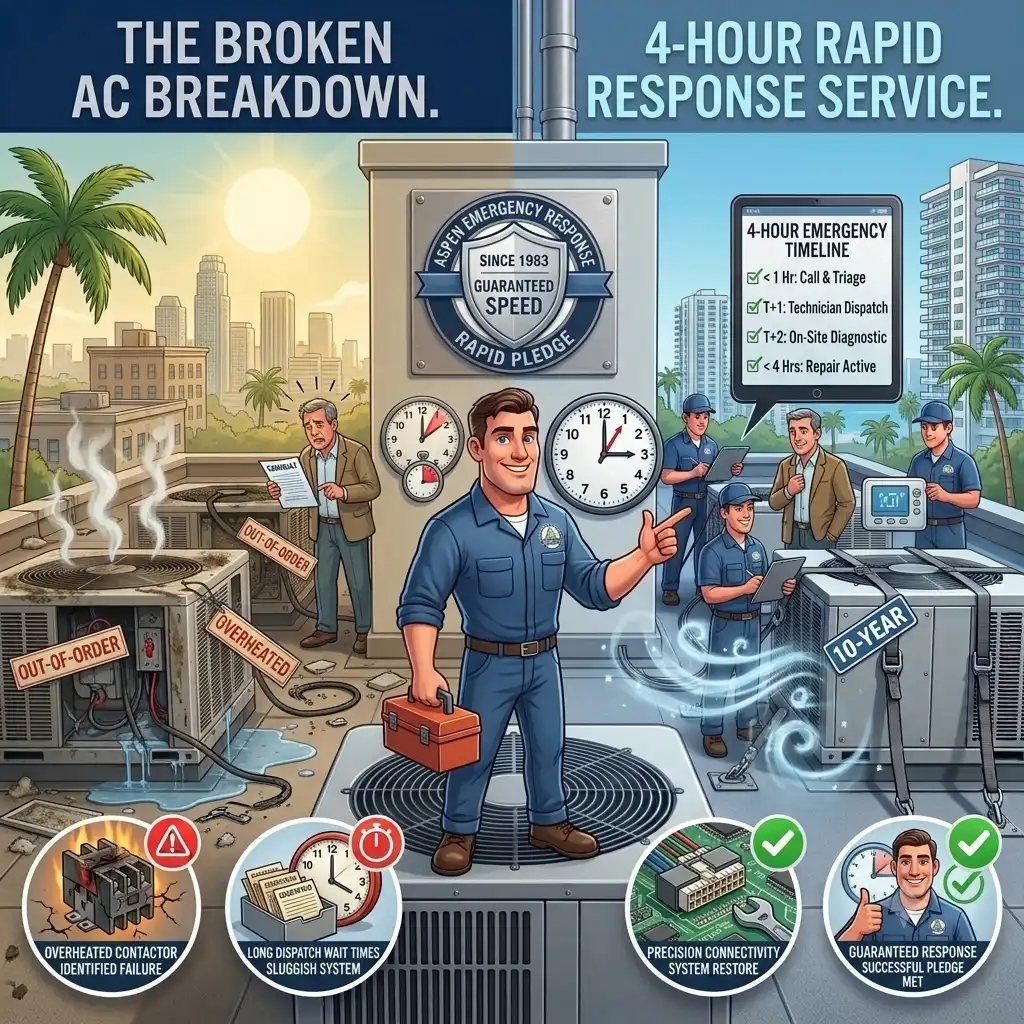
Emergency AC repair with a 4-hour response guarantee means a technician is on-site within four hours of your call, not four hours to schedule an appointment. For Aspen AC, that clock covers South Florida from Port St. Lucie to Miami, seven days a week, with same-day service for commercial cooling failures that can’t wait.
How the 4-Hour Response Clock Actually Works
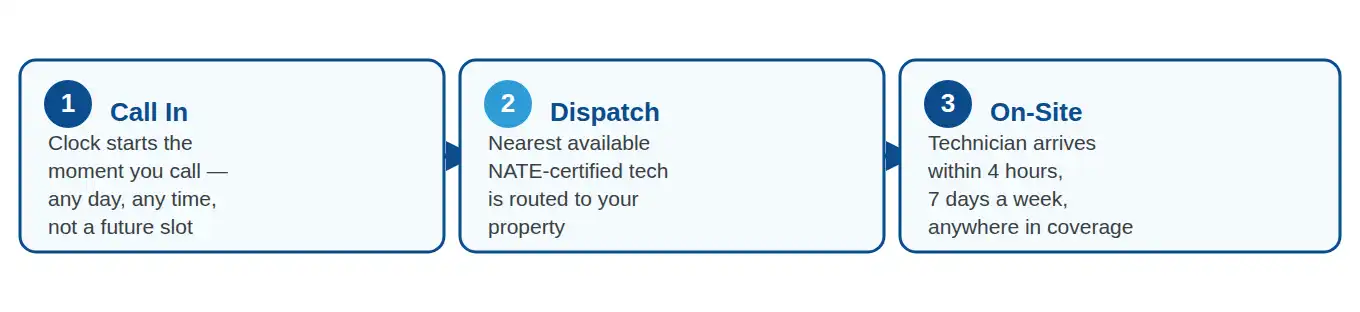
The 4-hour response clock starts the moment you call, not when a technician happens to be free — the difference between those two starting points is exactly what separates a real emergency guarantee from a vague promise.
- Call in — the clock begins when Aspen AC takes your call, any day of the week
- Dispatch — the nearest available NATE-certified technician is routed to your property immediately, not queued behind scheduled appointments
- On-site — the technician arrives within four hours, anywhere across the South Florida service area, with the diagnostic tools to start work on arrival
This isn’t a callback window or a next-available-slot promise — it’s a commitment to have a qualified technician physically at your property within four hours of that first call.
What Counts as an Emergency AC Repair
A genuine AC emergency is one that threatens business operations, safety, or property right now — total system failure, a refrigerant leak, electrical component failure, or burning smells and unusual noises from an outdoor unit all qualify.
- Total system failure — no cooling at all, especially during business hours or peak heat
- Refrigerant leaks — a noticeable drop in cooling performance, sometimes with ice visible on the outdoor unit
- Electrical failures — tripped breakers that won’t reset, sparking, or a burning smell near the unit
- Unusual noises — grinding, squealing, or banging that suggests a component is failing right now, not gradually
A system that’s simply running a little less efficiently than usual, or making a faint noise that’s been there for weeks, is a good candidate for a scheduled commercial AC repair visit rather than an emergency call — reserving true emergency dispatch for situations that can’t wait protects response times for everyone.
Why Response Time Matters More Than Most Businesses Realize
Response time matters because small HVAC problems compound quickly — a minor issue left unaddressed for even a day can escalate into complete component failure, turning a routine repair into an emergency replacement.
Beyond the mechanical risk, a commercial cooling failure affects employee productivity, customer comfort, and in some cases food safety or equipment protection — the cost of downtime rarely stays contained to just the repair bill. A provider that specializes in commercial systems, rather than splitting time between residential and commercial calls, also tends to diagnose commercial-specific equipment more accurately on the first visit, which shortens the whole repair timeline, not just the drive time.
What Makes Fast Response Possible
A real 4-hour response guarantee depends on three things working together: qualified technicians, availability every day of the week, and a service area small enough to route technicians efficiently.
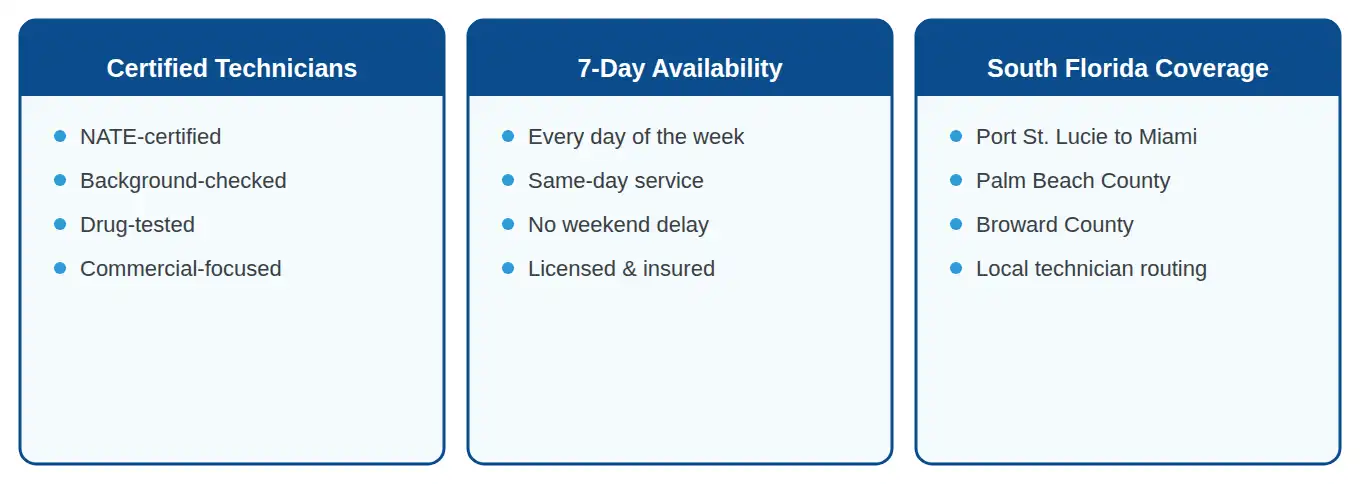
- Certified technicians — NATE-certified, background-checked, and drug-tested, so the first technician who arrives is qualified to actually solve the problem
- 7-day availability — emergency service runs every day, including weekends, since commercial cooling failures don’t check the calendar
- South Florida coverage — technicians routed locally across Palm Beach and Broward Counties, from Port St. Lucie to Miami, rather than dispatched from a distant central location
Maintenance Contracts and Priority Response
A commercial HVAC maintenance contract does more than prevent breakdowns — during high-demand periods, when every provider in South Florida is stretched thin, maintenance customers are typically prioritized for scheduling ahead of one-time or first-time callers.
Pairing routine maintenance with an emergency HVAC repair plan through a maintenance contract means fewer emergencies in the first place, and faster handling on the rare occasions one still happens.
What to Do While You Wait for the Technician
While you wait for the technician, turn off the system at the thermostat or breaker if you notice burning smells or electrical sounds, and clear a path to the outdoor unit so work can start the moment the technician arrives.
- Switch off the system at the breaker if you see sparking, smell burning, or hear electrical arcing
- Clear debris or obstructions around the outdoor unit so the technician isn’t delayed on arrival
- Note when the problem started and any warning signs beforehand — this speeds up diagnosis
- If the failure followed storm damage, photograph the equipment for insurance before the technician arrives