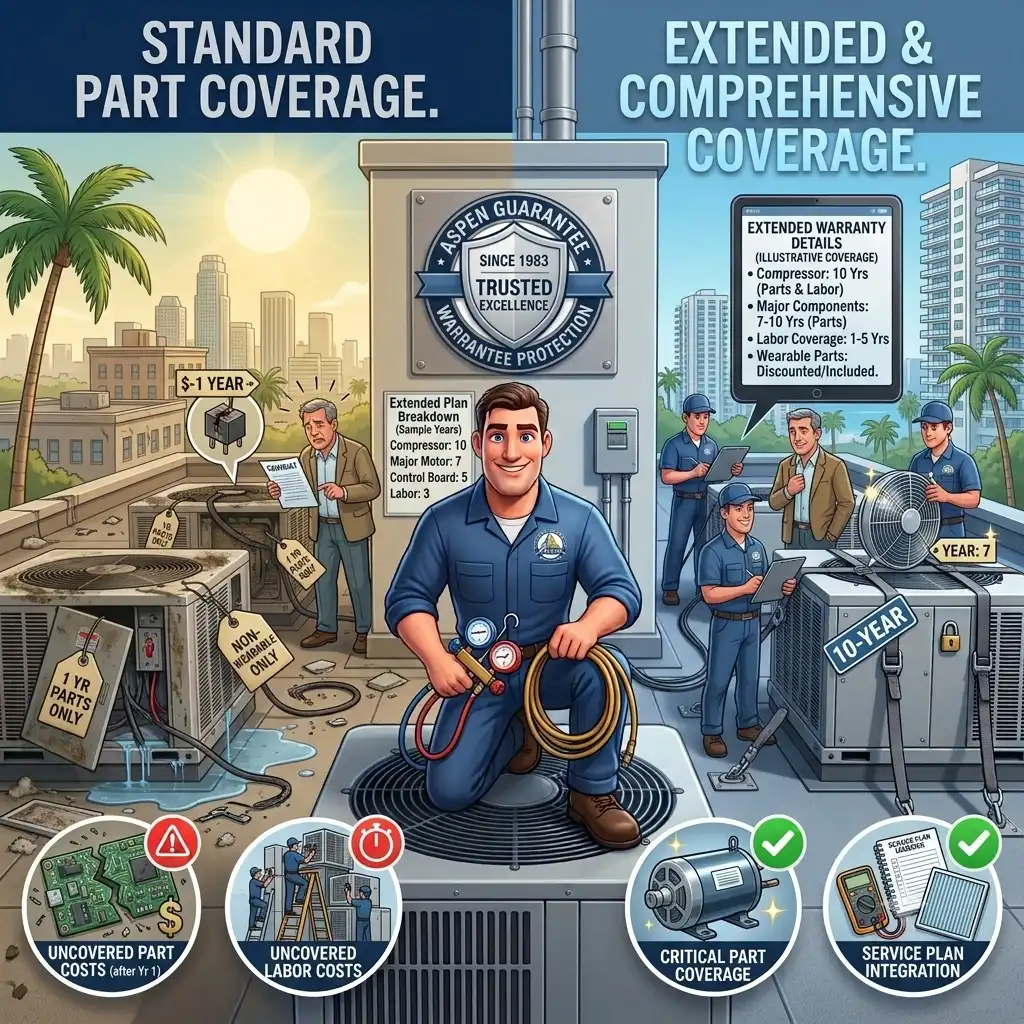
Commercial HVAC warranty coverage comes in three layers: a manufacturer parts warranty covering core components, a separate labor warranty from whoever installed the system, and an optional extended warranty that broadens either one. Most commercial equipment carries a standard 1-to-5-year parts warranty — shorter than typical residential terms, since commercial units run harder and longer.
The Three Layers of Commercial HVAC Warranty Coverage
Commercial HVAC warranty coverage isn’t a single document — it’s three separate layers, each with its own provider, term, and rules, and confusing one for another is how gaps in coverage go unnoticed until a repair bill arrives.
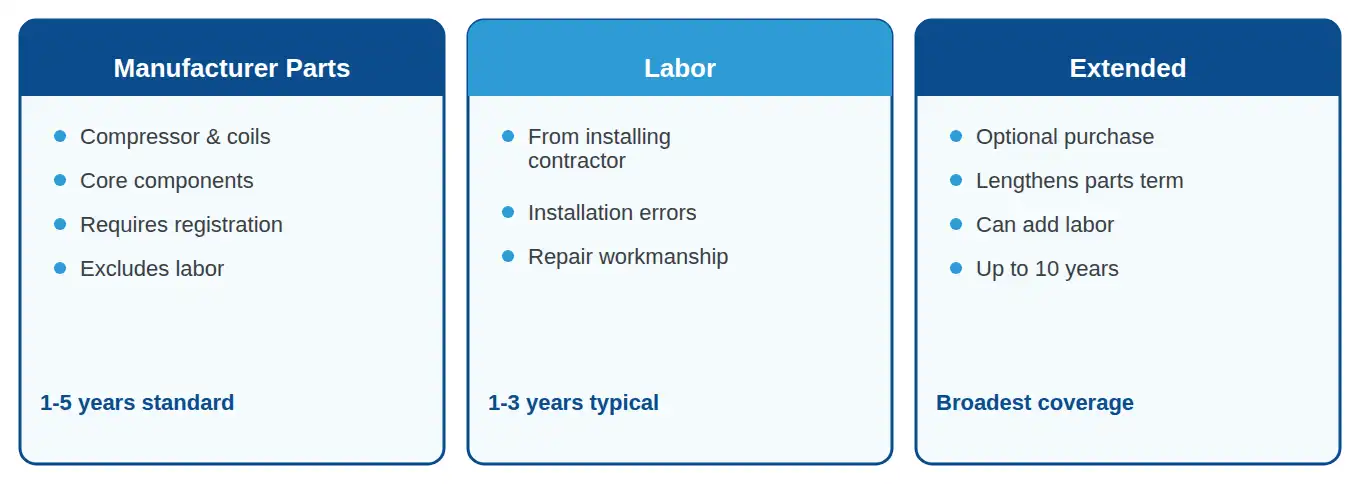
- Manufacturer parts warranty covers core components like the compressor and coils against defects, typically for 1 to 5 years on commercial equipment
- Labor warranty comes from the installing contractor, not the manufacturer, and covers installation errors and repair workmanship, typically for 1 to 3 years
- Extended warranty is an optional purchase that lengthens the parts term — sometimes up to 10 years — and can add labor coverage that the standard manufacturer warranty excludes
What a Manufacturer Parts Warranty Typically Covers
A manufacturer parts warranty covers core mechanical components — compressor, evaporator and condenser coils, heat exchanger, and similar internal parts — against defects in materials or workmanship, provided the system was installed and maintained correctly.
- Standard commercial coverage typically runs 1 to 5 years, shorter than the 5-to-10-year terms common on residential equipment
- Registration with the manufacturer, usually within a set window after installation, is often required to activate full coverage
- Parts warranties almost never include labor — replacing a covered part is free, but paying someone to install it usually isn’t
- Coverage requires proper usage and maintenance; the warranty doesn’t protect against neglect or misuse
What a Labor Warranty Covers — and Why It’s Separate
A labor warranty covers the cost of the technician’s time — for installation errors, adjustments, and repair work — and it comes from the installing contractor, not the equipment manufacturer, which is why it has its own separate term.
- Typically covers installation errors that surface after the system is running
- May cover labor for repairs during the coverage window, separate from parts cost
- Terms vary significantly by contractor — commonly 1 to 3 years, but always worth confirming directly rather than assuming
- Doesn’t transfer automatically if you switch service providers; check before assuming ongoing coverage
What Voids Commercial HVAC Warranty Coverage
Missed manufacturer registration, service by unauthorized technicians, skipped required maintenance, and damage from misuse are the most common ways commercial HVAC warranty coverage gets voided — and most of them are avoidable with basic documentation.
- Missing the registration deadline can reduce coverage significantly, sometimes cutting a 10-year term down to 5
- Using unauthorized or unlicensed technicians for service or repairs is one of the most common reasons a claim gets denied
- Skipping required maintenance — most manufacturers expect documented, regular service to keep coverage active
- Accidental damage or misuse falls outside what any warranty layer is designed to cover
A commercial HVAC maintenance contract with a licensed provider is one of the simplest ways to keep the maintenance requirement satisfied without tracking it manually.
Is an Extended Warranty Worth It for a Commercial Property?
An extended warranty is generally worth considering for South Florida commercial properties, where near-continuous cooling season runtime puts more cumulative wear on equipment than the standard 1-to-5-year manufacturer term is built to cover.
The trade-off is straightforward: an extended warranty costs money upfront in exchange for longer parts coverage and, in some cases, labor coverage the standard warranty doesn’t include. Whether that trade makes sense depends on how long you plan to operate the equipment, how much unplanned repair cost your business can absorb, and whether the property is a good candidate for replacement rather than continued repair as equipment ages.
Keeping Your Warranty Valid: Registration, Maintenance, and Documentation
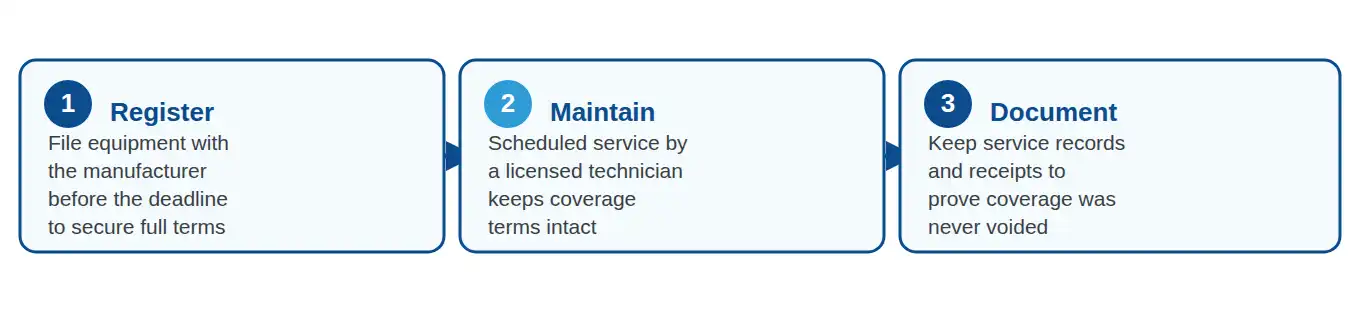
Keeping commercial HVAC warranty coverage valid comes down to three habits: registering equipment on time, maintaining it on a documented schedule, and keeping records that prove both happened.
- Register new equipment with the manufacturer immediately after installation — don’t wait for a slow season
- Schedule maintenance through a licensed provider and keep dated service records, not just verbal confirmation
- Store installation paperwork, registration confirmation, and every service invoice together, so a claim isn’t held up by missing documentation
- Confirm warranty service terms directly with your provider rather than assuming standard coverage applies to your specific equipment