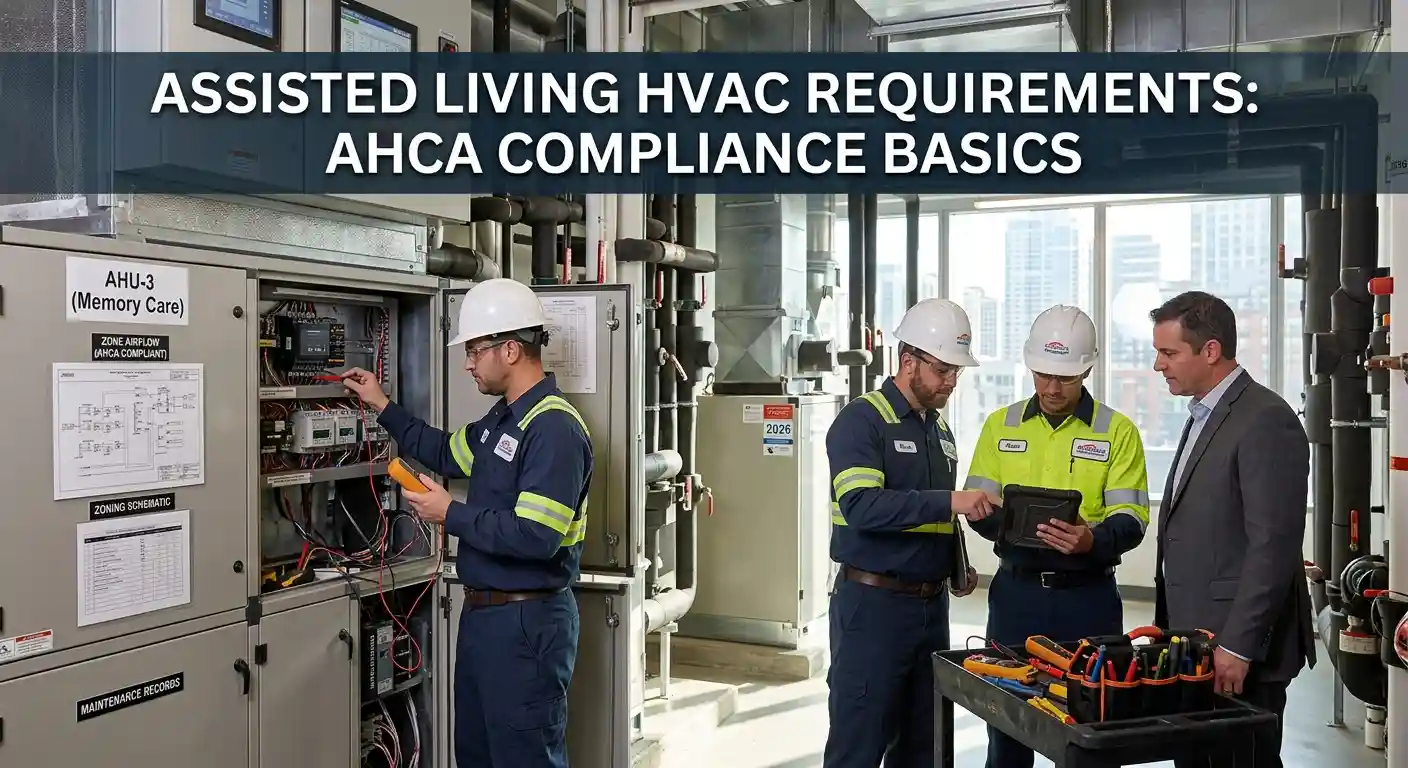

Healthcare HVAC maintenance means maintaining and documenting air change rates, pressure relationships, and filtration performance to the standards set by ASHRAE 170 — not just keeping equipment running. Because ventilation failures in a healthcare setting can directly affect infection control and patient safety, healthcare facilities are held to compliance requirements that standard commercial buildings simply aren’t.
Why Healthcare HVAC Maintenance Is Different From Standard Commercial Maintenance
Healthcare HVAC maintenance is a different discipline from standard commercial maintenance because ventilation failure in a healthcare setting translates directly into patient risk — a lost negative pressure in an isolation room or inadequate air changes in an operating room isn’t just an efficiency problem.
ASHRAE 170, Ventilation of Health Care Facilities, is the engineering standard that defines air change rates, pressure relationships, filtration levels, and temperature and humidity ranges for more than 60 types of healthcare spaces. It’s referenced by multiple regulatory frameworks — Joint Commission accreditation, CMS Conditions of Participation, and the FGI Guidelines for Design and Construction of Hospitals and Health Care Facilities — which is why healthcare HVAC work requires familiarity with compliance requirements that general commercial maintenance doesn’t touch.
The Regulatory Framework Behind Healthcare HVAC Compliance
Healthcare HVAC compliance rests on ASHRAE 170 as the technical engineering standard, with Joint Commission standard EC.02.06.01 as the regulatory requirement that healthcare organizations maintain — and document — their physical environment safely.
- ASHRAE 170 defines the technical performance targets: air changes per hour, pressure relationships, filtration, temperature, and humidity by space type
- Joint Commission EC.02.06.01 requires healthcare organizations to maintain their physical environment and to document that maintenance during accreditation surveys
- CMS Conditions of Participation tie ventilation and environmental performance to a facility’s ability to bill Medicare and Medicaid
- FGI Guidelines reference ASHRAE 170 as the authoritative ventilation standard while adding space types and requirements not covered elsewhere — where the two documents differ, the more stringent requirement applies
Air Changes, Pressure Relationships, and Filtration: What Gets Monitored
What actually gets monitored under ASHRAE 170 breaks down into three categories: air change rates and pressure relationships, filtration performance, and temperature and humidity — each with different targets depending on the specific space.
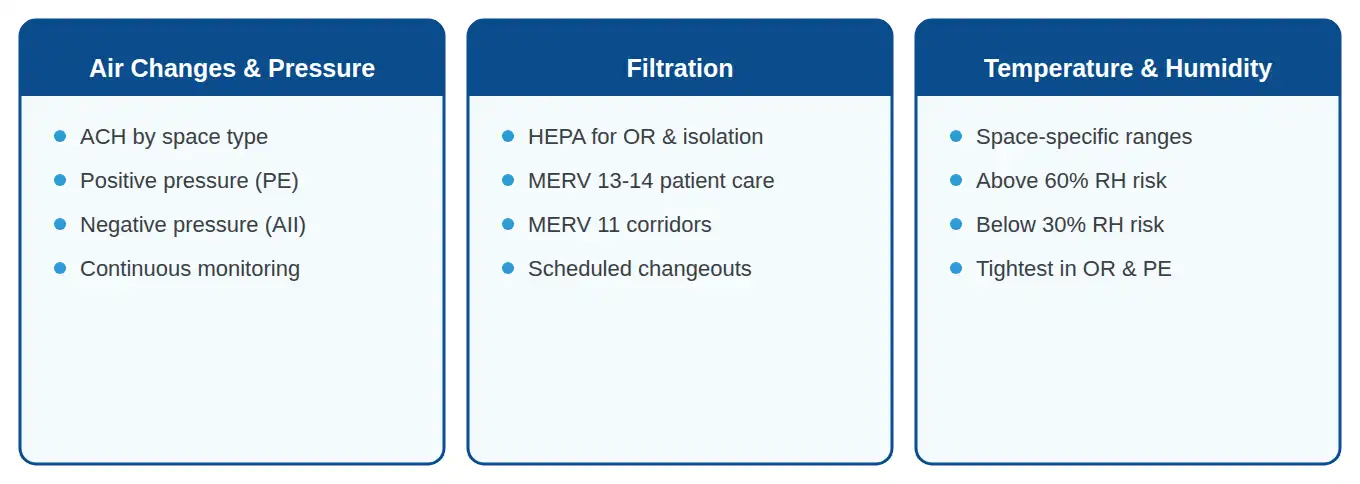
- Pressure relationships — positive pressure protects vulnerable patients in protective environment rooms by keeping corridor air out; negative pressure contains infectious aerosols inside airborne infection isolation rooms. ASHRAE 170 sets a minimum pressure differential, and most facilities maintain a margin above that minimum rather than running right at the threshold
- Filtration — HEPA filtration is used in operating rooms and isolation exhaust, mid-efficiency MERV filtration in general patient care areas, and lower-efficiency filtration in corridors and non-critical spaces
- Temperature and humidity — relative humidity above roughly 60% raises the risk of bacterial growth, while very low humidity raises static and other risks; operating rooms and protective environments carry the tightest tolerances
Critical areas are also expected to maintain full air change rates continuously — demand-based airflow reduction during unoccupied periods, common in standard commercial buildings, isn’t appropriate for these spaces.
Documentation: The Part Compliance Actually Lives In
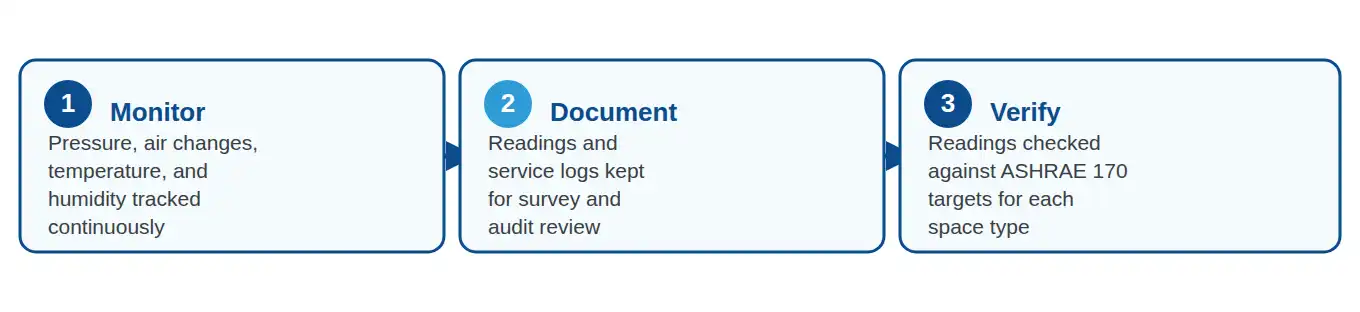
Documentation is where healthcare HVAC compliance actually gets assessed — a pressure relationship or filtration system that’s technically functioning but undocumented can still be flagged during a Joint Commission survey, because verification is what’s being reviewed, not just performance.
- Dated logs of pressure differential readings for every space with a required pressure relationship
- Filter change records tied to the filtration level required for each space classification
- Documented response protocols for what happens when a pressure or air change alarm triggers
- Service records that tie maintenance activity back to the specific ASHRAE 170 requirement it satisfies
Choosing an HVAC Provider for a Healthcare Facility
Choosing a provider for healthcare HVAC work means confirming specific familiarity with ASHRAE 170 space classifications, pressure monitoring, and documentation practices — general commercial HVAC experience doesn’t automatically cover healthcare-specific compliance needs.
Ask directly about a contractor’s experience with healthcare facility HVAC specifically, not just commercial HVAC broadly, and confirm how their maintenance approach documents pressure and air-change readings in a form your facility can produce during a survey. A maintenance contract built around healthcare compliance requirements looks different from a standard commercial agreement, and it’s worth confirming that difference before signing.