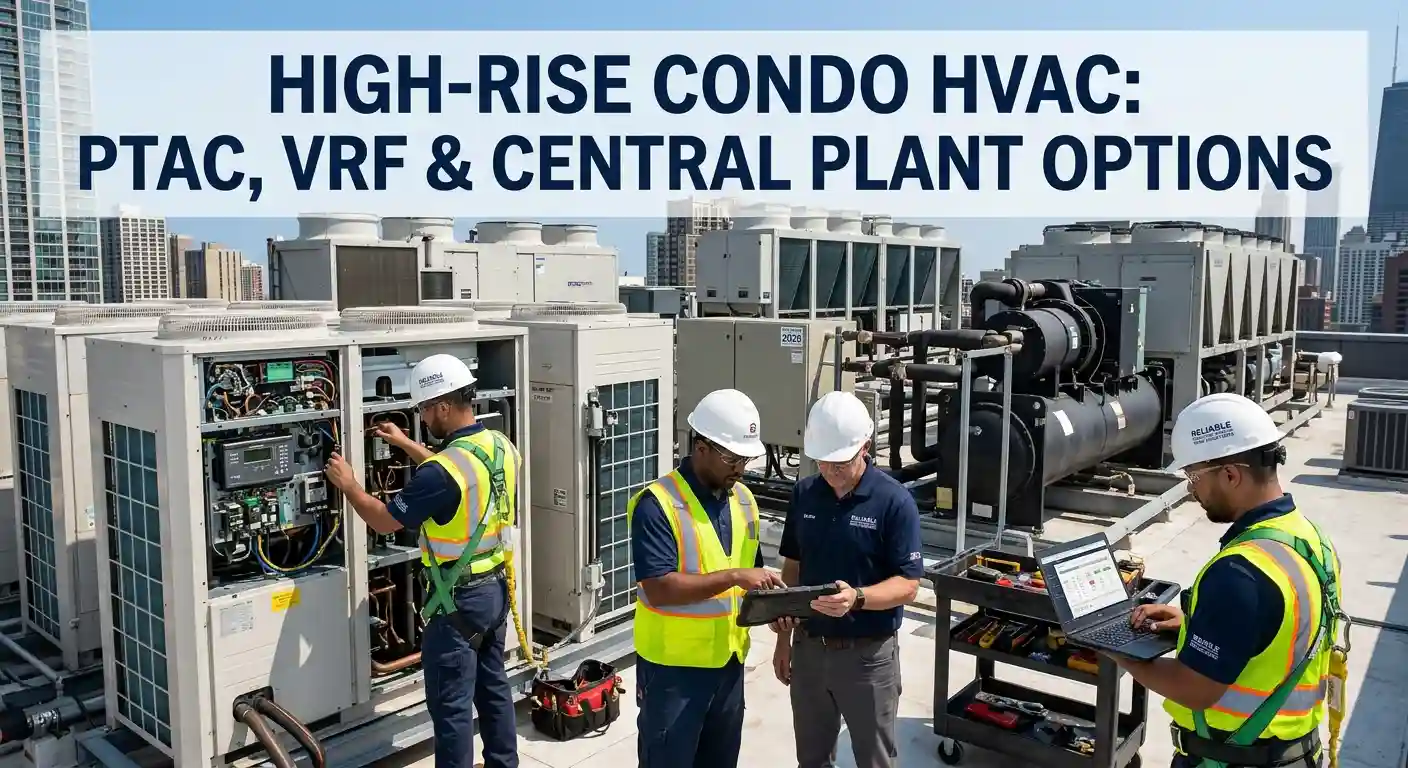

High-rise condominiums typically use PTAC units for existing sleeved buildings where individual per-unit control and simple replacement matter most, VRF systems for buildings prioritizing efficiency and quiet operation, and central chiller plants for the largest properties where scale makes centralized systems more economical than hundreds of standalone units.
The right system for a high-rise depends heavily on what’s already installed — retrofitting a fully sleeved building to central plant is a different conversation than choosing a system for new construction. This guide compares all three options and covers what drives the decision at each stage of a building’s life.
What Is a PTAC System and Why Do So Many High-Rises Use It?
PTAC units — packaged terminal air conditioners sleeved through each unit’s exterior wall — dominate existing South Florida high-rises because the sleeve infrastructure is already built into the building, replacement is a straightforward per-unit swap, and each owner controls and pays for their own unit independently.
That last point matters more than it might seem: PTAC’s per-unit independence means one owner’s system failure doesn’t affect neighbors, billing is naturally per-unit without submetering infrastructure, and a board never has to coordinate a whole-building shutdown for one owner’s equipment problem. Our PTAC brands guide covers the equipment side once a building has decided PTAC remains the right approach.
When Does VRF Make Sense for a High-Rise?
VRF makes the most sense for high-rises pursuing major renovation or new construction, where the building can be designed around VRF’s piping and zoning requirements from the start, delivering better efficiency and quieter operation than PTAC in exchange for a more complex, more expensive installation.
| System | Best fit | Trade-off |
|---|---|---|
| PTAC | Existing sleeved buildings, straightforward replacement | Less efficient, more mechanical noise than VRF |
| VRF | Major renovation, new construction, efficiency priority | Higher install cost, requires piping infrastructure |
| Central plant | Large-scale properties, campus-style developments | Highest capital cost, most efficient at scale |
Retrofitting VRF into an existing sleeved building is possible but disruptive — it typically requires running refrigerant piping through spaces the original design never accounted for, which is why VRF conversion is usually a renovation-scale decision rather than a routine replacement cycle.
When Does a Central Plant Make Sense?
Central chiller plants make the most economic sense at genuinely large scale — bigger high-rises and campus-style developments where the efficiency gains and reduced per-unit equipment count outweigh the substantial capital cost of building central mechanical infrastructure and distributing chilled water or refrigerant throughout the property.
Central plants also shift maintenance responsibility toward the building rather than individual owners, which associations should weigh carefully — it centralizes both the cost and the control, meaning the association takes on ongoing plant maintenance obligations that a PTAC building distributes across owners individually. This trade-off matters as much as the technical efficiency comparison when a board is deciding between approaches.
How Do the Systems Compare on Noise for Residents?
VRF and central plant systems generally produce less audible noise inside individual units than PTAC, since PTAC’s compressor sits directly in the sleeve wall of the unit it serves, while VRF and central plant systems locate the noisiest components — compressors, chillers — away from occupied space entirely.
Noise matters more in condo living than in most commercial settings, since residents experience their HVAC system continuously in a space they can’t simply leave at the end of a workday. Acoustic performance is increasingly reflected in equipment ratings referenced by ASHRAE standards, and buildings fielding frequent noise complaints about aging PTAC units should weigh acoustic improvement as a real factor in any system-type conversation, not just an efficiency or cost comparison.
How Do These Systems Compare on Long-Term Costs?
PTAC systems have the lowest installed cost per unit but the shortest typical service life, generally 7 to 10 years in coastal exposure, meaning associations budget for more frequent replacement cycles. VRF and central plant systems cost more upfront but typically last longer and run more efficiently, spreading their higher capital cost over a longer service life and lower ongoing energy expense.
The comparison isn’t simply which system is cheapest — it’s which total-cost profile fits the association’s capital planning approach. A board comfortable with steady, predictable per-unit replacement costs may prefer PTAC’s model; a board planning a major capital improvement cycle may find VRF or central plant’s higher upfront cost justified by lower long-term operating expense.
What Should a Board Consider Before Switching Systems?
A board considering a system change should weigh the disruption to residents during conversion, the capital assessment required to fund it, and whether the building’s age and remaining useful life justify a major mechanical infrastructure investment versus continuing with staged PTAC replacement on the existing sleeve infrastructure.
System conversion in an occupied high-rise is genuinely disruptive — residents face construction access to their units, potential temporary cooling arrangements, and special assessments most associations find contentious regardless of the long-term efficiency case. This is why system-type changes are far more common at major renovation or gut-rehab stages than as a standalone decision on a building that’s otherwise functioning normally.
What Role Does Building Age Play in the Decision?
Building age interacts with system choice more than owners often expect — an older building nearing a major structural or facade renovation is a natural point to reconsider mechanical systems entirely, while a newer building with healthy sleeve infrastructure has little reason to disrupt residents for a conversion that mainly chases incremental efficiency gains.
Buildings undergoing facade work, window replacement or structural repairs already have the disruption and access in progress that a VRF or central plant conversion would otherwise require as its own separate project — coordinating mechanical conversion with planned structural work can meaningfully reduce the total disruption residents experience compared to running the projects independently years apart. Boards planning a major renovation cycle should raise the HVAC system question early, since retrofitting mechanical infrastructure after finish work is complete costs more than integrating it into the original renovation scope.
How Should Aging PTAC Fleets Be Managed in the Meantime?
Buildings staying with PTAC should manage the fleet with staged replacement planning — budgeting a rolling percentage of units per year rather than waiting for failures — combined with seacoast-duty specification on every replacement unit, since standard-duty PTACs corrode faster in oceanfront exposure than the protected alternative.
Sleeve condition deserves attention at every changeout too; a corroded sleeve or blocked drainage path undermines even a brand-new unit installed into it, shortening its service life before it has really begun. Our high-rise HVAC team builds exactly this kind of staged replacement program for associations managing PTAC fleets that aren’t ready for a full system conversion.
What Does High-Rise HVAC Typically Cost?
PTAC replacement follows standard commercial equipment pricing for the unit itself, while VRF and central plant projects price at a different scale entirely given their infrastructure requirements — full detail on published commercial HVAC pricing, including the $10,000 to $30,000 and up per-unit range for standard commercial replacement, is on our commercial HVAC pricing page.
VRF and central plant conversion projects require site-specific quotes given the scope of infrastructure involved, and a serious proposal should break out equipment, piping or chilled-water distribution, controls, and disruption-minimization logistics as separate line items rather than one bundled capital number.
Frequently Asked Questions
Should our building switch from PTAC to VRF?
It depends on your building’s stage — VRF conversion makes the most sense during major renovation or when PTAC replacement cycles are becoming frequent and costly enough to justify the disruption and capital cost of a system change, rather than as a standalone decision on an otherwise functioning building.
How long do PTAC units last in a high-rise condo?
Typically 7 to 10 years in coastal exposure with standard-duty equipment, longer with seacoast-duty models and good filter maintenance. Buildings should budget for staged replacement rather than treating each failure as a surprise.
Is central plant HVAC more efficient than PTAC?
Generally yes at sufficient scale, but central plants require substantial capital investment and shift maintenance responsibility to the association rather than individual owners — the efficiency gain has to be weighed against that cost and control trade-off.
Can VRF be retrofitted into an existing sleeved building?
Yes, but it’s disruptive — retrofitting typically requires new refrigerant piping through spaces the original design didn’t account for, which is why VRF conversion is usually paired with a larger renovation rather than done as a standalone project.
Aspen Air Conditioning services PTAC fleets and advises high-rise associations on VRF and central plant options across Palm Beach and Broward Counties. Call 561-464-5010.