
Apartment complex HVAC maintenance differs from single-tenant commercial maintenance in three ways: shared central systems where one failure affects dozens of units at once, the logistics of coordinating access to occupied units, and the concentrated maintenance window that opens every time a unit turns over. A property manager’s maintenance plan needs to account for all three, not just filter changes.
Why Apartment Complex HVAC Maintenance Is Different
Apartment complex HVAC maintenance is different from other commercial maintenance because a single system failure can affect many residents simultaneously, and because getting to the equipment often means coordinating with tenants rather than working in an empty building.
Central chillers, air handlers, or shared rooftop equipment serve multiple units at once — when one of these fails, it’s not one tenant’s problem, it’s a building’s worth of complaints arriving at once. Unit-level equipment carries a more contained risk, but with dozens or hundreds of units, small unit-level issues add up to a steady stream of maintenance requests if there’s no structured plan behind them.
What to Prioritize: Central Systems vs. Unit-Level Equipment
What to prioritize comes down to consequence of failure: central systems that affect many units at once deserve the tightest preventive maintenance schedule, while unit-level equipment can generally be handled on a rotation tied to routine inspections and turnover.
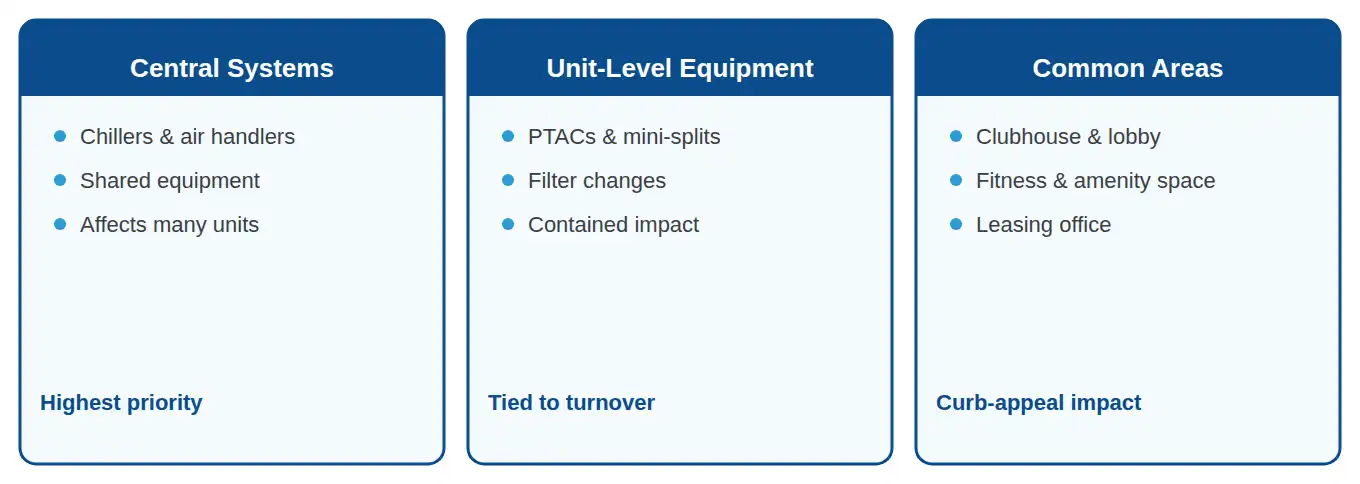
- Central systems — chillers, air handlers, and shared rooftop equipment get the highest-priority maintenance schedule, since failure here means a building-wide problem, not a single complaint
- Unit-level equipment — PTACs, mini-splits, and in-unit systems carry more contained risk and pair naturally with unit turnover inspections
- Common areas — clubhouse, leasing office, and amenity space HVAC affects prospective tenant impressions and curb appeal, even though it doesn’t carry the same urgency as resident-occupied systems
Building a Seasonal Maintenance Schedule for South Florida Apartments
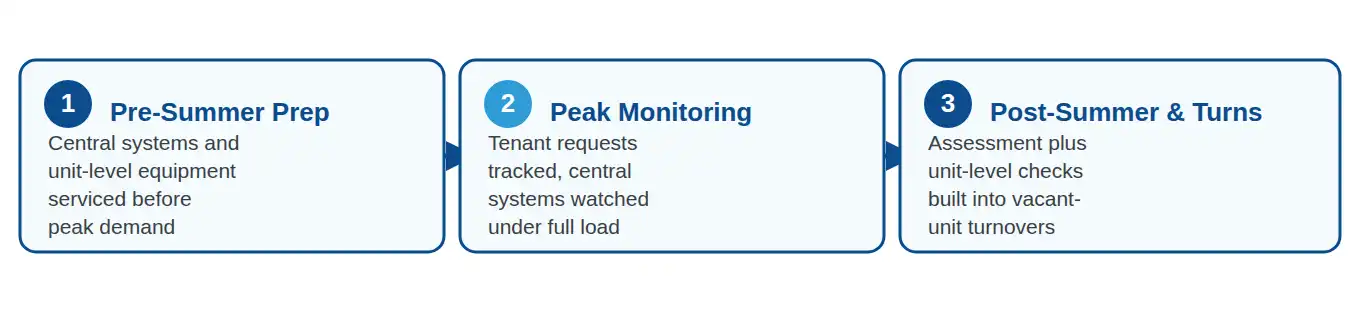
A seasonal maintenance schedule for South Florida apartment complexes should center on the cooling season rather than follow a four-season template built for colder climates — pre-summer preparation, peak-season monitoring, and a post-summer assessment matter far more here than winter heating prep.
- Pre-summer — service central and unit-level systems before peak cooling demand hits, and confirm parts availability for common failure points
- Peak season — track tenant-reported issues closely and watch central systems under full load, since this is when a small issue is most likely to become a building-wide one
- Post-summer — run a full assessment of wear from peak-season runtime, and use it to plan the coming year’s maintenance budget before issues compound
HVAC Maintenance and Unit Turnover: Timing It Right
Unit turnover is the most efficient window to service unit-level HVAC equipment, since the unit is already vacant and accessible without coordinating around a tenant’s schedule or working around their belongings.
Building an HVAC check into the standard turnover process — alongside cleaning, paint, and appliance inspection — means catching filter condition, airflow issues, and minor wear before a new tenant moves in, rather than fielding a maintenance request in the first week of a new lease. For units with aging equipment, turnover is also a natural checkpoint to evaluate whether a renovation or retrofit makes more sense than continued repair.
Tenant vs. Landlord Responsibility: Where HVAC Maintenance Fits
Tenants are typically responsible for simple tasks like replacing HVAC filters, unless the lease says otherwise, while property managers or landlords handle major system servicing, repairs, and equipment replacement — a split worth stating clearly in every lease.
Clarifying this division upfront avoids disputes when a maintenance request comes in, and it also shapes what a property-wide maintenance contract needs to cover — a contract built around landlord-responsibility items only won’t catch every issue if tenant-side upkeep, like filter changes, isn’t happening consistently across units.
What to Look for in a Multifamily HVAC Contractor
A multifamily HVAC contractor needs to do more than fix equipment — they need to coordinate scheduling and access across occupied units, document work per-unit for your records, and ideally offer a consistent point of contact rather than a different technician explaining the same context every visit.
Ask specifically about multifamily HVAC experience, not just general commercial experience, since the access-coordination and documentation demands of an apartment complex are meaningfully different from a single-tenant office building. A maintenance contract with priority scheduling also matters more here than in a single-tenant property — a central-system failure affecting dozens of residents isn’t a request that should sit in a general queue.