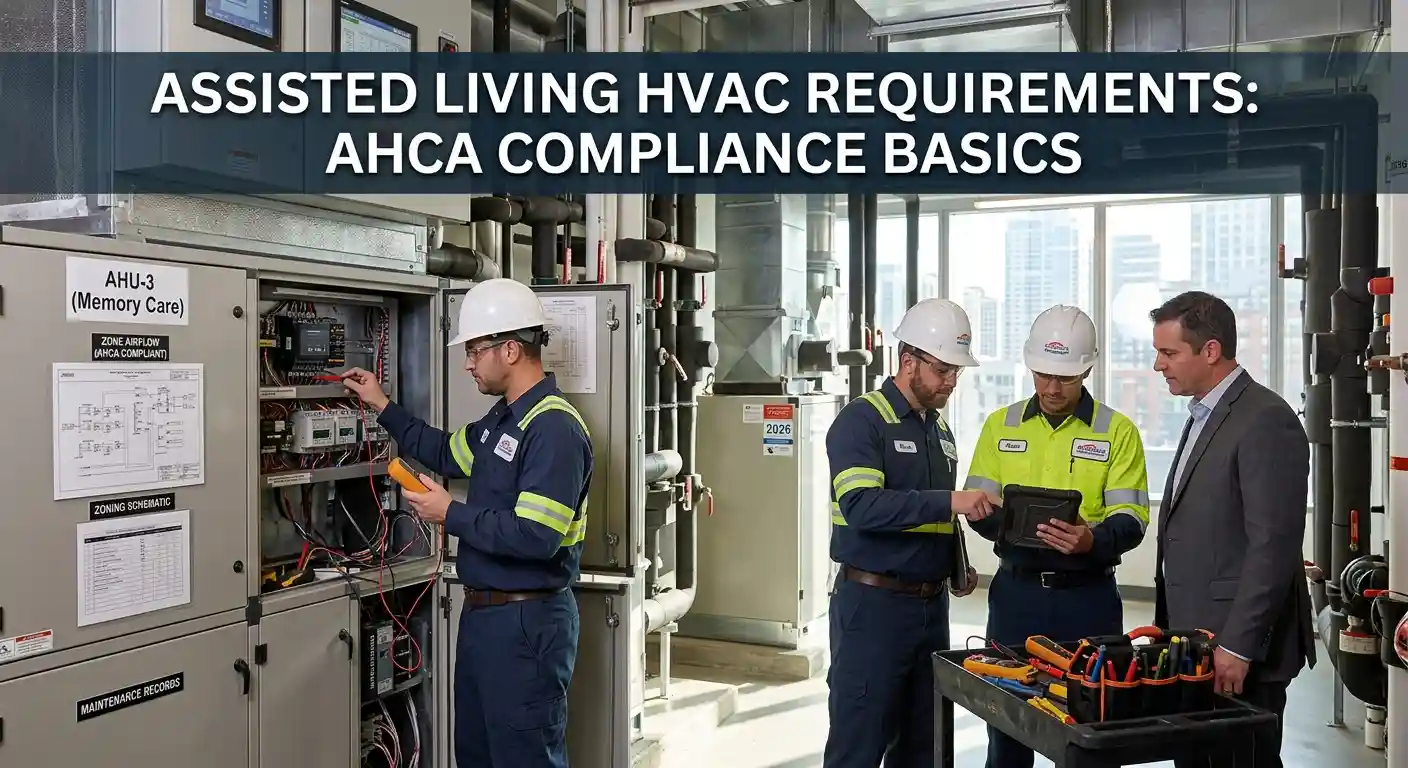

Assisted living HVAC compliance in Florida centers on maintaining temperature within a defined comfort range year-round, backup power planning for cooling during outages, and documentation that satisfies AHCA licensure inspections — requirements that exist because temperature extremes carry real health risk for the elderly and medically vulnerable residents these facilities serve.
Assisted living HVAC isn’t just a comfort standard — it’s a licensure requirement with inspection consequences, and the facilities that manage it well treat temperature control as a life-safety system rather than a standard building amenity. This guide covers what Florida requires, how backup power fits in, and what inspectors actually check.
What Temperature Requirements Apply to Assisted Living Facilities?
Florida’s Agency for Health Care Administration (AHCA) sets licensure requirements for assisted living facilities that include maintaining comfortable indoor temperatures, with specific attention to preventing the temperature extremes that pose real health risks to elderly residents, who regulate body temperature less effectively than younger, healthier populations.
Facilities should maintain documented ability to keep indoor temperatures within a safe comfort range regardless of outdoor conditions, which in South Florida means cooling capacity that doesn’t just meet code minimums but holds up reliably through the peak of summer heat, when the health consequences of a cooling failure are most severe.
Why Does Backup Power Matter for Assisted Living HVAC?
Power outages that would be an inconvenience in an office building become a genuine safety concern in assisted living, where residents with limited mobility or health conditions may not be able to relocate quickly if cooling fails during South Florida heat — which is why backup power planning for at least critical cooling zones is a standard expectation, not an optional upgrade.
| Planning element | Why it matters |
|---|---|
| Generator capacity for critical cooling | Keeps at-risk residents safe during grid outages |
| Documented transfer procedures | Ensures backup power actually engages when needed |
| Regular generator testing | Confirms the system works before an emergency, not during one |
| Fuel supply planning | Extends coverage through multi-day outages common after storms |
Facilities should test backup power systems on a regular schedule and document those tests, since an untested generator is a plan, not a guarantee.
How Does Hurricane Season Affect Assisted Living HVAC Planning?
Hurricane season adds urgency to backup power and cooling reliability planning for assisted living facilities specifically because storm-related outages combine the highest heat risk with the least ability to relocate vulnerable residents quickly — a combination that makes pre-season equipment readiness and tested backup power especially consequential for this facility type.
Our hurricane preparation guide covers the general commercial playbook; assisted living facilities should treat every element of that checklist as higher-priority given the vulnerability of the population involved, and should specifically confirm generator fuel supply and testing before June 1 rather than after.
What Should an AHCA-Focused Maintenance Program Include?
A maintenance program built for assisted living should run quarterly service visits like any South Florida commercial property, plus documentation specifically formatted to satisfy AHCA inspection requirements — temperature logs, equipment service records, and backup power test results kept in a form an inspector can review quickly.
The documentation standard here is higher than a typical commercial property because it directly supports licensure, not just good practice. Facilities should maintain records showing continuous temperature control capability, not just equipment service history — an inspector wants evidence the building can maintain safe temperatures, and a maintenance log alone doesn’t fully demonstrate that without temperature data attached.
How Does Redundancy Reduce Risk for Assisted Living Cooling?
Redundant cooling capacity — more than one unit serving critical areas, so a single equipment failure doesn’t eliminate cooling entirely — reduces risk meaningfully for assisted living facilities, where the gap between “cooling degraded” and “cooling completely lost” matters far more than it would in a typical office building.
A facility running a single large rooftop unit over resident areas has no fallback if that unit fails; a facility running staged or multiple smaller units retains partial cooling while the failed unit is repaired. This is the same N+1 logic used in server room cooling, applied to a population where losing conditioning entirely carries genuine health consequences rather than just discomfort. Facilities designing new HVAC systems, or replacing aging single-unit setups, should weigh redundancy as a resident-safety investment rather than purely a capacity decision.
What Should Staff Know About HVAC Emergency Protocols?
Facility staff should know the basic signs of HVAC trouble, who to call, and the interim steps to protect residents while service is arranged — because the technical fix matters less in the first hour of a failure than whether staff recognize the problem and act on the emergency plan immediately.
A documented protocol should specify at what indoor temperature staff escalate to emergency response, which areas of the building can serve as cooler refuge if part of the system fails, and how residents with particular heat sensitivity are identified and prioritized. This protocol works only if it’s reviewed periodically and staff actually know it exists — a plan filed away and never discussed, reviewed or drilled is not meaningfully different in practice from having no plan at all.
What Do AHCA Inspectors Typically Check?
Inspectors typically review temperature and humidity documentation, verify backup power systems are functional and tested, and check that HVAC equipment service records are current and complete — looking for evidence of an ongoing, documented program rather than equipment that happens to be running on inspection day.
Facilities that fail this kind of review often have functioning HVAC systems but incomplete documentation — a generator that works but was never formally tested and logged, or temperature control that’s fine day to day but has no records proving it. The gap between “the building is actually comfortable” and “the building can prove it’s been reliably comfortable” is exactly what inspection documentation exists to close.
How Should Assisted Living Facilities Handle HVAC Emergencies?
Assisted living facilities need an emergency response plan for HVAC failures that accounts for resident vulnerability specifically — faster response expectations than a typical commercial property, a clear protocol for managing residents if cooling is lost temporarily, and a maintenance provider who understands the urgency involved is different from a standard commercial service call.
Our assisted living HVAC team treats these facilities with priority response given the population served, and structures maintenance agreements around the documentation and reliability standards this facility type actually needs rather than a generic commercial approach.
What Does Assisted Living HVAC Typically Cost?
Assisted living HVAC pricing follows standard commercial ranges for equipment and repair — replacement generally $10,000 to $30,000 and up per unit, roughly $2,000 to $3,500 and up per ton, published on our commercial HVAC pricing page — with backup power infrastructure and enhanced documentation representing additional cost beyond a standard commercial installation.
That additional cost is a licensure and life-safety investment, not an optional upgrade, and facilities should budget for it accordingly rather than treating backup power and documentation systems as items to defer when capital budgets tighten. The cost of a documented compliance failure — in inspection consequences, licensure risk and genuine resident harm — outweighs the investment by a wide margin, and that comparison rarely needs much explaining to anyone who has sat through an AHCA survey.
Frequently Asked Questions
What temperature is required in Florida assisted living facilities?
Florida AHCA requirements call for maintaining comfortable, safe indoor temperatures for residents, with particular attention to preventing extremes given the health vulnerability of elderly populations. Facilities should verify their specific documented requirements directly with AHCA guidance for current standards.
Is backup power required for assisted living HVAC?
Backup power for at least critical cooling zones is a standard expectation for Florida assisted living facilities, given the health risks of losing cooling during outages. Facilities should confirm their specific obligations with AHCA and document regular generator testing.
What HVAC documentation do AHCA inspectors check?
Typically temperature and humidity logs, HVAC equipment service records, and backup power test results — inspectors look for evidence of an ongoing, documented program rather than equipment that simply happens to be functioning on inspection day.
How often should assisted living HVAC be serviced?
Quarterly is the standard cadence for South Florida commercial equipment, and assisted living facilities benefit from holding that full schedule given the health consequences of an unexpected failure, rather than reducing frequency to save on maintenance costs.
Aspen Air Conditioning provides HVAC service for assisted living and senior care facilities across Palm Beach and Broward Counties, built around AHCA compliance needs. Call 561-464-5010.