
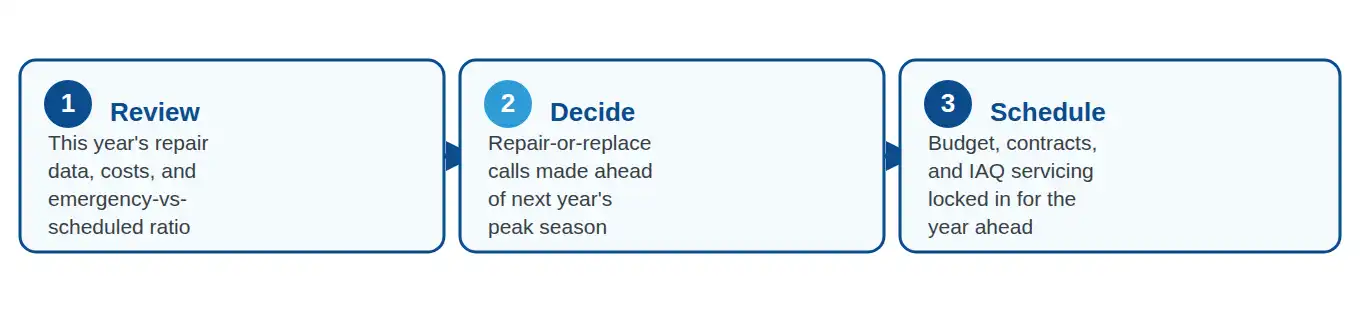
Fall HVAC maintenance planning is the annual checkpoint where property managers review the year’s repair and maintenance data, decide which aging equipment to repair versus replace, and set next year’s maintenance budget and contract terms — before peak cooling season forces those decisions to be made in a hurry. It’s a planning process, not an inspection.
Why Fall Is the Right Time for HVAC Planning (Not Just Maintenance)
Fall is the right planning window because cooling demand has eased, giving property managers room to make budget, contract, and equipment decisions deliberately instead of reacting mid-crisis during next year’s peak season.
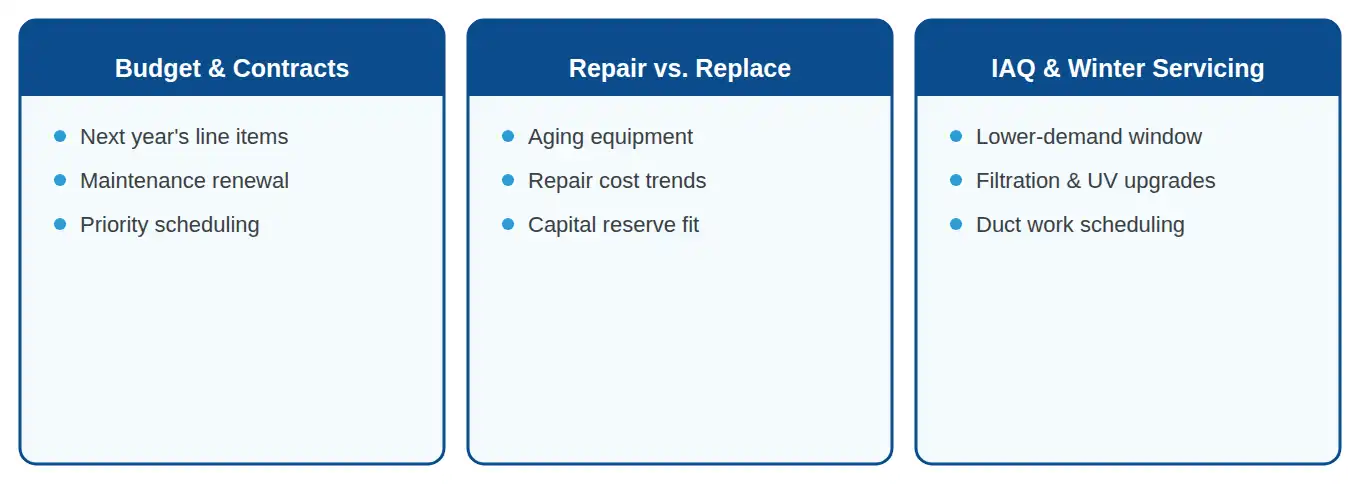
Fall planning covers three areas: reviewing budget and maintenance contract terms for the year ahead, making repair-versus-replace decisions on aging equipment before it fails on its own schedule, and using the lower-demand window for indoor air quality work that’s hard to schedule during summer. Each of these gets harder — and more expensive — to handle well once next year’s cooling season is already underway.
Reviewing the Year: What Your Maintenance and Repair Data Should Tell You
Reviewing the year’s HVAC data means looking at repair frequency and cost per unit, the ratio of emergency to scheduled service calls, and tenant comfort complaints tied to specific equipment — not just totaling up what was spent.
- Repair frequency and cost per unit — a unit with rising repair costs is sending a clearer signal than its age alone
- Emergency-versus-scheduled ratio — a high proportion of emergency calls usually points to a maintenance program that isn’t catching problems early enough
- Complaint patterns by equipment or zone — recurring tenant complaints tied to the same system are worth investigating even if no single repair stands out
- Actual spend versus budgeted spend — understanding where this year’s numbers diverged from the plan is what makes next year’s budget more accurate
Repair or Replace: Making the Capital Decision Before You’re Forced To
Making the repair-or-replace decision in fall, rather than after a failure, means comparing the cost and frequency of recent repairs against replacement cost and the equipment’s realistic remaining service life.
Equipment with a rising repair frequency and cost trend is generally a stronger replacement candidate than equipment that’s simply old but performing reliably — age alone is a weaker signal than a documented pattern of increasing repair calls. For units that make sense to replace, planning in fall means the work can be scheduled and budgeted on your timeline through commercial HVAC replacement or a renovation and retrofit rather than an emergency swap during peak season.
Setting Next Year’s Maintenance Budget and Contract Terms
Setting next year’s budget and contract terms in fall means locking in maintenance contract renewals and scheduling priority before the next high-demand season arrives, when providers across South Florida are stretched thin.
Use this year’s actual repair and maintenance data to inform next year’s budget line items rather than carrying forward the same number by default. If this year’s data showed a high emergency-call ratio, that’s a signal to expand commercial HVAC maintenance coverage next year rather than simply renewing the same contract terms.
Coordinating the Fall IAQ and Winter Servicing Window
Fall is a practical window for indoor air quality-focused servicing in South Florida, since the property isn’t under the same cooling-season strain that limits scheduling flexibility during summer.
This is a reasonable time to address IAQ improvements — filtration upgrades, UV light installation, duct inspection and cleaning — work that’s harder to schedule when systems are running continuously under peak demand. Bundling this work into the fall planning cycle, rather than treating it as a separate project, keeps it from getting pushed indefinitely.
Communicating Planned Work to Tenants
Communicating planned HVAC work to tenants early — once fall planning has set a schedule — reduces the disruption complaints that come from work that seems to appear without warning.
A brief notice covering what’s being done, roughly when, and what tenants should expect in terms of access or noise goes a long way toward keeping planned maintenance from generating the same frustration as an unplanned outage, even though the work itself is the same.