
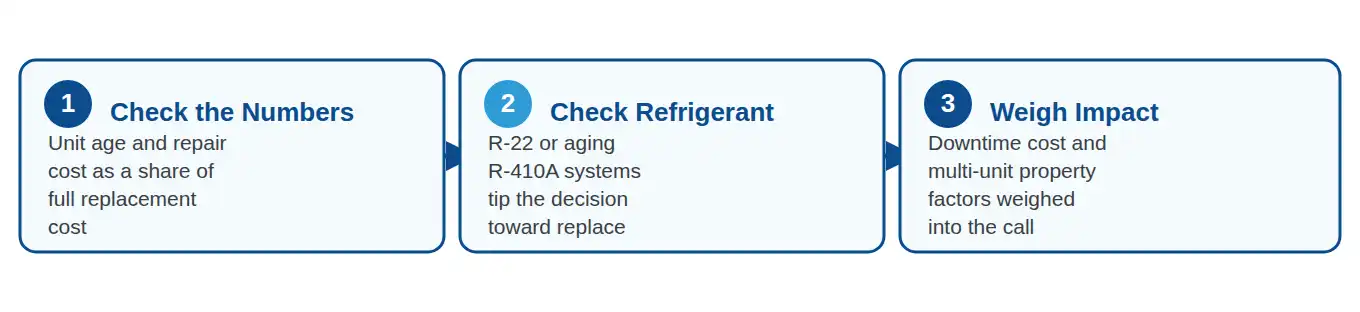
Deciding whether to repair or replace aging commercial AC equipment comes down to three factors: age, repair cost as a share of replacement cost, and refrigerant type. A unit past 10-12 years old, facing a repair costing half or more of replacement, or requiring an obsolete refrigerant, is usually a stronger replacement candidate than the repair bill alone suggests.
The Core Decision Framework: Age, Repair Cost, and Refrigerant
The repair-or-replace decision comes down to three factors working together, not any single number in isolation — age, the repair cost as a percentage of full replacement cost, and refrigerant type.
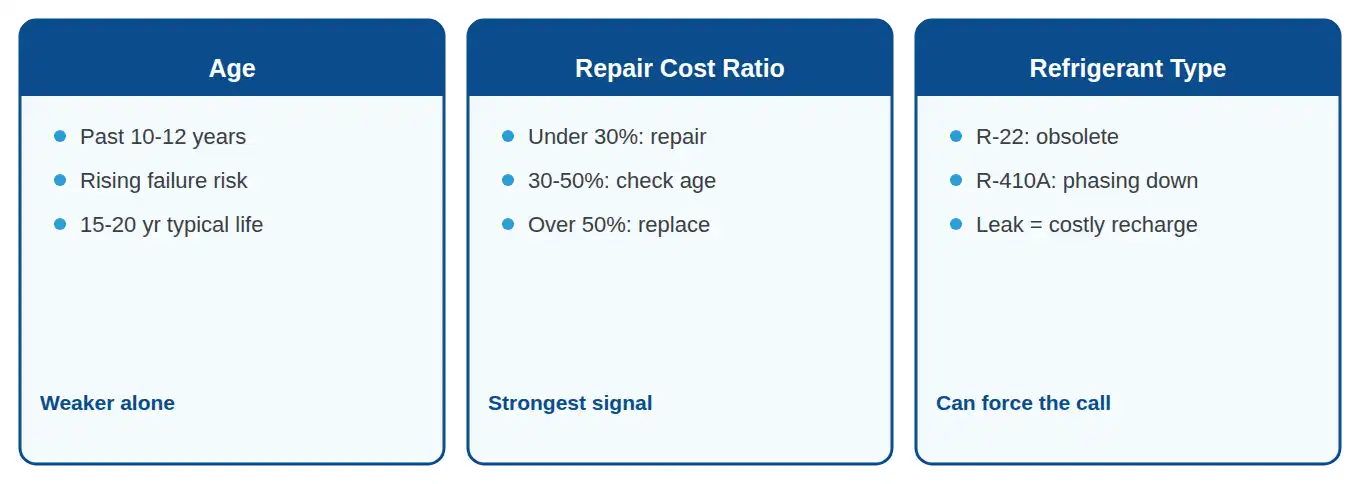
- Age — a weaker signal on its own, but one that makes every other factor more decisive as a unit gets older
- Repair cost ratio — generally the strongest single signal: how much the repair costs relative to full replacement
- Refrigerant type — can override the other two factors entirely if a unit needs an obsolete or scarce refrigerant
Popular residential rules of thumb — like multiplying a system’s age by the repair cost against a flat dollar threshold — don’t transfer cleanly to commercial equipment, where repair and replacement costs run far higher in absolute dollars. The underlying logic still applies; the specific dollar thresholds don’t.
How Age Affects the Replace Decision
Age affects the replace decision because failure risk rises meaningfully after 10 to 12 years, and a repair on an older unit often just delays the next one rather than resolving the underlying wear.
Commercial AC and heat pump equipment typically has a service life of 15 to 20 years with good maintenance. A unit in the first half of that range with a straightforward repair is usually worth fixing. A unit in the back half facing anything beyond a minor repair is worth evaluating against replacement — not because age alone disqualifies it, but because age changes how much confidence you should have that the current repair is the last one for a while.
The Repair-Cost-to-Replacement-Cost Ratio
The repair-cost-to-replacement-cost ratio is generally the single strongest signal in this decision: a repair under roughly 30% of replacement cost usually favors repair, a repair over roughly 50% usually favors replacement, and the middle ground depends on age and repair history.
- Under 30% of replacement cost — repair is usually the more cost-effective choice, particularly on equipment that isn’t especially old
- 30% to 50% of replacement cost — the decision depends more heavily on age, refrigerant type, and how many repairs the unit has already needed
- Over 50% of replacement cost — replacement is usually the stronger financial choice, especially on equipment past the midpoint of its expected service life
Multiple breakdowns within a single cooling season are worth weighing alongside this ratio — a unit that keeps generating smaller repair calls is often heading toward a larger one regardless of what any single repair estimate shows.
Why Refrigerant Type Can Force the Decision
Refrigerant type can override every other factor in this decision, because a system requiring an obsolete or increasingly scarce refrigerant may not be a cost-effective repair candidate regardless of age or repair-cost ratio.
R-22 refrigerant is no longer produced in the United States, so a leak requiring an R-22 recharge on an older system is usually a strong signal to replace — the refrigerant itself is scarce and expensive, on top of whatever the mechanical repair costs. R-410A, the more common current refrigerant, is also in a gradual phase-down as the industry transitions toward newer refrigerants, which is worth factoring into a longer-term replacement timeline even though it isn’t the same urgent trigger that an R-22 situation is.
Making the Decision for a Commercial Property
Making this decision for a commercial property adds factors that residential repair-or-replace guides don’t have to account for: the cost of business downtime during a failure, and properties with multiple rooftop units where replacement timing can sometimes be coordinated across several aging units at once.
A commercial HVAC maintenance history — documented repair frequency, cost, and technician notes — is what actually makes this decision well-informed rather than a guess based on how old the unit looks. When replacement is the right call, commercial HVAC replacement or a broader renovation and retrofit can be planned on a timeline that fits your business, rather than rushed after a failure. And if the unit is still under a manufacturer or labor warranty, confirm warranty service coverage before paying for a repair out of pocket.