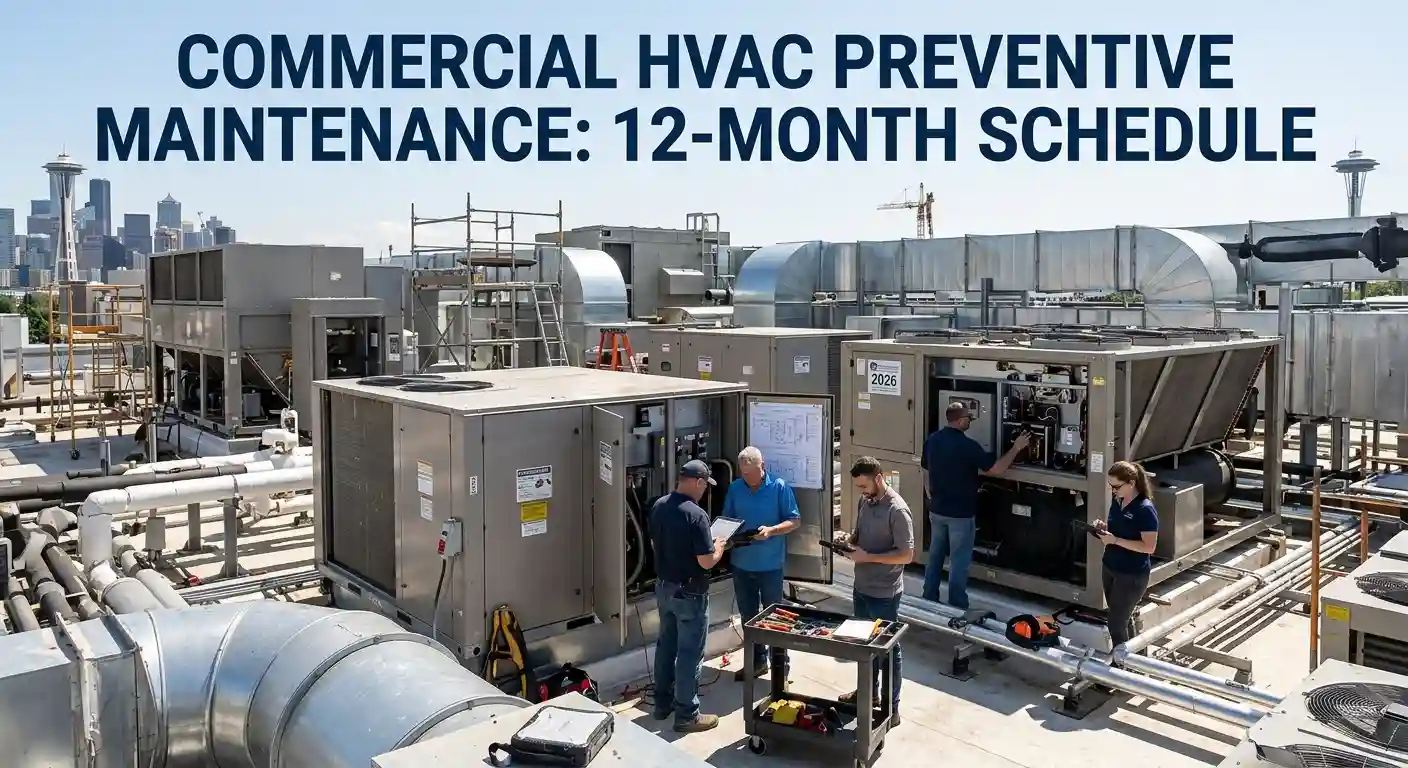

Commercial HVAC replacement in South Florida typically costs $10,000 to $30,000 and up per unit installed — roughly $2,000 to $3,500 and up per ton. Where a project lands in that range is decided by six drivers: tonnage, equipment type and tier, crane and rigging, curb adaptation, electrical scope, and permitting. Every figure here is guidance, not a quote; commercial projects price individually after a site assessment.
This budget guide walks through the full replacement math, driver by driver, so your capital plan starts from real numbers.
How Much Does Commercial HVAC Replacement Cost?
The published guidance ranges for South Florida commercial replacement work, from our pricing page:
| Item | Guidance figure |
|---|---|
| Replacement, per unit installed | $10,000 – $30,000+ |
| Replacement, per-ton basis | Approx. $2,000 – $3,500+ per ton |
| Typical repair (for comparison) | $395 – $2,500+ |
| Diagnostic assessment | Starting at $195 |
A worked example: a 10-ton rooftop unit over an office suite brackets roughly $20,000–$35,000 and up installed; a 25-ton unit over a retail box scales proportionally. The bracket is wide because the drivers below are real — two 10-ton projects can legitimately land far apart.
What Drives Replacement Cost Up or Down?
Six factors explain most of the spread between quotes, and none of them are optional extras — they’re the difference between a unit on a roof and a working system:
- Tonnage — cooling capacity is the baseline multiplier on equipment and labour alike
- Equipment type and tier — packaged rooftop units, split systems and VRF price differently; premium and coastal-duty builds sit above value lines (our brands guide maps the tiers)
- Crane and rigging — rooftop lifts are a real line item; tight lots and occupied buildings add planning
- Roof curb adaptation — a match is a bolt-in; a mismatch means sheet-metal work or an adapter
- Electrical and controls — panel capacity, disconnects, and building automation integration
- Permitting and code compliance — county mechanical permits plus Florida Building Code wind-load requirements with engineered tie-downs
Why Do Per-Ton Costs Vary So Much?
Because the per-ton figure carries everything that isn’t the compressor: access, code, coastal specification and equipment tier all ride inside it. At the low end of the $2,000–$3,500+ range sits the straightforward swap — ground-accessible or easy-lift unit, matching curb, adequate electrical, standard-duty equipment inland.
The high end collects the rest: premium or coastal-duty equipment, crane logistics over an occupied building, curb and electrical work, and the engineering that wind-load compliance demands. Two cautions when using per-ton math: compare projects, not bids — a low per-ton number with the coastal options stripped isn’t savings, it’s a shorter equipment life on layaway; and get the tonnage itself from a load calculation rather than the old nameplate, because buying the wrong size at the right price is still the wrong purchase. Our tonnage guide and load calculation guide cover that half of the decision.
What Does the Coastal Premium Buy?
Years of equipment life — the coastal package is the best-returning line item on any South Florida replacement quote. Within salt-aerosol reach of the Atlantic and Intracoastal (effectively east of I-95), uncoated condenser coils pit and fail years early; factory coil coating and corrosion-protected hardware routinely carry equipment from an 8–10-year coastal lifespan into the mid-teens.
Wind code adds the second layer: rooftop equipment must meet Florida Building Code wind-load requirements with engineered curbs and tie-downs, documented for permit — non-negotiable, and exactly where bargain quotes economize. The pattern in our coastal reliability records is unambiguous: the protected mid-tier unit outlasts the unprotected premium one. If the budget forces a choice, cut the equipment tier before you cut the protection.
When Does Replacement Beat Repair?
When age, failure severity and efficiency stack against the repair — usually past twelve to fifteen years, at compressor-level events, or on obsolete refrigerant platforms. The comparison isn’t sticker price (a $2,500 repair is obviously cheaper than a $20,000 unit); it’s what the repair actually buys.
On a healthy eight-year-old machine, a repair purchases years of remaining service. On a tired sixteen-year-old one, the same money is a bridge loan against the identical replacement bill — now scheduled by the next failure instead of by you. The EPA’s HFC phasedown sharpens the math: older refrigerant platforms get progressively costlier to service, and a major leak on one is close to a replacement verdict by itself. Our repair-or-replace framework runs the full decision; the short version is that honest quotes price both paths.
How Do You Time a Replacement to Save Money?
Replace on your schedule, not the equipment’s — the same unit costs meaningfully less as a planned shoulder-season project than as an August emergency. Planned replacement (roughly November through March here) buys flexible crane and crew scheduling, workable equipment lead times, commissioning in forgiving conditions, and a building that tolerates the changeover.
Emergency replacement buys whatever unit is available rather than the right one, premium logistics, and tenants cooking through the wait — with any interim emergency service billing at 1.5x the regular labour rate for weekend and extended hours. The mechanism that makes planning possible is knowing your fleet: documented condition assessments flag next year’s replacements this year, which is exactly what a maintenance agreement’s quarterly reports feed. The cheapest replacement is the one you saw coming two budgets ago.
How Should Multi-Unit Buildings Stage Replacements?
A rolling percentage per budget year, oldest and most stressed units first — not all at once, and never one emergency at a time. Staged replacement spreads capital across years, keeps the building functional throughout, and earns batch pricing that emergency singles never see.
Three staging rules from the field: sequence by condition data rather than age alone (the coastal-exposed unit at year eleven may deserve priority over the sheltered one at fourteen); standardize brand and curb dimensions as you go, which simplifies the next decade of parts, filters and technician familiarity; and re-run the load calculation per unit rather than cloning nameplates — buildings change, and staged replacement is the natural moment to fix historic sizing errors zone by zone. For associations and portfolios, pairing the staging plan with reserve budgeting turns HVAC from an annual surprise into a predictable line item.
How Do Financing and Tax Treatment Change the Math?
Replacement capital rarely has to land in one budget line, and the tax treatment is worth a conversation with your CPA before the purchase order, not after. Commercial HVAC improvements can qualify for accelerated deduction treatment under Section 179 — a meaningful offset against a five-figure project when it applies to your situation.
Energy efficiency compounds the case: new equipment at current efficiency standards typically runs well below what a fifteen-year-old unit consumes at South Florida run hours, so part of the replacement funds itself monthly on the utility bill, and efficiency-driven utility programs occasionally sweeten specific equipment choices. None of this is tax advice — qualification depends on your entity, income and timing — but the planning point stands: the true cost of a replacement is the installed price minus tax treatment minus energy savings, spread over 15 years. Buildings that run that math often find the “expensive” planned replacement cheaper than another year of an inefficient machine.
What Should a Replacement Quote Include?
Everything that makes it a working system — and the spread between bids usually hides in what’s missing, not what’s cheaper.
A quote worth signing itemizes: equipment model and tonnage with the sizing basis stated (ask for the load calculation); coastal options listed explicitly; crane, rigging and curb work; electrical scope; permitting and wind-load engineering; start-up and commissioning with documented readings; warranty terms — parts, compressor and labour separately (our warranty guide explains the layers); and disposal of the old unit including refrigerant recovery, which is EPA-regulated work. Compare quotes on scope before price, and insist on the caveat that protects both sides: figures are guidance until a site assessment turns them into a firm number. That’s how our replacement team quotes — assessment first, itemized proposal, published rates underneath.
Frequently Asked Questions
How much does it cost to replace a commercial AC unit in South Florida?
Typically $10,000 to $30,000 and up per unit installed — roughly $2,000 to $3,500 and up per ton — driven by tonnage, equipment tier, rigging, electrical scope and permitting. Every project is quoted individually after a site assessment.
How long does commercial HVAC replacement take?
A straightforward single-unit rooftop swap is typically one to two days on site once equipment, permit and crane are scheduled — planning lead time is the longer pole. Complex multi-unit or curb-modification projects run longer; the proposal should state the schedule.
Can I keep the same tonnage as my old unit?
Only if a fresh load calculation confirms it. Buildings change over fifteen years — new glazing, LED retrofits, tenant churn — and the old nameplate is history, not a specification. Sometimes the right new unit is smaller, which is money back at purchase and every month after.
Is replacing in winter really cheaper?
Planned shoulder-season projects avoid emergency logistics, get better scheduling and workable lead times, and commission in forgiving conditions. The unit price is similar; the project cost and the risk are not. The expensive replacement is the unplanned one.
Aspen Air Conditioning replaces commercial HVAC across Palm Beach and Broward Counties — load calculations included, published pricing underneath, since 1983. Call 561-464-5010.