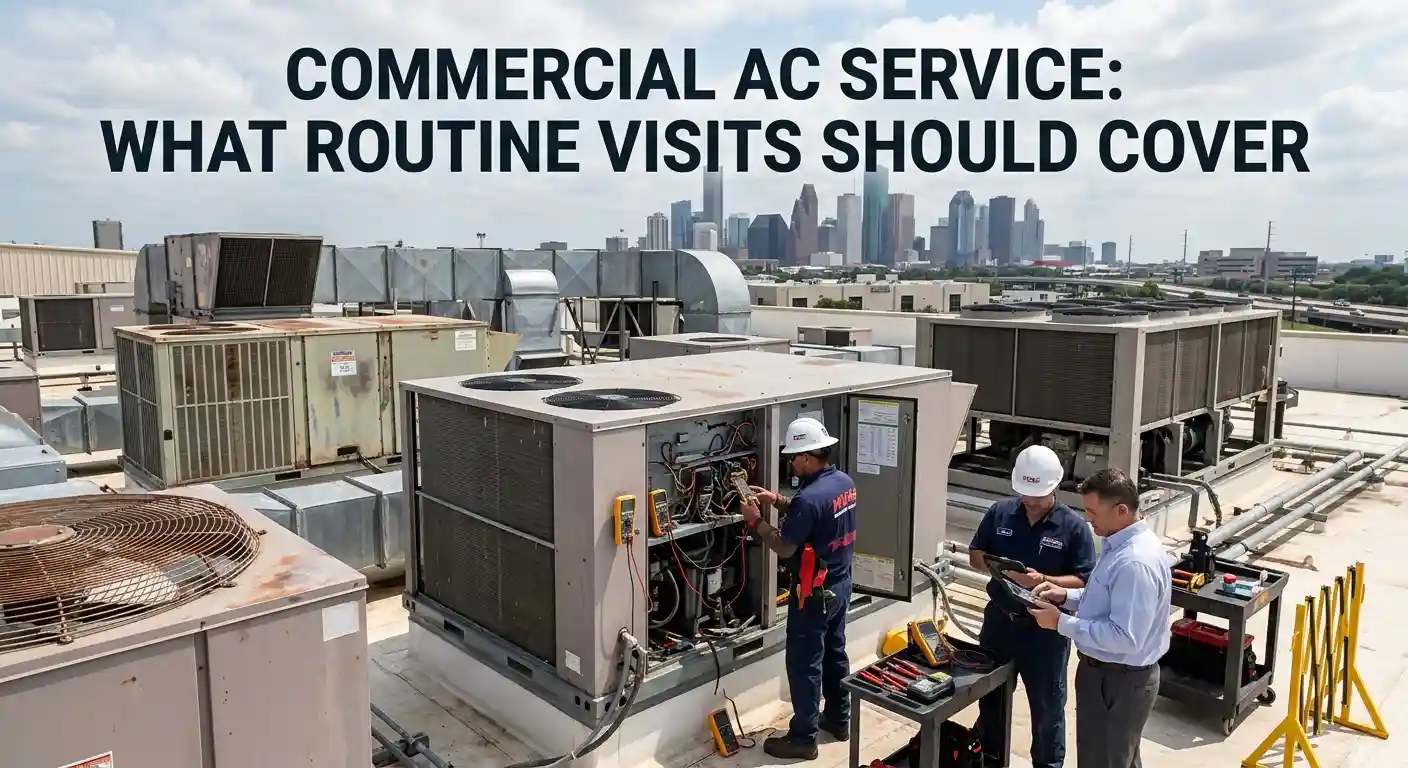

Q1 commercial HVAC planning saves South Florida property managers money by catching equipment failures before peak cooling season — when repair costs spike and contractor availability drops. In Palm Beach County, Broward County, and Fort Lauderdale, the January–March window is the last viable assessment period before humidity levels and cooling demand accelerate into the May–October peak, compressing both technician schedules and emergency repair budgets.
Property managers who schedule preventative HVAC assessments in Q1 consistently reduce annual energy costs by 15–30% and extend equipment lifespan by five or more years — outcomes that translate directly to lower capital expenditure and reduced tenant complaints during Florida’s peak heat months. For commercial properties across Boca Raton, West Palm Beach, and the broader Southeast Florida market, the question isn’t whether to plan HVAC maintenance — it’s whether you can afford to wait until summer to find out what failed.
Aspen AC has provided commercial HVAC services to Palm Beach and Broward County property managers since 1983. This guide outlines exactly what Q1 planning covers, what it costs to skip it, and how to build a maintenance schedule that protects your assets year-round.
Ready to lock in your Q1 commercial HVAC assessment before peak season?
The Economic Rationale for First-Quarter HVAC Assessment
Commercial HVAC infrastructure represents one of the most significant operational expenses within any commercial property portfolio. For office buildings, retail centers, high-rise condominiums, and healthcare facilities across Southeast Florida, HVAC systems typically account for 40–50% of total energy consumption — making them the single largest controllable cost line on an operating budget.
The Q1 window delivers a specific financial advantage that no other quarter replicates: moderate ambient temperatures allow technicians to stress-test systems, measure performance baselines, and replace degrading components without disrupting tenant comfort. By May, that option is gone. Emergency repair rates in South Florida during peak season routinely run 30–50% higher than scheduled maintenance costs, and contractor lead times extend from days to weeks when the entire region is operating at full cooling demand simultaneously.
The compressor failures, refrigerant leaks, and electrical malfunctions that become $8,000–$20,000 emergency interventions in July are frequently the same issues that cost $400–$1,500 to resolve in February — if identified during a scheduled inspection. That cost differential is the core economic argument for Q1 commercial HVAC planning, and it applies to every commercial property category Aspen AC services across Palm Beach and Broward Counties.
Beyond repair cost avoidance, Q1 assessments enable accurate capital forecasting. When a property manager in Boca Raton or Coral Springs knows in February that a rooftop packaged unit has 18–24 months of serviceable life remaining, that information drives budget allocation decisions — not reactive emergency line-item additions in August.
South Florida’s Hidden Q1 Advantage: Why January–March Is the Only Real Maintenance Window
Most commercial HVAC planning content is written for markets that experience genuine winters — periods where cooling systems rest completely and inspections occur naturally during low-demand months. South Florida does not have that buffer.
What South Florida does have is a narrow operational window between December and March where ambient temperatures drop sufficiently to allow full-system diagnostics without risk of tenant impact. During this period:
- Compressors can be cycled off for internal inspection without leaving occupants in 85°F heat.
- Coil cleaning and refrigerant recharges can be completed without immediate performance demand.
- Ductwork inspections and IAQ assessments can run during normal business hours without after-hours surcharges.
- Control system recalibrations can be validated under real operating conditions before peak load hits.
Once April arrives in Palm Beach County and Broward County, this operational flexibility collapses. The system must run — which means maintenance windows shrink to nights and weekends, labor rates increase, and any discovered component failure requires an immediate emergency procurement rather than a planned replacement order.
Salt air corrosion compounds this urgency specifically for Southeast Florida coastal properties. Facilities within two miles of the Atlantic coastline — spanning Fort Lauderdale Beach, Boca Raton’s coastal corridor, and properties along the Intracoastal Waterway — face accelerated condenser coil degradation and electrical connection corrosion that is invisible without a physical inspection. A condenser coil that appears functional from the rooftop deck may be operating at 60–70% efficiency due to salt-induced fouling, driving energy costs upward while the system appears to be running normally.
Q1 is the only quarter where a thorough inspection of these components can be scheduled, documented, and remediated without operational disruption. For property managers overseeing coastal commercial assets in Southeast Florida, this inspection cycle is not optional — it is a structural requirement of responsible asset management.
Preventative Maintenance and Long-Term Asset Preservation
Commercial HVAC systems represent capital investments that depreciate on a 15–25 year replacement cycle for major components. The difference between a system that reaches year 20 in serviceable condition and one that requires full replacement at year 12 is, in most cases, the consistency of its maintenance history.
Aspen AC’s four decades of commercial HVAC work across Southeast Florida consistently validates one operational pattern: systems receiving annual preventative maintenance — particularly Q1 assessments — demonstrate extended operational lifespans that often exceed manufacturer specifications by five to seven years. That extension translates directly to deferred capital expenditure. For a property manager in West Palm Beach overseeing a portfolio of mid-size commercial properties, deferring a $45,000 rooftop unit replacement by five years represents a material improvement in both operating cash flow and asset valuation.
The components that benefit most from Q1 maintenance attention are the ones that fail most expensively when neglected:
- Evaporator coils: Accumulated biofilm and particulate buildup reduces heat transfer efficiency by 10–20% annually in high-humidity South Florida environments. Annual cleaning restores performance and prevents the microbial growth that triggers IAQ complaints.
- Condensate drain systems: Blocked condensate drains are the leading cause of water damage claims in South Florida commercial properties — particularly in multi-tenant buildings where a single blockage on an upper floor can damage tenant build-outs below. Q1 flushing and inspection eliminates the primary failure vector before cooling season demand produces the volume that reveals the blockage.
- Air handlers and belt drives: Worn belts and misaligned air handlers operate at reduced efficiency and generate the vibration patterns that accelerate bearing failure. Detection during a Q1 inspection costs hundreds. Discovery during peak season, when the bearing seizes and the unit fails, costs thousands — plus tenant disruption claims.
- Electrical connections and contactors: South Florida’s humidity accelerates oxidation on electrical connections throughout HVAC control systems. Loose or corroded connections are a leading cause of compressor failures — the most expensive single-component repair in commercial HVAC. Annual torque checks and connection cleaning during Q1 inspections are the primary preventive measure.
For property managers overseeing healthcare facilities, high-rise condominiums, or multi-tenant retail in Palm Beach County and Broward County, these failure modes are not theoretical risks — they are documented patterns that Aspen AC technicians encounter consistently in buildings that deferred maintenance.
Q1 Commercial HVAC Checklist for Palm Beach & Broward Property Managers
The following assessment framework reflects the inspection protocol Aspen AC applies to commercial HVAC evaluations across Southeast Florida. Property managers can use this as both a vendor evaluation tool and an internal planning reference.
System Performance Assessment
- Measure and record supply air temperatures at all zones against design specifications
- Calculate system efficiency against SEER/EER baseline for equipment age
- Document refrigerant charge levels — illegal refrigerant shortfalls are a compliance liability under current EPA Section 608 regulations
- Test economizer operation and outdoor air damper calibration
- Verify thermostat calibration and control system communication across all zones
Mechanical Inspection
- Inspect and clean evaporator and condenser coils
- Flush and treat condensate drain pans and drain lines
- Check and lubricate all moving parts — motors, bearings, fan blades
- Inspect and tension or replace belts on all belt-driven equipment
- Measure and log amperage draw on all motors against nameplate ratings
Electrical & Controls
- Inspect and torque all electrical connections at disconnect boxes, contactors, and control boards
- Test all safety controls — high-pressure, low-pressure, and freeze protection
- Inspect capacitors and contactors for wear — these are leading-cause failure points for compressors
- Test and document all BAS/BMS setpoint configurations
Indoor Air Quality (IAQ)
- Replace all air filters to MERV rating appropriate for occupancy type
- Inspect ductwork for leakage, contamination, and physical damage
- Test CO₂ levels against ASHRAE 62.1 ventilation standards
- Evaluate UV light or air purification system performance if installed
Documentation & Compliance
- Update equipment maintenance logs with all findings and actions taken
- Record refrigerant additions in EPA-compliant logs
- Flag components with end-of-life indicators for capital planning
- Generate written report for property owner records and liability documentation
This checklist aligns with ASHRAE Standard 180 commercial HVAC inspection protocols and supports the documentation requirements that property managers in Palm Beach County and Broward County need for insurance, lease compliance, and regulatory defensibility.
Regulatory Compliance and Risk Mitigation in 2026
The regulatory environment governing commercial HVAC operations has tightened materially over the past three years, and 2026 carries compliance requirements that directly affect property managers in Southeast Florida.
EPA Refrigerant Regulations: The phasedown of HFC refrigerants under the AIM Act is accelerating. Systems still operating on R-22 are now dependent on increasingly expensive recovered refrigerant supply. Systems operating on R-410A face future cost exposure as that refrigerant enters its own phasedown cycle. Q1 planning provides the assessment window to evaluate refrigerant transition timelines before emergency failures force unplanned conversions at peak-season pricing.
Florida Building Code — Energy Efficiency Standards: Commercial properties undergoing significant HVAC system replacements in Broward County and Palm Beach County must comply with the current Florida Energy Code, which mandates minimum efficiency ratings for replacement equipment. A Q1 assessment identifies which units are approaching mandatory replacement thresholds, allowing property managers to plan compliant upgrades within budget cycles rather than responding to code enforcement after an emergency replacement.
Liability Documentation: In the event of tenant disputes, insurance claims, or litigation arising from inadequate climate control, the property manager’s primary defense is a documented maintenance record demonstrating systematic care. Aspen AC’s inspection reports provide the written documentation trail — date-stamped, technician-signed, and equipment-specific — that property managers need to establish reasonable care under Florida’s comparative negligence standard.
The absence of maintenance documentation does not merely create legal risk — it eliminates the primary defense available to property owners when tenant complaints escalate to formal disputes. Q1 documentation, conducted and recorded by a licensed commercial HVAC contractor, is the structural foundation of that defense.
Why Aspen AC for Your Southeast Florida Commercial Properties
Commercial HVAC planning requires a contractor who understands both the technical systems and the operational realities of managing commercial property in Southeast Florida’s demanding climate. Not all HVAC contractors are positioned to serve the full scope of what commercial property managers need.
Aspen AC’s qualifications for Palm Beach County and Broward County commercial property managers:
NATE-Certified Technicians — Every Job. NATE (North American Technician Excellence) certification is the highest independent technical standard in the HVAC industry. Every Aspen AC technician is NATE-certified, background-checked, and drug-tested. For property managers responsible for tenant-occupied buildings — particularly healthcare facilities, assisted living centers, and high-rise condominiums — this credential provides the documented technician qualification that liability management requires.
Sub-4-Hour Emergency Response, 7 Days a Week. Q1 planning reduces emergency calls. But when emergencies occur — during peak season, on holidays, or during extreme heat events — Aspen AC guarantees on-site response within four hours across Palm Beach and Broward Counties. That SLA is the operational backstop that preventative maintenance contracts are built on.
40+ Years of Southeast Florida Commercial Experience. Since 1983, Aspen AC has served commercial properties across Boca Raton, Fort Lauderdale, West Palm Beach, Coral Springs, Pompano Beach, Deerfield Beach, Hollywood, and Pembroke Pines. That operational history means technicians who understand the specific failure patterns of South Florida’s coastal climate — not technicians applying generic national maintenance protocols to a market they don’t know.
Specialized Sector Coverage. Aspen AC services commercial HVAC across high-rise condominiums, healthcare facilities, educational institutions, industrial and warehouse facilities, hospitality and restaurant properties, retail and shopping centers, and worship facilities — each with the sector-specific compliance and performance requirements that distinguish commercial work from residential service.
Fully Licensed, Bonded, and Insured. Every Aspen AC engagement carries the complete licensing, bonding, and insurance coverage that responsible property managers require of vendors operating in their facilities.
Frequently Asked Questions
Answers below cover the questions property managers ask most before committing to a commercial AC maintenance schedule.
How often should commercial HVAC systems be serviced in South Florida?
Commercial HVAC systems in South Florida should receive a minimum of two full inspections per year — one in Q1 (January–March) before peak cooling season, and one in Q3 (July–September) to assess mid-season performance. Properties with high-occupancy demands, coastal salt air exposure, or specialized IAQ requirements — such as healthcare facilities and high-rise condominiums — typically require quarterly inspections to maintain performance standards and regulatory compliance.
What is the best time to schedule commercial AC maintenance in Palm Beach County?
January through March is the optimal window for comprehensive commercial HVAC maintenance in Palm Beach County. During this period, ambient temperatures allow full system diagnostics without operational disruption, technician availability is highest before peak-season demand, and any identified component failures can be remediated with standard lead times rather than emergency procurement. Property managers who schedule in Q1 also benefit from lower after-hours rates, since most maintenance work can be completed during standard business hours in moderate weather.
How much can preventative HVAC maintenance save a commercial property manager?
Preventative commercial HVAC maintenance consistently delivers 15–30% reductions in annual energy costs compared to reactive maintenance strategies. Over a system’s full operational lifespan, comprehensive maintenance programs reduce total cost of ownership by 20–40% — primarily by extending equipment service life, preventing emergency repair events, and maintaining efficiency baselines that minimize energy waste. For a mid-size commercial property in Boca Raton or Fort Lauderdale with annual HVAC energy costs of $40,000–$80,000, a 20% efficiency improvement represents $8,000–$16,000 in annual savings against a maintenance contract cost that is typically a fraction of that figure.
What is included in a commercial HVAC Q1 inspection in Broward County?
A comprehensive commercial HVAC Q1 inspection in Broward County covers: full system performance measurement against design specifications; coil cleaning and refrigerant charge verification; condensate drain inspection and treatment; electrical connection inspection and torque verification; capacitor and contactor assessment; air filter replacement; IAQ evaluation; control system calibration; and a written inspection report with capital planning recommendations. The specific scope varies by system type — packaged rooftop units, VRF/VRV systems, split systems, and PTACs each carry system-specific inspection requirements.
Does Aspen AC offer commercial HVAC maintenance contracts for multiple properties?
Yes. Aspen AC structures preventative maintenance contracts for single properties and multi-property portfolios across Palm Beach and Broward Counties. Contract terms are customized to property type, system configuration, occupancy requirements, and budget cycle, with flexible scheduling that accommodates building operations without tenant disruption.
How much can property managers save with Q1 HVAC planning?
20-30% on service costs versus peak season, plus ongoing energy reductions from optimized efficiency.
Is Q1 too early for HVAC maintenance in humid South Florida?
No; addresses winter salt buildup and preps for humidity, preventing early summer strain on systems.
What does a Q1 commercial HVAC tune-up include?
Coil cleaning, filter changes, electrical checks, drain flushes, and belt inspections for peak performance.
How does HVAC planning impact tenant retention in South Florida?
Reliable cooling minimizes complaints, boosts satisfaction, and supports lease renewals during hot months.
Can Q1 planning qualify for HVAC rebates in Florida?
Yes; early efficiency upgrades often align with state energy programs for commercial high-SEER units.
FAQ: Commercial HVAC Planning in South Florida
How often should commercial HVAC systems be serviced in South Florida?
Commercial HVAC systems in South Florida should receive a minimum of two full inspections per year — one in Q1 (January–March) before peak cooling season, and one in Q3 (July–September) to assess mid-season performance. Properties with high-occupancy demands, coastal salt air exposure, or specialized IAQ requirements — such as healthcare facilities and high-rise condominiums — typically require quarterly inspections to maintain performance standards and regulatory compliance.
What is the best time to schedule commercial AC maintenance in Palm Beach County?
January through March is the optimal window for comprehensive commercial HVAC maintenance in Palm Beach County. During this period, ambient temperatures allow full system diagnostics without operational disruption, technician availability is highest before peak-season demand, and any identified component failures can be remediated with standard lead times rather than emergency procurement. Property managers who schedule in Q1 also benefit from lower after-hours rates, since most maintenance work can be completed during standard business hours in moderate weather.
How much can preventative HVAC maintenance save a commercial property manager?
Preventative commercial HVAC maintenance consistently delivers 15–30% reductions in annual energy costs compared to reactive maintenance strategies. Over a system’s full operational lifespan, comprehensive maintenance programs reduce total cost of ownership by 20–40% — primarily by extending equipment service life, preventing emergency repair events, and maintaining efficiency baselines that minimize energy waste. For a mid-size commercial property in Boca Raton or Fort Lauderdale with annual HVAC energy costs of $40,000–$80,000, a 20% efficiency improvement represents $8,000–$16,000 in annual savings against a maintenance contract cost that is typically a fraction of that figure.
What is included in a commercial HVAC Q1 inspection in Broward County?
A comprehensive commercial HVAC Q1 inspection in Broward County covers: full system performance measurement against design specifications; coil cleaning and refrigerant charge verification; condensate drain inspection and treatment; electrical connection inspection and torque verification; capacitor and contactor assessment; air filter replacement; IAQ evaluation; control system calibration; and a written inspection report with capital planning recommendations. The specific scope varies by system type — packaged rooftop units, VRF/VRV systems, split systems, and PTACs each carry system-specific inspection requirements.
Does Aspen AC offer commercial HVAC maintenance contracts for multiple properties?
Yes. Aspen AC structures preventative maintenance contracts for single properties and multi-property portfolios across Palm Beach and Broward Counties. Contract terms are customized to property type, system configuration, occupancy requirements, and budget cycle, with flexible scheduling that accommodates building operations without tenant disruption.
How much can property managers save with Q1 HVAC planning?
20-30% on service costs versus peak season, plus ongoing energy reductions from optimized efficiency.
Is Q1 too early for HVAC maintenance in humid South Florida?
No; addresses winter salt buildup and preps for humidity, preventing early summer strain on systems.
What does a Q1 commercial HVAC tune-up include?
Coil cleaning, filter changes, electrical checks, drain flushes, and belt inspections for peak performance.
How does HVAC planning impact tenant retention in South Florida?
Reliable cooling minimizes complaints, boosts satisfaction, and supports lease renewals during hot months.
Can Q1 planning qualify for HVAC rebates in Florida?
Yes; early efficiency upgrades often align with state energy programs for commercial high-SEER units.
Aspen AC is a fully licensed, bonded, and insured commercial HVAC contractor headquartered in Boca Raton, Florida. Serving Palm Beach County and Broward County since 1983. NATE-certified technicians. 7-day availability. Sub-4-hour emergency response.