A commercial AC system in South Florida rarely fails without warning. Knowing the seven signs that your system needs repair — before peak summer heat arrives — is the difference between a scheduled service call and an emergency shutdown that costs your business thousands in downtime.
South Florida’s subtropical climate is the harshest operating environment for commercial HVAC equipment in the continental United States. Year-round cooling demand, coastal humidity, and salt air corrosion compress the standard commercial AC lifespan from 15–20 years down to 10–13 years for properties across Boca Raton, Fort Lauderdale, and Palm Beach County. When a system begins to fail in this environment, it does so fast — and the consequences for commercial properties are immediate: lost productivity, tenant complaints, compliance exposure in healthcare and food service facilities, and emergency repair costs that dwarf the price of proactive service.
Aspen AC has been diagnosing and repairing commercial HVAC systems across Southeast Florida since 1983. The seven warning signs below are the most consistent pre-failure indicators our NATE-certified technicians document across Palm Beach and Broward Counties — ranked from the earliest detectable signals to the most urgent mechanical failures requiring same-day intervention.
Why South Florida’s Climate Accelerates Commercial AC Failure
Commercial HVAC systems in South Florida operate under conditions that have no equivalent in most U.S. markets. Understanding the specific environmental stressors that accelerate system degradation in this region is essential context for any property manager making maintenance and repair decisions.
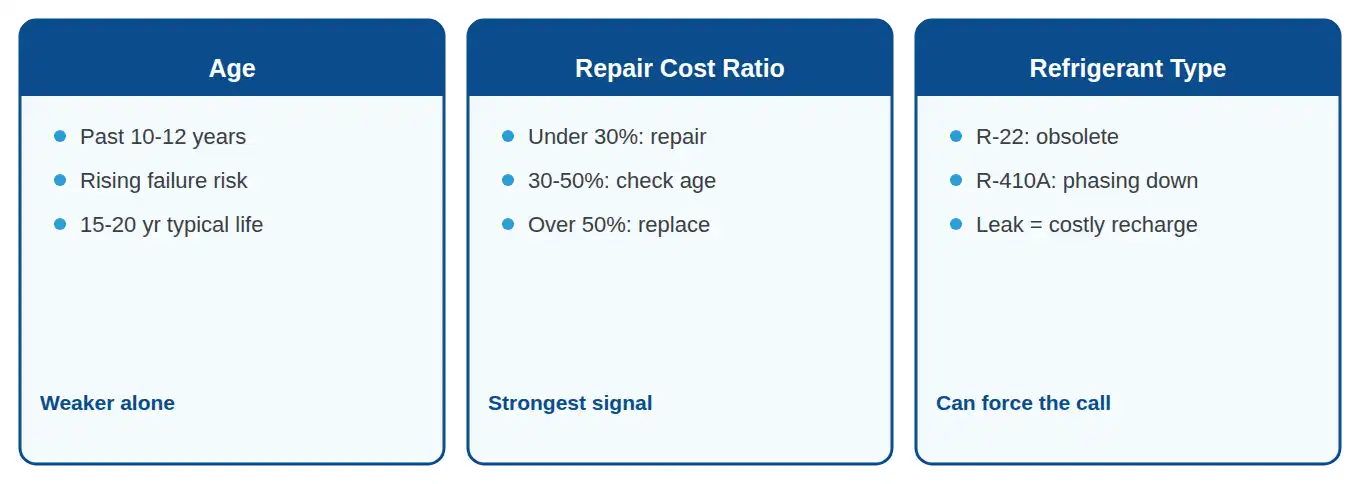
Year-Round Cooling Load. South Florida’s subtropical climate classification (Köppen Aw) means commercial AC systems in Boca Raton, Fort Lauderdale, and across Palm Beach County operate at cooling load for 10 to 11 months of the year. National HVAC lifespan benchmarks — typically 15–20 years for commercial equipment — are compressed to 10–13 years in this market due to continuous operational demand. A system that would be considered mid-life in Chicago or Atlanta may already be approaching end-of-life in Broward County.
High Humidity and Salt Air Corrosion. Coastal proximity accelerates corrosion on condenser coils, copper refrigerant lines, and electrical connections. Properties within 5 miles of the Atlantic coastline — including a substantial portion of Aspen AC’s Palm Beach and Broward County service territory — experience accelerated oxidation rates that standard maintenance schedules do not account for. Off-season inspections specifically designed for salt air environments require additional coil cleaning protocols and anti-corrosion treatment application that goes beyond a standard tune-up.
Hurricane Season Preparation Window. South Florida’s hurricane season runs June 1 through November 30. Commercial properties that enter this window with unresolved HVAC issues face the compounded risk of storm-related mechanical stress on systems already operating with latent deficiencies. The optimal window for comprehensive commercial AC repair and off-season diagnostics is March through May — before peak heat and before hurricane exposure begins.
Any commercial HVAC contractor operating in South Florida who does not specifically account for these climate variables in their service protocols is applying a national standard to a regional problem. Aspen AC has been calibrating its maintenance and repair approach to Southeast Florida’s specific environmental demands since 1983.
Sign 1: Unexplained Spikes in Energy Consumption
One of the earliest indicators that your commercial AC system requires attention is an unexplained increase in energy expenditure. When cooling units operate inefficiently due to mechanical degradation, refrigerant loss, or compromised electrical components, they consume disproportionate amounts of electricity while delivering diminished cooling output.
Property managers and facility directors should conduct comparative analyses of utility invoices across equivalent operational periods. Statistically significant deviations from established consumption baselines warrant immediate professional evaluation. A 15–20% increase in energy consumption without a corresponding change in occupancy or operational hours is a reliable early-warning threshold.
Commercial AC repair specialists possess the diagnostic instrumentation to identify specific inefficiencies — whether attributable to compressor deterioration, ductwork integrity failure, or thermostat calibration drift. Proactive off-season assessment by qualified technicians can substantially reduce operational costs while preventing equipment failure during critical cooling periods.
Sign 2: Inconsistent Temperature and Airflow Across Zones
Commercial environments require precise climate control to maintain employee productivity, protect sensitive equipment, and ensure occupant comfort. When building occupants report temperature disparities across different zones, or when airflow appears reduced or inconsistent from supply registers, these conditions typically indicate underlying systemic deficiencies requiring professional commercial AC repair.
Such irregularities may stem from obstructed air handlers, deteriorated ductwork seals, malfunctioning zone dampers, or failing blower motors. In multi-tenant commercial properties and high-rise condominiums across Palm Beach County, zone inconsistency is frequently the first complaint that precedes a full system failure event.
Off-season evaluation permits comprehensive diagnostic assessment without disrupting normal business operations. Aspen AC’s certified technicians employ advanced testing methodologies to identify root causes and implement corrective measures that restore uniform climate distribution throughout commercial facilities.
Sign 3: Unusual Noises — Grinding, Squealing, or Banging
Commercial HVAC systems operating within normal parameters produce consistent, relatively subdued operational sounds. The emergence of unusual acoustic signals — grinding, squealing, banging, or hissing — constitutes direct evidence of mechanical distress requiring expert evaluation.
These sounds map to specific failure modes. Grinding typically indicates motor bearing failure. Squealing points to belt wear or blower misalignment. Banging suggests loose or dislodged internal components. Hissing near refrigerant lines or the indoor unit is a refrigerant leak indicator until proven otherwise.
These signals should never be dismissed as ambient operational noise. Each of these fault types escalates rapidly under continued system operation. A commercial system producing any of these sounds should be evaluated by a certified technician within 24 hours — not at the next scheduled maintenance interval.
Sign 4: Visible Deterioration, Leaks, and Ice Formation
Physical inspection of commercial AC infrastructure often reveals direct evidence of impending failure. Refrigerant leaks manifest as oily residue accumulation around connection points. Corrosion on coils, pipes, or housing units indicates moisture intrusion and chemical degradation — a particularly accelerated process in South Florida’s coastal environment.
Excessive condensation, water pooling near drain pans, or ice formation on evaporator coils and refrigerant lines signals drainage obstruction or refrigerant charge imbalance. Visible electrical component deterioration — including frayed wiring, burnt connection points, or repeatedly tripped breakers — represents a safety and operational hazard requiring immediate remediation.
The off-season window provides the optimal juncture for comprehensive visual assessments and necessary commercial AC repair, without the urgency imposed by active peak-season demand.
Sign 5: Short-Cycling — Your System Is Working Against Itself
Short-cycling occurs when a commercial AC system powers on, runs briefly, and shuts off before completing a full cooling cycle — only to restart minutes later. In South Florida’s high-humidity environment, this is more than an efficiency issue. It is a mechanical distress signal.
Each start-up cycle places the highest electrical load demand on the compressor. A system short-cycling 8–12 times per hour instead of the standard 2–3 cycles accelerates compressor wear at a rate that can reduce equipment lifespan by years, not months. Common root causes include oversized equipment, low refrigerant charge, frozen evaporator coils, or a failing thermostat.
For commercial property managers in Boca Raton and Fort Lauderdale, short-cycling carries a compounding cost: inflated energy bills, premature compressor failure, and — critically — loss of humidity control. In South Florida’s subtropical climate, a system that cannot complete full dehumidification cycles creates conditions for mold proliferation inside ductwork and air handling units. That is a liability, not just a maintenance issue.
If your building’s HVAC system is cycling irregularly, do not delay. Short-cycling is one of the few failure modes that escalates from a repair into a full replacement if left unaddressed past a single season.
Sign 6: Refrigerant Leak Indicators — A Compliance and Performance Issue
Refrigerant leaks in commercial HVAC systems produce a cluster of identifiable symptoms: reduced cooling output despite normal system operation, ice formation on evaporator coils or refrigerant lines, hissing or bubbling sounds near the indoor unit, and oily residue at connection points or on coil surfaces.
In 2026, refrigerant leak diagnosis carries regulatory weight that goes beyond performance. Florida commercial facilities operating systems charged with R-410A must account for the EPA’s transition mandates under the AIM Act Section 103, which restricts the manufacture of new R-410A equipment and is accelerating the industry shift to A2L refrigerants including R-32 and R-454B. A system with an active refrigerant leak is not simply losing charge — it may be approaching end-of-life serviceability for its refrigerant type.
Aspen AC’s NATE-certified technicians are trained in leak detection, refrigerant recovery, and recharge procedures compliant with EPA 608 certification requirements. For commercial properties across Palm Beach and Broward Counties, addressing refrigerant issues during the off-season window eliminates the risk of losing full system function when thermal loads are at their highest.
Do not allow oily residue, ice formation, or unexplained warm air output to persist without professional diagnosis. What appears to be a minor charge issue can mask coil deterioration or compressor damage.
Sign 7: Thermostat and Control System Failures — When the Brain Loses Command
Commercial HVAC systems do not fail only at the mechanical level. Control system degradation — including faulty thermostats, unresponsive building automation interfaces, zone controller malfunctions, and sensor calibration drift — produces symptoms that are frequently misattributed to mechanical failure, resulting in misdiagnosed repairs and unnecessary component replacements.
Indicators of control system failure include: temperature setpoints that are not reached despite the system running continuously, zones that do not respond to scheduling commands, inconsistent behavior between HVAC zones in multi-tenant or multi-floor facilities, and thermostat displays showing error codes or blank screens.
For high-rise condominiums, healthcare facilities, and multi-tenant commercial properties in South Florida — environments where Aspen AC maintains significant operational presence — control system integrity is non-negotiable. A malfunctioning BAS (Building Automation System) or zone controller in a medical office or assisted living facility is not an inconvenience. It is an operational and compliance risk.
Advanced control system diagnostics require technicians trained in both mechanical HVAC systems and digital control architecture. Aspen AC’s certified team delivers integrated diagnostics that evaluate the full system — mechanical components and control logic — to identify root cause accurately before any repair work begins.
Don’t wait for a breakdown. Schedule your commercial AC diagnostic with Aspen AC — on-site across Boca Raton, Fort Lauderdale, and Palm Beach County within 4 hours.
Repair Now or Wait? The Off-Season Advantage
Off-season repair — roughly November through March in South Florida — means faster scheduling, no peak-season response premiums, and time to order parts without a building running hot. The same compressor issue addressed in January is a planned line item; discovered in July, it becomes an emergency with tenants waiting. Facilities on a maintenance contract catch these repairs in the off-season by design.
Repair or Replace? A Decision Framework for South Florida Commercial Property Managers
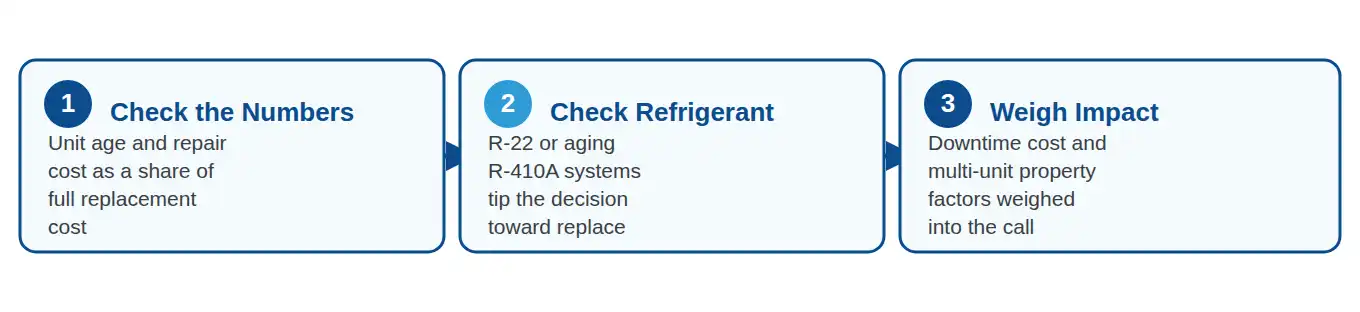
When a commercial AC system presents multiple simultaneous failure indicators, the repair-versus-replace calculation becomes the most consequential decision a facility manager will make. Executing a major repair on a system approaching end-of-life extends cost without extending value. Replacing a system prematurely abandons remaining serviceable life. The following framework provides objective decision criteria.
Replace When:
- The system is 12+ years old and requires a repair exceeding 50% of replacement cost (the industry-standard “Rule of 5000” — multiply system age by repair cost; if the result exceeds $5,000, replacement typically delivers better ROI).
- The system is charged with R-22 refrigerant (fully phased out; legal recharge is no longer available) or dependent on R-410A with a repair requiring full refrigerant recovery and recharge, given A2L transition economics in 2026.
- The system has required two or more major repairs in the preceding 24 months.
- Energy consumption data shows the system is operating at 30% or more above its rated efficiency baseline.
Repair When:
- The system is under 8 years old and the fault is isolated to a single, non-compressor component.
- The system has a documented preventive maintenance history that supports longevity assessment.
- Replacement would require structural or electrical infrastructure upgrades — VRF conversion, electrical panel upgrade — that extend project cost and timeline beyond immediate operational need.
The Honest Assessment Standard
Aspen AC’s diagnostic protocol includes a system age and performance evaluation at every service call. For commercial properties across Palm Beach and Broward Counties, the goal is never to sell a replacement that a repair can solve — or to execute a repair that delays an inevitable capital expenditure. That assessment is available through a scheduled off-season evaluation with no obligation to proceed beyond the diagnostic.
For commercial properties in the 2026 capital planning cycle, Aspen AC’s team can provide formal equipment condition assessments suitable for budget submission and facilities management reporting.
Frequently Asked Questions: Commercial AC Repair in South Florida
How often should commercial AC systems be serviced in South Florida?
Commercial HVAC systems in South Florida require a minimum of two professional service visits per year — one pre-season inspection before peak summer demand (typically April–May) and one off-season assessment (October–November). Given the year-round cooling load and high-humidity environment that accelerates wear in this region, many commercial property managers opt for quarterly maintenance contracts, particularly for healthcare facilities, high-rise condominiums, and multi-tenant retail properties where system failure carries direct operational and compliance consequences.
How much does commercial AC repair cost in Boca Raton and Fort Lauderdale?
Commercial AC repair costs in South Florida vary significantly by system type, fault category, and equipment age. Diagnostic service calls for commercial systems typically range from $150 to $300. Component-level repairs — including contactor replacement, capacitor failure, or blower motor service — generally fall in the $400–$900 range. Compressor replacement or refrigerant system overhaul on large commercial units can range from $2,000 to $8,000 or more depending on system tonnage and refrigerant type. Properties operating aging equipment approaching compressor failure should evaluate repair-versus-replace economics before authorizing major component work.
How quickly should I act if my commercial AC system is making unusual noises?
Immediately. Grinding, squealing, and banging sounds in commercial HVAC equipment are not ambient operational noise — they are mechanical fault signals. Grinding typically indicates motor bearing failure; squealing points to belt wear or blower misalignment; banging suggests loose or dislodged internal components. Each of these fault types escalates rapidly under continued operation. A system producing these sounds should be taken off full-load operation and evaluated by a certified commercial HVAC technician within 24 hours. For commercial properties in Boca Raton and across Palm Beach County, Aspen AC guarantees on-site response within 4 hours, 7 days a week.
How often should a commercial AC system be inspected in South Florida?
Have a professional inspection at least twice a year, before the hottest months and before winter, to catch issues early and reduce surprise breakdowns.
What can building managers do to prevent commercial AC breakdowns?
Change filters regularly, keep vents unblocked, schedule routine maintenance, monitor energy bills, and address small comfort changes quickly instead of waiting.
How long should a commercial AC system last in a hot, coastal area like South Florida?
Many commercial systems last about 10–15 years, but heavy use, salt exposure, and poor maintenance can shorten that lifespan significantly.
Is it better to repair or replace an older commercial AC that needs constant service?
If the unit is older than 10–15 years and major parts keep failing, replacement often brings lower energy costs and fewer emergency calls than ongoing repairs.
How can I reduce energy costs while keeping a commercial space cool in South Florida?
Use programmable controls, seal leaks, shade windows, keep filters clean, and maintain equipment so it can run efficiently without overworking.
Aspen AC has served commercial properties across Southeast Florida since 1983. Licensed, bonded, and insured. NATE-certified technicians. Serving Palm Beach County, Broward County, Boca Raton, Fort Lauderdale, West Palm Beach, Coral Springs, and surrounding areas — 7 days a week.