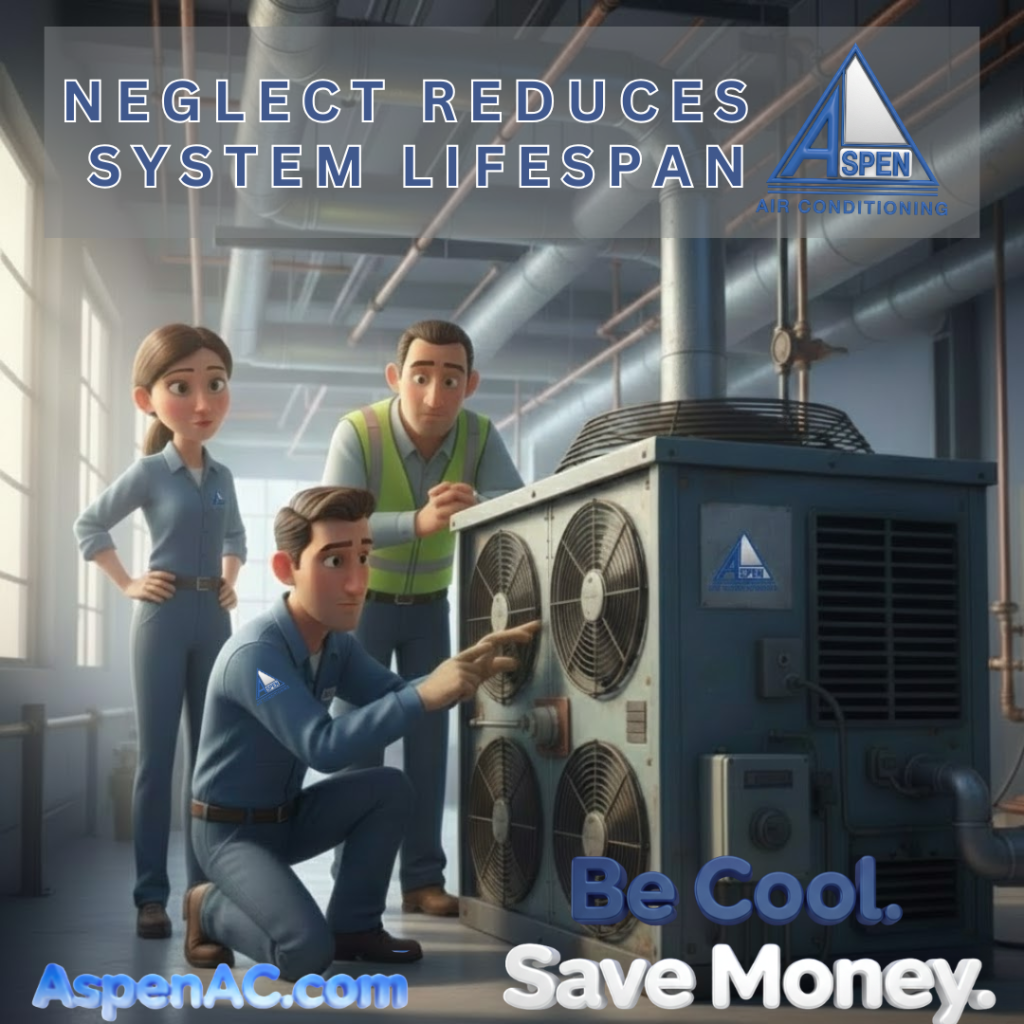
Deferred maintenance reduces commercial AC system lifespan by 40 to 60 percent — and in South Florida’s year-round cooling climate, that cost compounds faster than almost anywhere else in the country.
For commercial property managers in Boca Raton, Fort Lauderdale, and across Palm Beach and Broward Counties, skipping or delaying routine HVAC service isn’t a budget strategy — it’s a capital risk. When minor mechanical deficiencies go unaddressed, they cascade: compressors operate under elevated load, refrigerant levels drift, heat exchange surfaces foul, and what began as a $300 service call becomes a $15,000 emergency replacement.
This guide breaks down exactly how deferred maintenance shortens your commercial AC system lifespan, what the warning signs look like before failure occurs, and what South Florida property managers can do right now to protect their HVAC investment.
Why South Florida’s Climate Makes Deferred Maintenance a Higher-Stakes Risk
Commercial HVAC systems in most U.S. markets run a fraction of the year at full cooling load. In South Florida, systems run at or near capacity for 9 to 11 months out of 12 — more than double the operating hours of a typical seasonal market. Boca Raton, Fort Lauderdale, and the broader Palm Beach and Broward County corridor operate in a climate that never fully releases pressure on commercial cooling infrastructure.
That sustained operational demand transforms routine maintenance gaps into accelerated failure events. Three climate-specific stressors distinguish South Florida’s risk profile from the national baseline:
Salt-Air Corrosion: Coastal proximity across Boca Raton, Deerfield Beach, and Fort Lauderdale exposes condenser coils to chloride-laden air. Without scheduled coil cleaning and corrosion-inhibiting treatments, salt deposits accelerate metal oxidation, reduce heat transfer efficiency, and trigger premature condenser failure — often within five to seven years on systems rated for fifteen.
Humidity-Driven Biological Growth: South Florida’s sustained high-humidity environment creates ideal conditions for mold, algae, and bacterial growth inside condensate drain lines and air handling units. Deferred maintenance allows biological buildup to block drainage systems, producing water damage to building structures and degraded indoor air quality — a compounding liability for healthcare facilities and multi-tenant commercial properties.
Year-Round Compressor Load: Unlike northern markets where compressors cycle down seasonally, South Florida systems run continuously. Compressors operating without regular refrigerant checks, oil analysis, and electrical inspections accumulate stress without recovery periods. The result is a measurably shortened compressor lifespan — the single most expensive component in any commercial HVAC system.
Commercial AC System Lifespan: Maintained vs. Neglected
The financial argument for preventive maintenance is not theoretical. The following reflects general industry benchmarks for common commercial HVAC system types under maintained versus deferred maintenance protocols — actual results vary by manufacturer, usage, and local conditions.
Packaged Rooftop Units — 15–20 years maintained, dropping to 7–10 years deferred, roughly a 50% reduction.
Split Systems — 15–18 years maintained, dropping to 8–10 years deferred, roughly a 45% reduction.
VRF / VRV Systems — 20–25 years maintained, dropping to 10–14 years deferred, roughly a 44% reduction.
PTACs — 10–12 years maintained, dropping to 5–7 years deferred, roughly a 42% reduction.
Chillers — 20–30 years maintained, dropping to 10–15 years deferred, roughly a 50% reduction.
For a commercial property carrying three rooftop packaged units with a replacement value of $18,000–$25,000 each, deferred maintenance effectively advances a $54,000–$75,000 capital expenditure by seven to ten years. Against that figure, a structured preventive maintenance contract represents a high-ROI operational decision, not a discretionary expense.
One of the most widely cited figures in facilities management, from Rick Biedenweg of Pacific Partners Consulting Group, puts the ratio at roughly four to seven dollars in avoided repair and replacement costs for every dollar spent on preventive maintenance. In South Florida’s high-demand environment, that ratio skews toward the upper range.
Your commercial AC system’s lifespan starts with your next service decision. Aspen AC has protected commercial HVAC investments across Boca Raton, Fort Lauderdale, and Palm Beach County since 1983.
Schedule a Maintenance Assessment
The Evidentiary Correlation Between Maintenance Deferrals and System Degradation
Industry documentation and field experience consistently demonstrate that commercial air conditioning systems subjected to deferred maintenance protocols experience accelerated degradation patterns. When routine inspections, filter replacements, refrigerant level assessments, and component servicing are postponed or eliminated, the cumulative effect manifests as premature system failure. A commercial HVAC contractor with over four decades of operational experience can attest to the documented reduction in equipment lifespan — often by 40 to 60 percent — when preventative maintenance schedules are not rigorously observed.
The mechanical and thermodynamic principles governing commercial HVAC operation require consistent attention to maintain design specifications. Deferred maintenance allows minor deficiencies to compound, creating cascading failures that compromise system integrity. Compressor strain, heat exchanger inefficiency, ductwork deterioration, and electrical component failure represent common manifestations of neglect that transform manageable maintenance issues into capital expenditure requirements.
Liability Considerations and Regulatory Compliance Obligations
From a legal and regulatory perspective, commercial property owners and facility managers in Florida bear specific obligations regarding HVAC system maintenance. Building codes, health and safety regulations, and environmental compliance standards mandate that commercial air conditioning systems operate within established parameters. Failure to maintain these systems appropriately may result in regulatory non-compliance, potentially exposing property owners to citations, penalties, or liability in the event of tenant or occupant harm.
Furthermore, insurance policy provisions frequently contain stipulations regarding proper maintenance of building systems. Deferred maintenance that results in system failure, property damage, or business interruption may jeopardize insurance coverage or complicate claims processes. Engaging a qualified commercial HVAC contractor to establish and document regular maintenance protocols provides essential protection against these legal and financial exposures while ensuring compliance with applicable regulatory frameworks.
Economic Analysis of Deferred Maintenance Versus Preventative Investment
The economic calculus of deferred maintenance presents a compelling argument for preventative service investment. While postponing maintenance expenditures may appear to generate short-term cost savings, the actuarial reality demonstrates substantially higher long-term financial burdens. Emergency repairs command premium pricing, replacement equipment represents significant capital outlay, and operational disruptions impose measurable costs through lost productivity, tenant dissatisfaction, and reputational damage.
As noted above, the widely cited Pacific Partners Consulting Group ratio of four to seven dollars in avoided costs for every dollar invested in preventative maintenance holds directly relevant here. For commercial properties throughout South Florida, where climate conditions impose particularly demanding operational requirements on air conditioning systems, this economic relationship becomes even more pronounced.
Technical Consequences of Inadequate Maintenance Protocols
The technical ramifications of deferred maintenance extend throughout commercial HVAC systems, affecting multiple components and operational parameters. Neglected air filtration allows particulate accumulation on heat exchange surfaces, reducing thermal transfer efficiency and forcing compressors to operate under increased load conditions. Refrigerant leaks, when undetected and unaddressed, compromise system capacity while potentially violating environmental regulations governing refrigerant emissions.
Electrical connections subjected to thermal cycling without periodic inspection develop resistance that generates heat, increasing fire risk and component failure probability. Condensate drainage systems that receive inadequate attention may harbor biological growth or experience blockages that result in water damage to building structures. These technical degradations, individually significant, collectively accelerate the obsolescence of commercial air conditioning assets, necessitating premature replacement that proper maintenance would have forestalled.
6 Warning Signs Your Commercial AC Is Being Damaged by Deferred Maintenance
Deferred maintenance rarely announces itself as a single catastrophic event. It accumulates through a sequence of observable signals that most facility managers recognize in retrospect — after the emergency call has already been placed. These six indicators warrant immediate professional assessment.
1. Rising Energy Costs Without Usage Change — A commercial AC system operating with fouled coils, low refrigerant, or degraded components must work harder to maintain setpoint temperatures. If your energy bills are climbing without a corresponding increase in occupancy or operational hours, the system is compensating for internal inefficiency — a direct product of deferred service.
2. Uneven Temperature Distribution Across Zones — Inconsistent cooling across floors or zones signals airflow restrictions, refrigerant imbalances, or failing zone control components. In multi-tenant commercial properties, this generates tenant complaints and productivity disruption well before equipment failure occurs.
3. Unusual Odors From Air Supply — Musty or biological odors indicate mold or bacterial growth inside air handling units or ductwork — conditions that develop when condensate systems go uninspected. In healthcare facilities and food service environments, this constitutes both an IAQ liability and a regulatory compliance risk.
4. Increased Compressor Short-Cycling — If the compressor is starting and stopping in rapid succession, it is operating outside design parameters. Short-cycling accelerates compressor wear meaningfully, and left unaddressed for a full season it can shorten remaining useful life substantially.
5. Ice Formation on Refrigerant Lines — Visible ice on refrigerant lines or the evaporator coil indicates restricted airflow or low refrigerant — both conditions that deferred maintenance allows to develop undetected. Ice formation forces the compressor into a stress state that can cause irreversible damage within hours of onset.
6. Increased Frequency of Minor Repair Calls — An uptick in small service calls — thermostat issues, drainage blockages, intermittent cooling — is rarely coincidental. It signals that the system is entering the accelerated degradation curve that precedes major component failure. Each unresolved minor issue compounds the next.
Commercial AC Lifespan: Maintained vs. Neglected
Consistent maintenance is the difference between replacing commercial cooling equipment on schedule and replacing it years early. The ranges below reflect typical South Florida service life, where year-round runtime, humidity, and coastal air already shorten equipment life relative to national averages.
| Equipment | Typical lifespan, maintained | Typical lifespan, neglected |
|---|---|---|
| Rooftop units (RTUs) | 15–20 years | 8–12 years |
| Split DX systems | 12–15 years | 7–10 years |
| Chillers | 20–25 years | 12–18 years |
| PTAC units | 10–12 years | 5–8 years |
| Commercial refrigeration | 12–15 years | 6–10 years |
A structured commercial maintenance contract keeps every unit on the service intervals that protect these lifespans.
Frequently Asked Questions — Commercial AC Maintenance & System Lifespan
How often should commercial HVAC systems be serviced in Florida?
Commercial HVAC systems in South Florida should be serviced a minimum of twice per year — typically in spring before peak cooling season and in fall following the summer high-demand period. Given South Florida’s 8,000+ annual cooling hours, many high-use commercial properties benefit from quarterly inspections, particularly for compressor health checks, refrigerant level assessments, and condensate system clearance.
What are the first signs of deferred maintenance on a rooftop unit?
Common early signs include reduced airflow, warm spots in the building, unusually high runtime before reaching set temperature, more frequent breaker trips, or visible dirt and rust on the unit.
How can I create a maintenance schedule to prevent deferred AC damage?
For most commercial ACs, set a schedule with:
-
Filter changes every 1–3 months.
-
Coil cleaning and basic checks every 6 months.
-
Full professional tune‑ups in spring and fall.
Is deferred maintenance on commercial AC more expensive in the long run?
Yes. Skipping routine work leads to more frequent repairs, higher energy bills, and earlier full‑system replacement, which often costs far more than a consistent maintenance plan over time.
What should building managers do if they realize deferred maintenance has already damaged the AC?
A qualified technician should perform a full inspection, prioritize cleaning coils and checking refrigerant, replace worn parts, and put the system on a strict maintenance schedule to slow further degradation.
How long does a well‑maintained commercial AC system usually last?
A commercial AC that gets regular spring and fall tune‑ups typically lasts around 15–20 years, with some high‑quality systems reaching closer to 25 years if kept clean and properly serviced.
What happens if you don’t maintain a commercial AC system?
Unserviced commercial AC systems experience accelerated component degradation across all major mechanical subsystems. Compressor lifespan shortens, heat exchange efficiency drops, refrigerant leaks go undetected, and electrical connections develop fault-inducing resistance. The cumulative result is premature system failure — often 40 to 60 percent earlier than the manufacturer’s rated lifespan — and emergency replacement costs that dwarf the cost of the maintenance that was deferred.
How long do commercial AC units last in South Florida?
Under a structured preventive maintenance program, commercial packaged rooftop units typically last 15 to 20 years, VRF/VRV systems 20 to 25 years, and chillers up to 30 years. Without regular service, those lifespans compress to 7 to 14 years depending on system type and operational load. South Florida’s year-round cooling demand and coastal air conditions reduce lifespan further when maintenance is absent.
Is commercial HVAC maintenance required by law in Florida?
Florida building codes and health and safety regulations impose specific obligations on commercial property owners regarding HVAC system operation and indoor air quality. Healthcare facilities, food service operations, and multi-tenant commercial properties are subject to inspection and compliance standards that require documented maintenance protocols. Beyond regulatory requirements, insurance policies frequently contain maintenance provisions — deferred maintenance that leads to system failure may void coverage or complicate claims.
What does a commercial HVAC maintenance contract typically include?
A structured commercial maintenance contract from a qualified contractor typically covers: scheduled inspections of all major mechanical components, refrigerant level checks and leak testing, coil cleaning and corrosion treatment, condensate drain clearing, electrical connection inspection and tightening, filter replacement, and documented service records for compliance purposes. Aspen AC designs maintenance contracts specifically for the operational demands of South Florida commercial properties across Palm Beach and Broward Counties.
Commercial HVAC systems in South Florida should be serviced a minimum of twice per year — typically in spring before peak cooling season and in fall following the summer high-demand period. Given South Florida’s 8,000+ annual cooling hours, many high-use commercial properties benefit from quarterly inspections, particularly for compressor health checks, refrigerant level assessments, and condensate system clearance.
Common early signs include reduced airflow, warm spots in the building, unusually high runtime before reaching set temperature, more frequent breaker trips, or visible dirt and rust on the unit.
For most commercial ACs, set a schedule with:
-
Filter changes every 1–3 months.
-
Coil cleaning and basic checks every 6 months.
-
Full professional tune‑ups in spring and fall.
Yes. Skipping routine work leads to more frequent repairs, higher energy bills, and earlier full‑system replacement, which often costs far more than a consistent maintenance plan over time.
A qualified technician should perform a full inspection, prioritize cleaning coils and checking refrigerant, replace worn parts, and put the system on a strict maintenance schedule to slow further degradation.
A commercial AC that gets regular spring and fall tune‑ups typically lasts around 15–20 years, with some high‑quality systems reaching closer to 25 years if kept clean and properly serviced.
Unserviced commercial AC systems experience accelerated component degradation across all major mechanical subsystems. Compressor lifespan shortens, heat exchange efficiency drops, refrigerant leaks go undetected, and electrical connections develop fault-inducing resistance. The cumulative result is premature system failure — often 40 to 60 percent earlier than the manufacturer’s rated lifespan — and emergency replacement costs that dwarf the cost of the maintenance that was deferred.
Under a structured preventive maintenance program, commercial packaged rooftop units typically last 15 to 20 years, VRF/VRV systems 20 to 25 years, and chillers up to 30 years. Without regular service, those lifespans compress to 7 to 14 years depending on system type and operational load. South Florida’s year-round cooling demand and coastal air conditions reduce lifespan further when maintenance is absent.
Florida building codes and health and safety regulations impose specific obligations on commercial property owners regarding HVAC system operation and indoor air quality. Healthcare facilities, food service operations, and multi-tenant commercial properties are subject to inspection and compliance standards that require documented maintenance protocols. Beyond regulatory requirements, insurance policies frequently contain maintenance provisions — deferred maintenance that leads to system failure may void coverage or complicate claims.
A structured commercial maintenance contract from a qualified contractor typically covers: scheduled inspections of all major mechanical components, refrigerant level checks and leak testing, coil cleaning and corrosion treatment, condensate drain clearing, electrical connection inspection and tightening, filter replacement, and documented service records for compliance purposes. Aspen AC designs maintenance contracts specifically for the operational demands of South Florida commercial properties across Palm Beach and Broward Counties.
Protect Your Investment — Contact Aspen AC
The empirical evidence, legal considerations, and economic analysis uniformly support the implementation of rigorous maintenance protocols for commercial air conditioning systems. Aspen AC, headquartered in Boca Raton and serving businesses throughout South Florida for more than 40 years, delivers comprehensive maintenance solutions that extend equipment lifespan, ensure regulatory compliance, and protect your commercial property investment.
Whether your facility requires establishment of preventative maintenance schedules, system assessment following periods of deferred service, or a full HVAC infrastructure evaluation, Aspen AC’s NATE-certified technicians bring decades of commercial experience to every engagement. Our understanding of South Florida’s unique climate challenges — from coastal salt-air corrosion to year-round compressor load — enables us to design maintenance protocols specifically tailored to your operational requirements.
Don’t let deferred maintenance become the capital loss that forces an early replacement cycle. Partner with Aspen AC and protect your commercial HVAC investment across Palm Beach, Broward, and Miami-Dade Counties.
Call Aspen AC today or request a Commercial Maintenance Assessment — NATE-certified technicians, under 4-hour response, 7 days a week.
Request a Commercial Maintenance Assessment
Disclaimer: Lifespan figures, cost estimates, and ROI ratios cited in this article are general industry benchmarks, not a projection for any specific property. Actual results depend on equipment type, usage, and maintenance history. Contact Aspen AC for an assessment specific to your systems.