Most commercial AC failures are preventable. A peer-reviewed study from Lawrence Berkeley National Laboratory, analyzing multi-year monitoring data across 151 buildings and more than 60,000 pieces of HVAC equipment, found that on any given day, roughly 40% of commercial air handling units are running with at least one active fault — and most of those faults go undetected for months. For property managers, facility directors, and restaurant and retail operators across Boca Raton, Fort Lauderdale, and Palm Beach County, that means a summer AC failure is rarely a surprise — it is a missed signal.
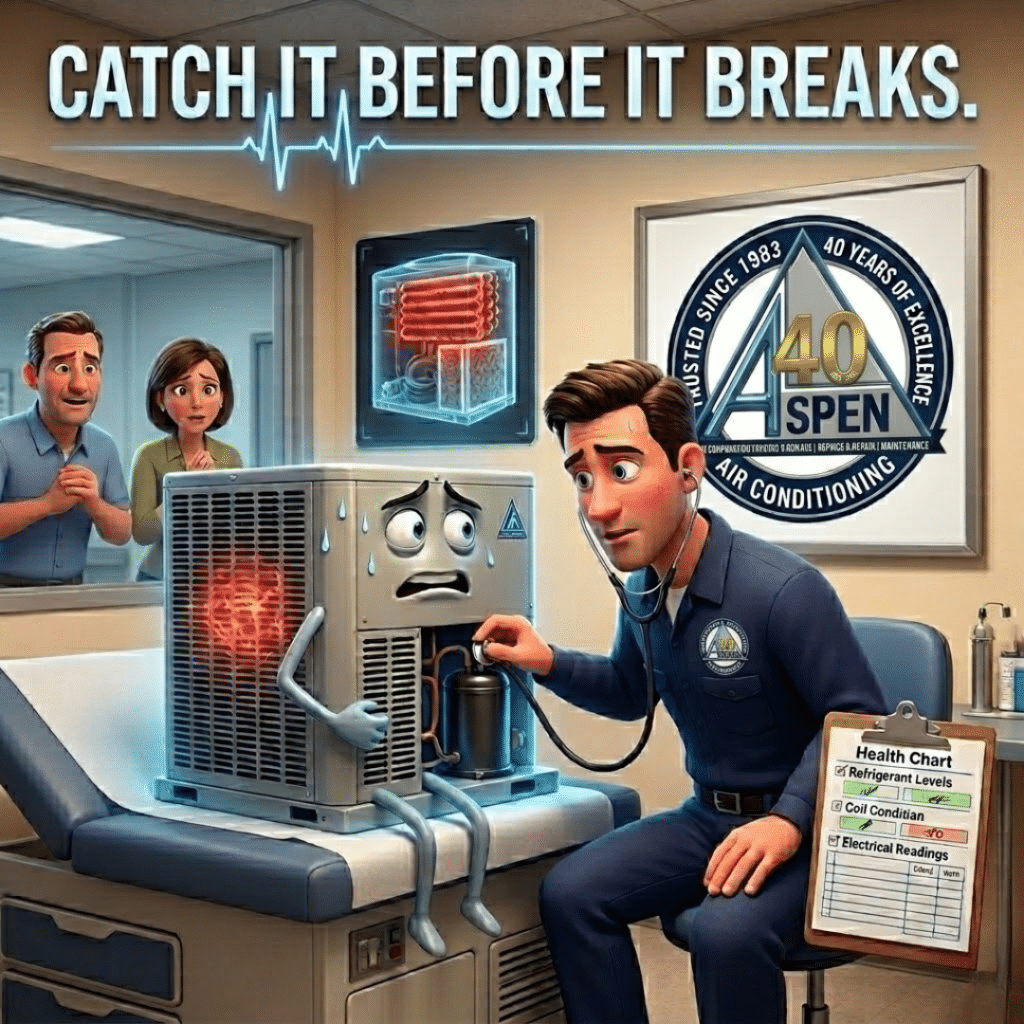
The warning signs are consistent and detectable: inconsistent temperatures across zones, unusual cycling patterns, strange noises from rooftop or split units, unexplained energy spikes, and excess moisture around equipment. In South Florida’s sustained summer heat, the window between an early indicator and a full breakdown is shorter than in cooler markets — which is exactly why recognizing these signals early is the difference between a scheduled repair and an emergency one.
Commercial AC Failures Rarely Happen Without Warning
The most frustrating aspect of a commercial AC breakdown is discovering that the warning signs were there all along. A peer-reviewed study from Lawrence Berkeley National Laboratory, drawing on multi-year monitoring data from 151 buildings and more than 60,000 pieces of HVAC equipment, found that on any given day, an average of 40% of air handling units have at least one active fault. These are not catastrophic failures — they are early indicators that something is drifting toward breakdown, and that the window for low-cost intervention is still open.
For commercial operators across Boca Raton, Fort Lauderdale, and Palm Beach County, that window is narrower than in cooler markets. High ambient temperatures and continuous summer operation compress the timeline between early warning and full failure considerably — which is why structured inspection and documentation matter far more here than a national average would suggest.
The Warning Signs South Florida Operators Most Often Ignore
Certain warning signs appear consistently before commercial AC failures, and most are subtle enough to dismiss during a busy operating day. Each one points to a specific mechanical issue:
Inconsistent temperatures across zones — usually points to failing dampers, ductwork problems, or compressor strain.
Unusual cycling (frequent on/off) — short cycling that accelerates compressor wear dramatically.
Strange noises from rooftop or split units — typically loose belts, worn bearings, or motor deterioration.
Unexplained energy consumption spikes — often dirty coils, low refrigerant, or components running out of spec.
Excess humidity or moisture around equipment — points to drainage problems, failing seals, or capacity loss.
In South Florida’s summer heat, any of these unaddressed issues will escalate faster than in a cooler operating environment. Aspen AC’s NATE-certified commercial technicians are trained specifically to identify and address these indicators before they cascade into larger failures — the core of effective commercial AC repair is catching the problem before it becomes one.
What Actually Causes Commercial AC Systems to Fail
Understanding failure causes is essential for prevention. The U.S. Department of Energy identifies four leading contributors to premature system failure and reduced efficiency:
- Dirty or blocked coils — the most acute risk in South Florida, where heat, humidity, and airborne debris accelerate coil fouling and force compressors into prolonged high-stress operation
- Low refrigerant — driving longer run times and signaling a leak requiring repair
- Clogged filters — restricting airflow and stressing the entire system
- Neglected electrical connections — corroding and loosening, increasing amperage draw and fire risk
In South Florida, dirty condenser coils are the single most common failure driver, dramatically shortening equipment lifespan when left unaddressed. Pre-season inspection must cover refrigerant pressure verification, coil condition, electrical connections, thermostat calibration, and condensate management as minimum baseline items — all of which Aspen AC’s commercial HVAC maintenance programs address on a structured schedule calibrated to South Florida’s operating demands.
How Preventive Service Changes the Outcome
Emergency AC repairs cost significantly more than scheduled maintenance — both in direct service costs and in operational disruption. Structured preventive maintenance consistently and substantially reduces equipment breakdowns compared to reactive, run-to-failure approaches, since most of the faults identified in the LBNL research above are catchable well before they cascade into a full failure. For South Florida commercial properties where tenant comfort, health compliance, and operational continuity all depend on cooling performance, that reduction is a meaningful financial and reputational advantage.
Preventive service transforms a system’s risk profile by ensuring every component operates within its intended parameters before summer load arrives. It also gives facility managers current, documented knowledge of equipment condition — supporting better capital planning and reducing the likelihood of costly surprises. For operators who want that protection formalized, an HVAC maintenance contract keeps inspection on a reliable cadence, while emergency HVAC repair remains available if a system does fail mid-season.
Frequently Asked Questions
What are the most common warning signs of commercial AC failure?
The most common early warning signs are inconsistent temperatures across zones, unusual cycling patterns (frequent on/off), strange noises from rooftop or split units, unexplained energy consumption spikes, and excess humidity or moisture around equipment. Each points to a specific developing mechanical issue that is far cheaper to address before full failure.
Are commercial AC failures actually preventable?
Largely, yes. Research indicates roughly 75% of catastrophic HVAC failures display early warning signs that routine inspection would catch, and structured preventive maintenance can reduce equipment breakdowns by 70 to 75%. The majority of summer AC failures stem from detectable, preventable causes.
What causes commercial AC systems to fail in South Florida?
The U.S. Department of Energy identifies dirty or blocked coils, low refrigerant, clogged filters, and neglected electrical connections as the leading causes. In South Florida, dirty condenser coils are the most acute risk — heat, humidity, and airborne debris accelerate fouling, forcing compressors into prolonged high-stress operation.
Why do AC systems fail faster in South Florida summers?
South Florida’s high ambient temperatures and continuous summer operation compress the timeline between an early warning sign and full failure. A developing fault that might persist for weeks in a cooler climate can cascade into a complete breakdown in days under sustained peak load.
How quickly should I act on a commercial AC warning sign?
Immediately. In South Florida’s summer heat, the window between an early indicator and full failure is short, and a developing fault left unaddressed escalates into an emergency — where repair costs are higher and downtime lands during peak demand. Prompt inspection at the first sign is the lowest-cost intervention.
Before It Breaks, Call Aspen AC First
South Florida operators who wait for a failure to act pay for it in emergency premiums, operational disruption, and the kind of tenant or customer experience that is hard to recover from in the middle of a summer heatwave. Aspen AC has been preventing those outcomes for commercial clients across Boca Raton, Fort Lauderdale, and Palm Beach County since 1983, with four decades of technical expertise and a preventive service approach built around South Florida’s real operating conditions.
Because in South Florida, a breakdown is never just an inconvenience — it is a business problem you could have avoided.
→ Contact our commercial team today and schedule a pre-season inspection while the schedule is still open.
Resources
- Empirical Analysis of the Prevalence of HVAC Faults in Commercial Buildings — Crowe & Chen, Lawrence Berkeley National Laboratory
- U.S. Department of Energy — Central Air Conditioning Maintenance & Efficiency — U.S. DOE Office of Energy Efficiency & Renewable Energy
- ASHRAE — Standards & Technical Resources for Commercial HVAC — American Society of Heating, Refrigerating and Air-Conditioning Engineers
Disclaimer: Fault statistics and failure-cause data cited are general industry and academic research, not a prediction for any specific system. Actual risk depends on equipment age, condition, and maintenance history. Contact Aspen AC for an assessment specific to your property.