
Commercial HVAC replacement in South Florida is best budgeted per ton, not per square foot — roughly $2,000 to $3,500 and up per ton installed, since two buildings with identical square footage can need very different tonnage depending on occupancy, glazing and use. Per-square-foot estimates common in national cost articles routinely mislead commercial buyers here.
Property managers researching commercial HVAC costs often start with a per-square-foot number because it feels like the simplest comparison. In practice it’s the least reliable one for commercial buildings, and this guide explains why, then walks through the per-ton math that actually holds up.
Why Doesn’t Cost Per Square Foot Work for Commercial HVAC?
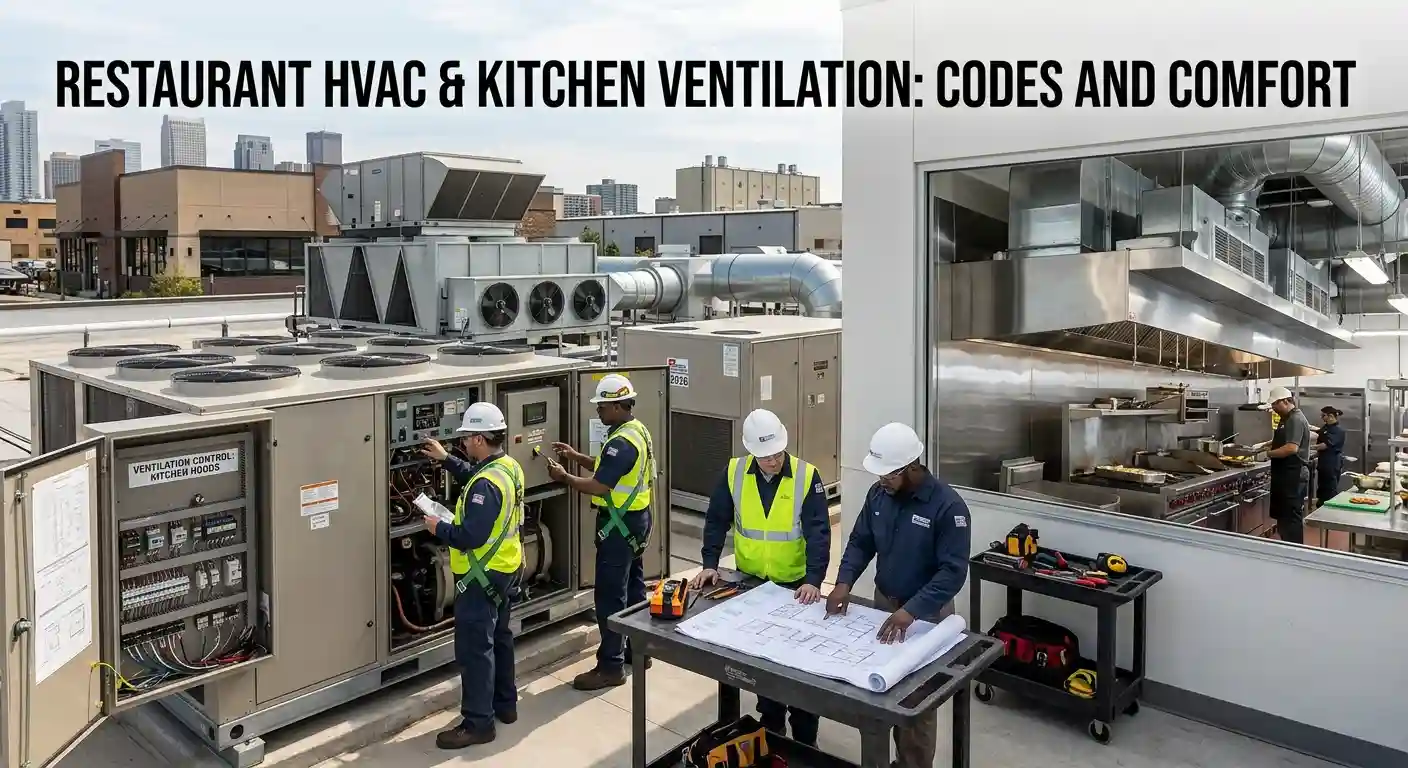
Cost per square foot fails for commercial HVAC because tonnage — not floor area — is what actually drives equipment and installation cost, and tonnage per square foot varies enormously by building type: a restaurant kitchen needs several times the cooling capacity of an equal-area storage room.
A per-square-foot figure implicitly assumes uniform tonnage across every building type, which simply isn’t true. An office, a restaurant, and a warehouse of identical footprint can require wildly different tonnage, and therefore wildly different equipment and installation cost, for the same number of square feet. Our tonnage guide covers exactly how much that requirement swings by building type.
How Should Commercial HVAC Cost Be Budgeted Instead?
Budget commercial HVAC replacement per ton of required cooling capacity, generally $2,000 to $3,500 and up per ton installed, then determine tonnage from a proper load calculation rather than a square-footage guess — the per-ton figure is far more stable across building types than any per-square-foot number could be.
| Approach | Reliability for commercial buyers |
|---|---|
| Cost per square foot | Unreliable — ignores building type and load variation |
| Cost per ton | Reliable — reflects the equipment actually being purchased |
| Cost per ton + load calculation | Most accurate — grounds the ton count in your building’s real load |
Full published pricing detail is on our commercial HVAC pricing page, structured around exactly this per-ton framework rather than a square-footage shortcut.
What Engineering Standard Actually Determines Tonnage?
Commercial tonnage should come from a load calculation performed to ACCA Manual N or ASHRAE-based procedures, which model envelope, glazing, occupancy, ventilation and equipment heat load for the specific building — not from a benchmark or square-footage rule applied generically across building types.
These methods, referenced through ASHRAE standards, exist precisely because square footage alone cannot predict cooling load reliably — two spaces of equal area can differ by a wide margin once occupancy density, glazing exposure and internal equipment heat are actually accounted for. Any credible commercial HVAC cost estimate should trace back to this kind of calculation rather than a convenient square-footage shortcut that skips the engineering entirely.
How Do You Estimate Tonnage Before Getting a Quote?
For early budgeting, South Florida commercial space benchmarks around one ton per 350 to 500 square feet depending on building type — offices toward the higher end of that range, restaurants and dense-occupancy spaces toward the lower end — with a proper load calculation required before any purchase decision.
These benchmarks exist to bracket a budget conversation, not to replace engineering. A load calculation accounts for occupancy, glazing, ceiling height, equipment heat and South Florida’s significant latent (humidity) load — factors a square-footage number can’t see. Our load calculation guide covers why this engineering step matters more here than in drier climates.
Does Equipment Type Change the Per-Ton Cost?
Yes — packaged rooftop units, split systems and VRF systems all carry different per-ton installed costs, so the per-ton range itself should be read as a starting bracket that narrows once the equipment type is chosen, not a single number that applies identically to every system.
A straightforward rooftop replacement on a matching curb typically lands toward the lower end of the per-ton range; a VRF system with its added piping and controls infrastructure typically lands toward the higher end for comparable tonnage. Our commercial HVAC brands guide and VRF versus rooftop comparison cover how equipment type factors into that range in more detail than a single per-ton figure can capture on its own.
How Much Does Replacement Actually Cost, Building Type by Building Type?
Applying the tonnage benchmarks to the per-ton range shows how dramatically total replacement cost varies for the same square footage: a 5,000-square-foot office at roughly 11 to 14 tons brackets around $22,000 to $49,000 installed, while a 5,000-square-foot restaurant at roughly 17 to 25 tons brackets meaningfully higher for the identical floor area.
That spread is the whole argument against per-square-foot estimating — a single blended “cost per square foot” figure averaged across building types tells a restaurant owner and an office manager the same number for genuinely different projects, which helps neither one budget accurately and can lead both toward capital planning numbers that miss the actual project cost by a wide margin.
Why Do National Cost Articles Get This Wrong?
National HVAC cost content often defaults to per-square-foot figures because they’re easy to publish as a single number, but that convenience comes at the cost of accuracy for commercial buyers whose building type, climate and load profile the national average was never built to reflect.
South Florida compounds the problem specifically: our humidity load is heavier than most of the country’s, which affects tonnage requirements in ways a generic national benchmark doesn’t capture. A commercial buyer using a national per-square-foot figure to budget a South Florida replacement is working from a number calibrated for a different climate entirely — one that never had to account for the moisture load our buildings fight nearly year-round.
What Else Moves Cost Within the Per-Ton Range?
Beyond tonnage, six factors move a project within the $2,000 to $3,500-and-up per-ton range: equipment tier and brand, crane and rigging access, roof curb compatibility, electrical scope, permitting and Florida Building Code wind-load compliance, and coastal coil protection for buildings near salt air.
- Equipment tier — premium and coastal-duty builds price above value lines
- Access and rigging — rooftop crane logistics add real cost on tight or occupied sites
- Curb compatibility — a matching curb is a bolt-in; a mismatch means fabrication work
- Electrical scope — panel capacity and disconnects sized to the new equipment
- Permitting — mechanical permits plus engineered wind-load tie-downs
- Coastal protection — coil coating that pays for itself in extended equipment life
How Should You Use Cost Estimates When Comparing Bids?
Compare bids on cost per ton against a shared, verified tonnage figure — ideally each bidder’s own load calculation — rather than comparing bottom-line prices or, worse, dollar-per-square-foot figures that hide whether bidders are even proposing the same tonnage for your building.
When bids disagree meaningfully on tonnage for the same space, that disagreement is the more important finding than any price difference — one bidder is likely guessing, and that guess is the real risk in the proposal, not the price difference sitting next to it. Ask each for their sizing basis before comparing price at all; our replacement team includes the load calculation in every proposal specifically so the tonnage behind the number is never a guess, and so the price on the page actually means what it appears to mean.
Frequently Asked Questions
What is the average cost per square foot for commercial HVAC?
There isn’t a reliable single figure — tonnage requirements vary too much by building type for a per-square-foot number to mean much. Budgeting per ton, generally $2,000 to $3,500 and up installed, gives a far more accurate starting point for South Florida commercial buildings.
Why do two buildings with the same square footage cost different amounts to cool?
Because tonnage, not floor area, drives cost, and tonnage depends on occupancy, glazing, ceiling height and equipment heat. A restaurant and an office of identical size can need very different cooling capacity, and therefore very different equipment cost.
How many tons of AC does my building need?
South Florida commercial space benchmarks around one ton per 350 to 500 square feet depending on building type, useful for early budgeting. A proper load calculation is required before purchasing, since only it accounts for your building’s actual load factors.
Should I trust a contractor’s per-square-foot quote?
Treat it as a red flag worth questioning. A credible commercial quote should be built from tonnage and a load calculation, not a square-footage shortcut — ask what tonnage the quote assumes and how it was determined before comparing price.
Aspen Air Conditioning prices commercial HVAC replacement per ton, grounded in real load calculations, across Palm Beach and Broward Counties. Call 561-464-5010.