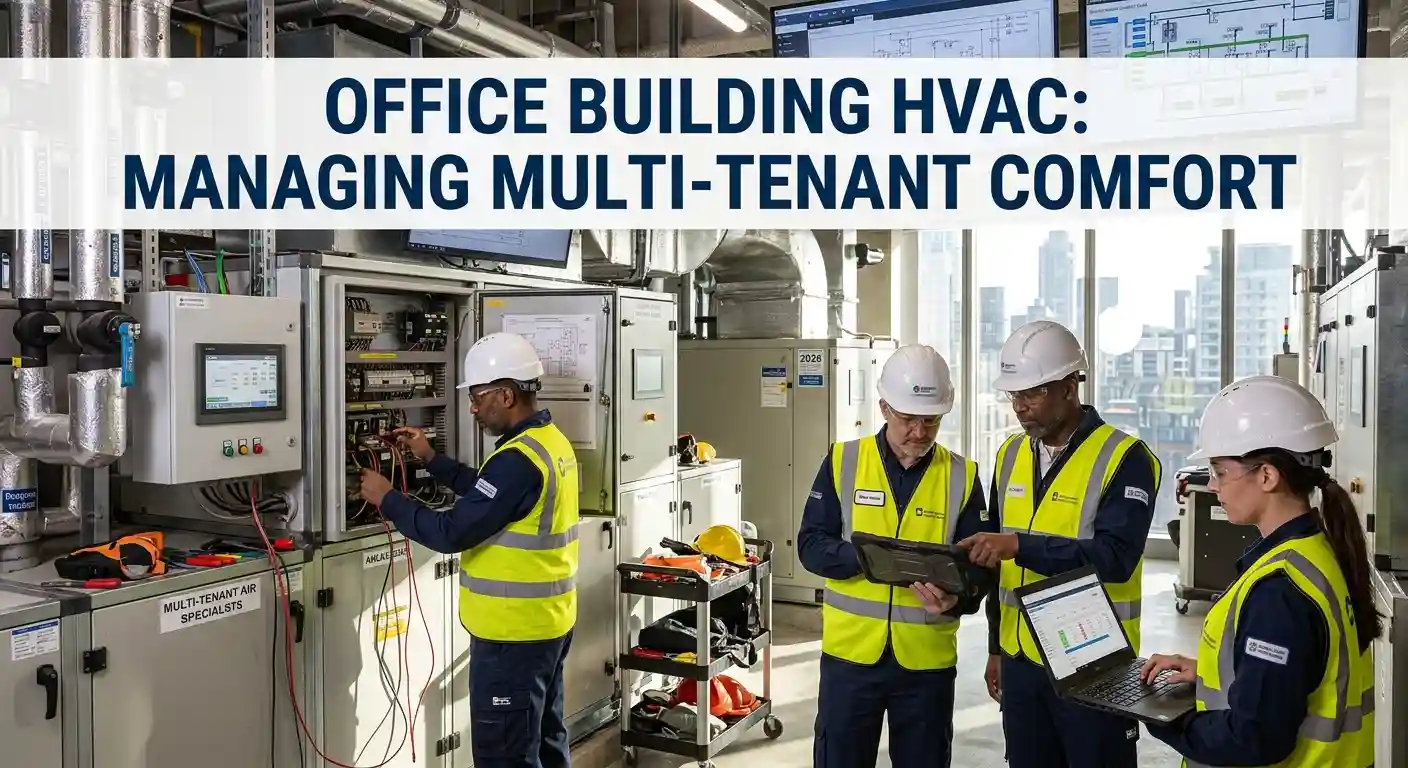

Multi-tenant office HVAC comfort depends on zoning that matches how each tenant actually uses their space, metering that fairly allocates energy cost, and a maintenance program that prevents one tenant’s complaint from becoming everyone’s problem. The buildings that manage this well treat HVAC as a shared system with individual accountability, not a single thermostat serving everyone the same way.
Office comfort complaints are among the most common tenant issues property managers field, and most trace back to zoning or scheduling decisions made — or not made — at the system design stage. This guide covers what drives multi-tenant office comfort, how zoning and metering actually work, and how to resolve the disputes that come up anyway.
Why Are Multi-Tenant Offices Harder to Condition Than Single-Tenant Buildings?
Multi-tenant offices combine different companies with different schedules, different occupancy densities, and often different comfort preferences on the same HVAC system — a combination that a single-tenant building sized around one company’s known patterns never has to reconcile.
A law firm with a 9-to-5 schedule and a tech company running later hours in the same building create genuinely conflicting HVAC demands if they share zoning. One tenant’s dense conference-room meeting and another’s mostly-empty afternoon happen simultaneously on systems that, without proper zoning, average those different needs into a compromise that satisfies neither tenant particularly well.
How Should Multi-Tenant Office Buildings Be Zoned?
Zoning should generally follow tenant boundaries at minimum, with additional sub-zoning for spaces that have genuinely different loads within one tenant’s footprint — a west-facing conference room, an interior server closet, a reception area with heavier foot traffic than the offices behind it.
| Zoning approach | Best for | Trade-off |
|---|---|---|
| Floor-level zoning | Single-tenant floors, simple buildings | Doesn’t help multi-tenant floors |
| Tenant-boundary zoning | Multi-tenant floors, standard buildups | Baseline for fair, independent control |
| Sub-zoning within tenant space | Larger tenants with varied internal loads | Higher cost, better comfort and efficiency |
| VRF/zone-level control | Buildings prioritizing tenant flexibility | Highest upfront cost, most granular control |
Our VRF versus rooftop comparison covers the system-level decision that underlies serious tenant-boundary zoning in multi-tenant buildings.
How Does Energy Cost Get Fairly Allocated Between Tenants?
Fair allocation depends on metering that reflects actual usage per tenant — submetering at the tenant or zone level, rather than a single building meter split by square footage, which charges light users the same as heavy users and creates exactly the kind of dispute property managers spend the most time resolving.
Buildings without submetering tend to see more thermostat conflicts, since tenants who aren’t individually billed have less incentive to moderate usage, and tenants who are billed by square footage alone reasonably object to subsidizing a neighbor running their space colder than necessary. Submetering isn’t free to install, but it resolves a category of tenant dispute that otherwise recurs indefinitely.
What Causes Most Tenant Comfort Complaints?
The most common complaints trace to three causes: inadequate zoning forcing tenants with different needs to share a system, scheduling that doesn’t match a tenant’s actual occupied hours, and equipment that’s degraded enough to underperform even though it hasn’t fully failed.
A tenant complaining their space is always warm in the afternoon may be dealing with west-facing solar gain a zoning decision never accounted for, or with a system whose scheduled setback is fighting their actual later working hours, or simply with a unit that’s lost capacity to fouled coils and needs the maintenance visit its neighbor already got. Diagnosing which cause applies before proposing a fix saves both the property manager and the tenant a repeated cycle of complaints.
How Should Building Automation Systems Handle Multiple Tenants?
Building automation should give each tenant independent scheduling and setpoint control within their own zone, while still allowing the property manager to monitor system health and override in genuine emergencies — a balance that respects tenant autonomy without losing the property-wide oversight a building this complex actually needs.
Tenants who can adjust their own schedule and setpoint within reasonable bounds generate far fewer complaints than tenants locked into a building-wide schedule that doesn’t match their hours. Modern controls make tenant-level scheduling straightforward on properly zoned systems — the limitation is usually the zoning itself, not the controls layered on top of it.
How Does Shared Ventilation Affect Indoor Air Quality Between Tenants?
Office ventilation systems that draw outdoor air through shared ductwork can carry odors, allergens or contaminants between tenant spaces if dampers, filtration and zone separation aren’t properly designed — a real air-quality consideration on top of the temperature and humidity issues most comfort disputes focus on.
Ventilation rates in commercial office buildings are governed by ASHRAE ventilation standards, which set minimum outdoor-air requirements based on occupancy and space type. Multi-tenant buildings should verify that shared air handling equipment includes adequate filtration and that zone dampers actually isolate tenant spaces as designed — a detail worth confirming during any HVAC upgrade, since ductwork installed decades ago for a different tenant configuration doesn’t always match current lease boundaries.
How Should Maintenance Be Scheduled Across Multiple Tenants?
Maintenance visits in occupied multi-tenant buildings should happen outside business hours or in coordinated windows communicated to affected tenants in advance, since HVAC service that disrupts one tenant’s workday generates a different kind of complaint than a comfort issue — one that’s entirely avoidable with better scheduling.
Quarterly service — the standard cadence for South Florida commercial equipment — can rotate through a multi-tenant building zone by zone rather than shutting down the whole system at once, minimizing disruption to any single tenant. Our office building HVAC team coordinates maintenance windows directly with property management to avoid exactly this kind of avoidable tenant friction.
How Do You Resolve a Comfort Dispute Between Adjacent Tenants?
Start with data, not assumptions — a temperature and humidity log from both spaces over a few days usually reveals whether the complaint reflects a real zoning or equipment problem or a genuine difference in comfort preference between two tenants sharing imperfectly zoned space.
If the data shows a real load imbalance — one zone genuinely running warmer due to solar exposure or equipment heat — the fix is usually a zoning or controls adjustment, not a debate about preferences. If the data shows both zones performing to spec and the complaint is really about differing comfort preferences between tenants, that’s a conversation about expectations, not a maintenance ticket, and treating it as the wrong one wastes everyone’s time and erodes trust in the maintenance program itself.
What Does Multi-Tenant Office HVAC Typically Cost?
Base equipment pricing follows standard commercial ranges — replacement generally $10,000 to $30,000 and up per unit, roughly $2,000 to $3,500 and up per ton, published on our commercial HVAC pricing page — with sub-zoning, submetering and tenant-level controls adding incremental cost on top of base equipment.
That incremental cost is usually worth weighing against what it prevents: the ongoing property management time spent mediating comfort disputes, the tenant turnover risk when comfort complaints go unresolved, and the energy waste of a system that’s overcooling one zone to satisfy another’s complaint. Buildings that invest in proper zoning upfront generally spend less on dispute management over the building’s life than buildings that skip it and pay for the same fix piecemeal, tenant complaint by tenant complaint, years later.
Frequently Asked Questions
How should HVAC zones be divided in a multi-tenant office building?
At minimum, zones should follow tenant boundaries so each tenant controls their own space independently. Larger tenants or spaces with varied internal loads — conference rooms, server closets — benefit from additional sub-zoning within their footprint.
Who pays for HVAC energy costs in a multi-tenant building?
It depends on the lease and metering setup — submetering allows fair per-tenant billing based on actual usage, while buildings without it typically split costs by square footage, which can create disputes between light and heavy users.
Why is one office always colder or warmer than neighboring offices?
Common causes include solar exposure differences, inadequate zoning forcing spaces with different needs to share a system, or degraded equipment losing capacity. A temperature log over a few days usually identifies which factor applies.
How often should HVAC maintenance happen in an occupied office building?
Quarterly is standard for South Florida commercial equipment, scheduled outside business hours or in coordinated windows communicated to tenants in advance, often rotating zone by zone to minimize disruption to any single tenant.
Aspen Air Conditioning designs and maintains multi-tenant office HVAC across Palm Beach and Broward Counties, built around fair zoning and tenant comfort. Call 561-464-5010.