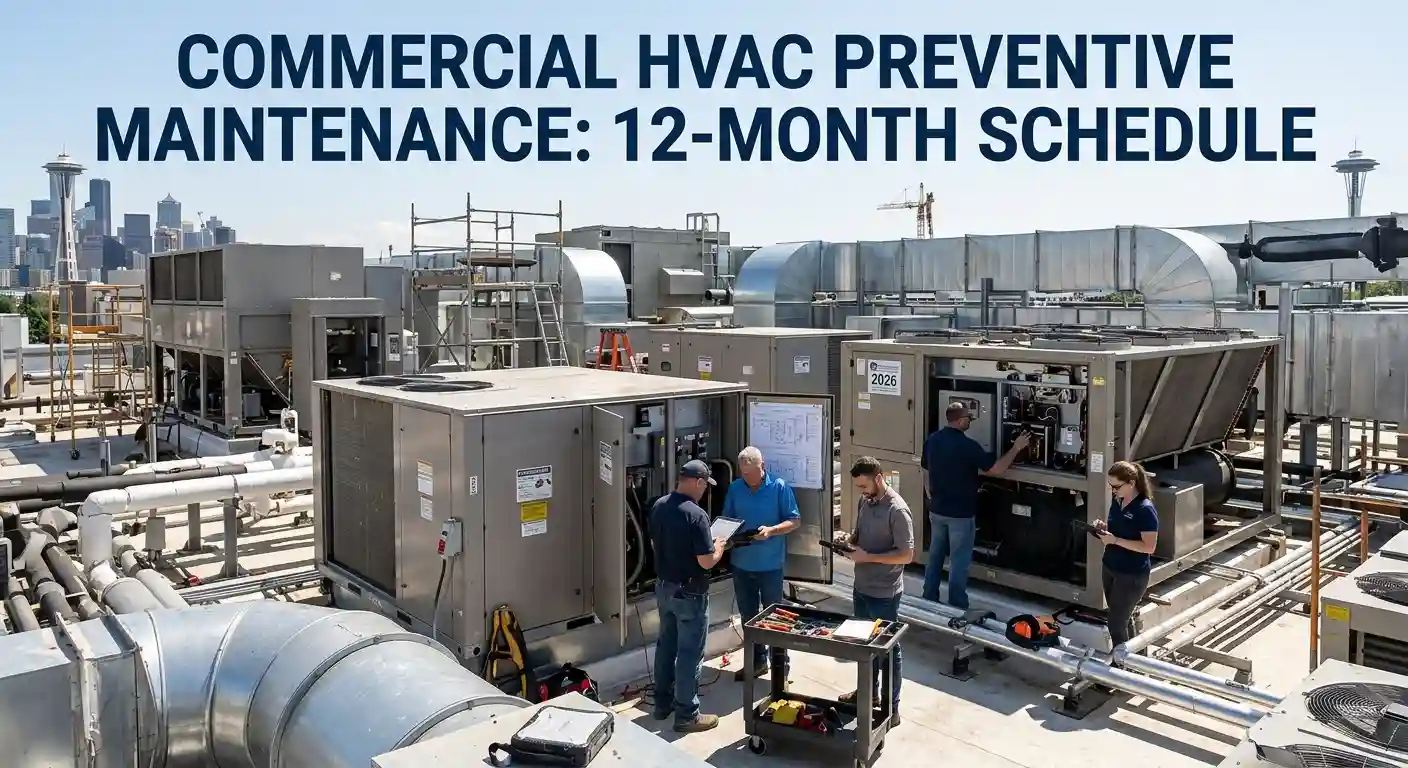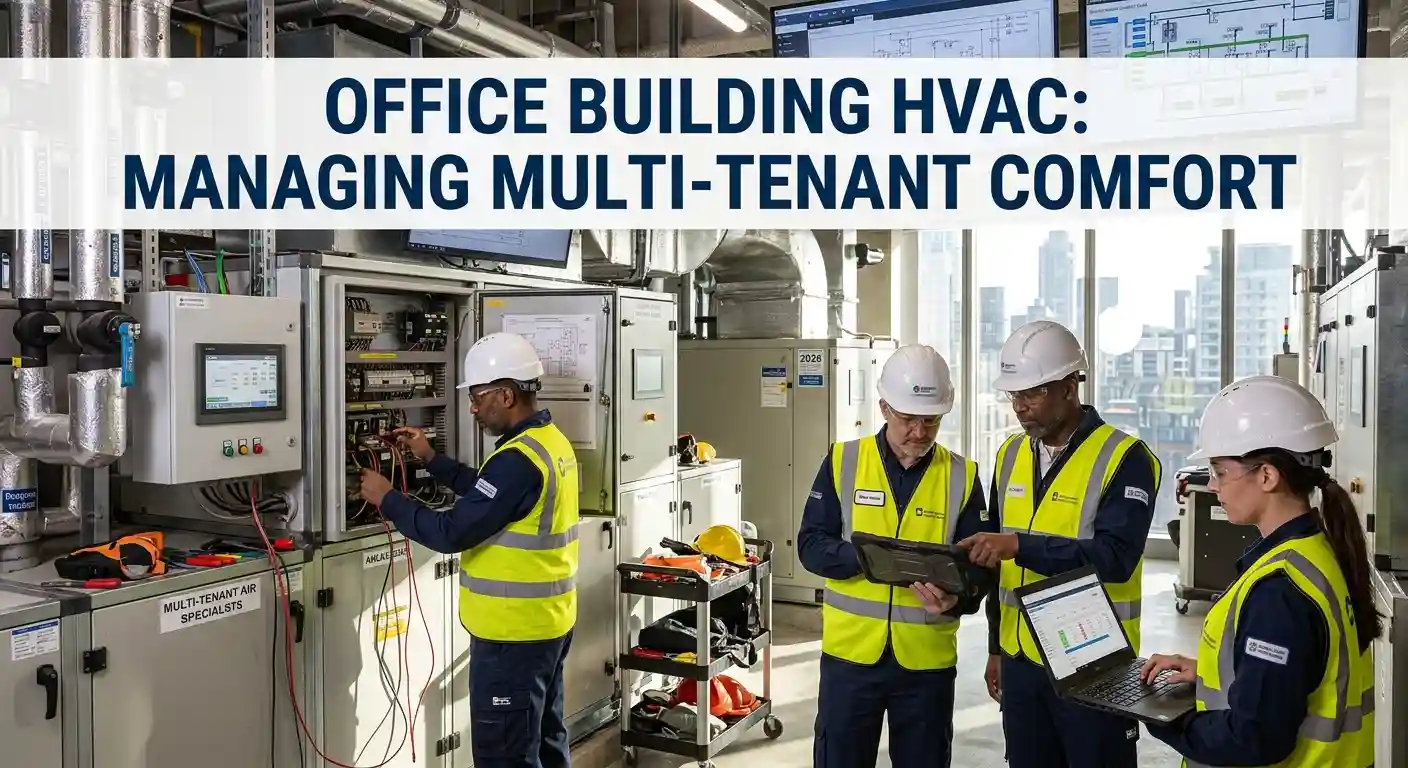

New construction HVAC follows a defined process from design through commissioning: load calculation and system design during the design phase, equipment selection and coordination with other trades during construction documents, installation and startup during the build, and commissioning verification before occupancy.
Skipping or rushing any one of those stages is how new commercial buildings end up with HVAC problems on day one — wrong sizing, ductwork fighting the ceiling grid, or systems that were never actually tested before tenants moved in and complaints started arriving on the property manager’s desk instead of the punch list. This guide walks through each phase and what a property owner or general contractor should expect at every step.
When Should HVAC Design Begin on a New Construction Project?
HVAC design should begin during design development, alongside the architectural drawings, rather than after the building shell is finalized — early involvement lets the mechanical design influence decisions like ceiling heights, structural penetrations and electrical capacity before they’re locked in.
Projects that bring HVAC design in late routinely hit conflicts that cost real money to fix: ductwork that doesn’t fit the ceiling cavity, rooftop equipment that exceeds the structural load the roof was designed for, or electrical service sized before the mechanical load was calculated. Our new construction HVAC team works from design development forward specifically to avoid this sequence.
How Is Commercial HVAC Load Calculated for New Buildings?
New construction load calculations model the building’s envelope, glazing, orientation, occupancy schedule, ventilation requirements and equipment heat load using ASHRAE-based procedures or ACCA Manual N — producing both the tonnage and the sensible-to-latent split the equipment needs to handle.
This is real engineering, not a benchmark applied to square footage. South Florida’s climate makes the latent (moisture) side of that calculation especially consequential — a system sized only for temperature can hit setpoint while still leaving the building humid, which is precisely the failure mode a proper load calculation is designed to prevent. Our load calculation guide covers the method in more depth.
What Happens During Equipment Selection and Coordination?
Equipment selection matches the load calculation’s output to specific units, brands and configurations, then coordinates those choices with every other trade whose work touches the mechanical system — structural for rooftop loads, electrical for equipment power, and the general contractor’s overall schedule.
| Coordination point | What gets confirmed |
|---|---|
| Structural | Roof can carry the equipment’s weight; curb and mounting details finalized |
| Electrical | Panel capacity and disconnects sized to the selected equipment |
| Permitting | Mechanical permit and Florida Building Code wind-load compliance documented |
| Schedule | Equipment lead times confirmed against the overall construction timeline |
Equipment lead times deserve particular attention on new construction — packaged rooftop units and larger commercial systems can run several weeks to a few months depending on tonnage and configuration, and ordering late is one of the most common causes of new-construction schedule slippage that traces back to mechanical.
What Does HVAC Installation Involve on a New Building?
Installation on new construction covers duct and pipe routing, equipment setting, electrical connections, and refrigerant charging, sequenced to match the building’s overall construction schedule rather than working in isolation.
Rooftop equipment typically sets once the roof structure and curbs are ready but before final roofing membrane work completes, requiring tight coordination with the roofing trade. Ductwork installation generally follows framing and precedes ceiling work, and its routing should already be resolved on paper from the design coordination phase — installation is where a well-coordinated design executes cleanly, and where a poorly coordinated one generates field changes that cost time and money — often the same conflicts a proper design-phase coordination review would have caught for free.
What Does Commissioning Actually Verify?
Commissioning is the formal process of verifying that installed HVAC systems perform to their design specifications before occupancy — refrigerant charge confirmed by weight, airflow measured at each zone, controls tested through their full sequence, and readings documented rather than assumed.
This step is where new-construction problems get caught before tenants experience them: a zone that’s not getting design airflow, a control sequence that doesn’t actually do what the drawings specify, a refrigerant charge that’s off enough to affect efficiency and equipment life. Skipping commissioning, or treating it as a formality, is how buildings end up with HVAC systems that technically installed correctly but never actually work as designed.
Who Should Be Involved in New Construction HVAC Commissioning?
A thorough commissioning process involves the installing contractor performing the technical verification, the general contractor confirming it against the project schedule, and ideally a documented report the owner keeps — not a verbal confirmation that everything is fine.
On more complex projects, third-party commissioning agents are sometimes brought in specifically because they have no stake in signing off quickly — their only job is confirming the systems perform as designed, which removes any incentive to call a marginal reading close enough. For most commercial new-construction projects, a detailed report from the installing contractor, with actual readings rather than checkmarks, gives the owner the documentation needed for warranty claims and future maintenance planning — and becomes the baseline every future service visit gets measured against.
How Does Florida Building Code Affect New Construction HVAC?
New commercial HVAC installations in South Florida must meet Florida Building Code requirements, including wind-load compliance for rooftop equipment with engineered tie-downs — a requirement that shapes equipment placement and mounting from the design phase forward, not something added at the end.
Mechanical permits are required for new HVAC installation, and permitted work should include the wind-load engineering documentation as part of the approval, not as an afterthought discovered during inspection. A design that accounts for these requirements from the start avoids the schedule delay of redesigning equipment placement after a permit rejection — a rework cycle that can add weeks to a project timeline that had no slack to begin with.
What Does New Construction HVAC Typically Cost?
New construction HVAC pricing follows the same commercial ranges as replacement work, generally $10,000 to $30,000 and up per unit installed, roughly $2,000 to $3,500 and up per ton — with new-construction projects adding design and commissioning scope on top of the equipment and installation cost.
Full detail on published commercial HVAC pricing is on our pricing page. New-construction quotes should itemize design, equipment, installation, permitting and commissioning separately rather than as one bundled number, which lets an owner or general contractor compare proposals on scope rather than just the bottom line — the same discipline that makes any commercial construction bid comparison meaningful instead of misleading.
What System Types Are Common on New Commercial Construction?
New commercial builds in South Florida most often use packaged rooftop units for straightforward single-zone spaces, VRF systems for multi-zone buildings with varied schedules, and larger chiller plants for high-rise or campus-scale projects — the choice depends on the building’s zoning needs more than its size alone.
Offices, retail and hotels with many independently-controlled zones increasingly specify VRF at the design stage, since retrofitting zone-level control into a rooftop-only system later is far more disruptive than designing for it up front. Our VRF/VRV installation team is involved in new-construction design conversations specifically to make that system-type decision early, when it’s cheapest to make correctly.
Frequently Asked Questions
When should HVAC design start on a new construction project?
During design development, alongside architectural drawings — not after the building shell is finalized. Early HVAC involvement lets mechanical requirements influence decisions like ceiling heights and structural loads before they’re locked in, avoiding costly conflicts later.
What is HVAC commissioning and why does it matter?
Commissioning verifies installed systems perform to their design specifications — refrigerant charge, airflow, and controls all tested and documented before occupancy. Skipping it means problems surface after tenants move in rather than before, when they’re far more expensive to fix.
How long does new construction HVAC take to install?
Equipment lead times alone can run several weeks to a few months depending on tonnage and configuration, and installation timing coordinates with the broader construction schedule. Ordering equipment early, once design is finalized, is essential to avoiding schedule delays.
Does new construction HVAC need a mechanical permit?
Yes — mechanical permits are required for new commercial HVAC installation in Florida, including documentation of Florida Building Code wind-load compliance for rooftop equipment. Permitting should be built into the design timeline, not handled as an afterthought.
Aspen Air Conditioning provides new construction HVAC design, installation and commissioning for commercial properties across Palm Beach and Broward Counties. Call 561-464-5010.