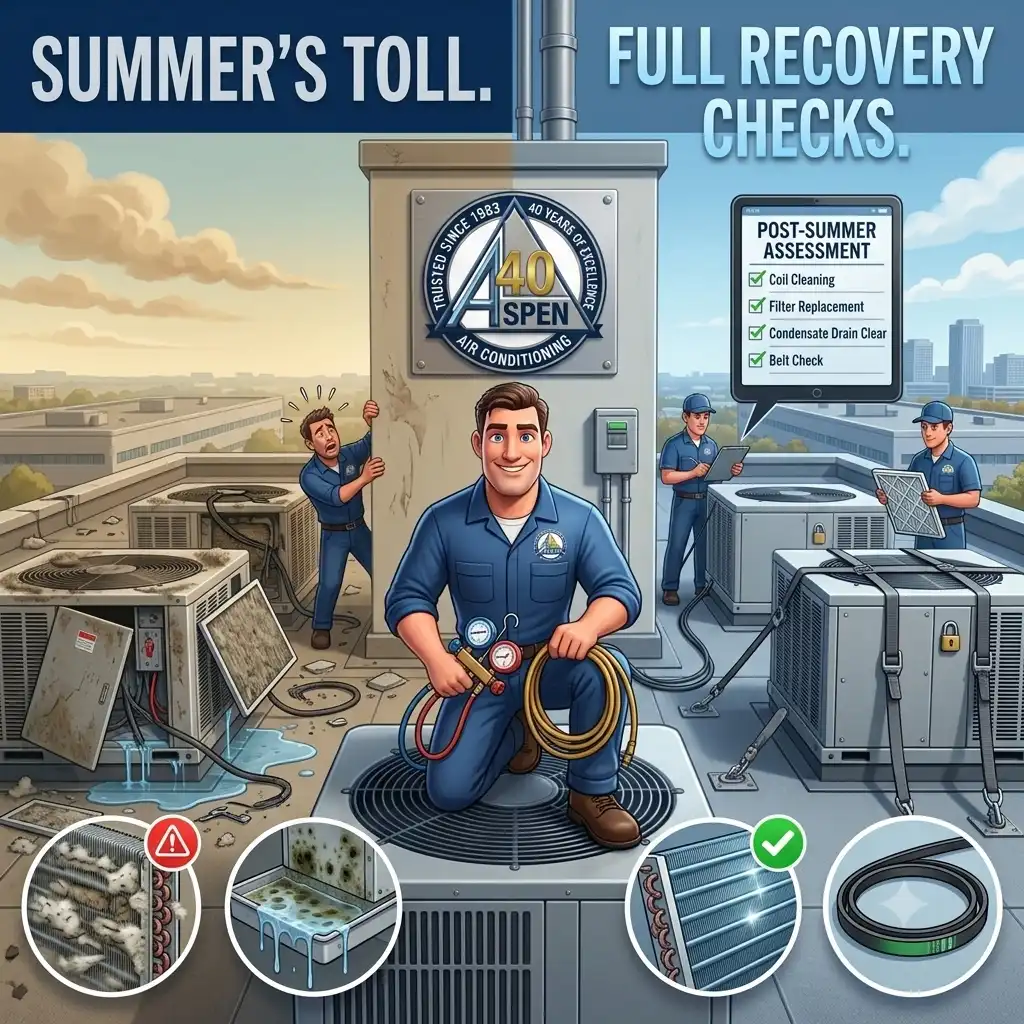
A post-summer commercial HVAC assessment checks refrigerant charge, coil condition, electrical components, and drainage after months of continuous cooling — before those small issues turn into fall breakdowns or higher utility bills. In South Florida, where systems run near-continuously for six months straight, this checkpoint catches wear that a quick visual walk-through misses.
Why a Post-Summer Assessment Matters for South Florida Commercial Properties
A post-summer assessment matters because South Florida HVAC systems don’t get the seasonal break that systems in most other markets do — they run near-continuously from roughly May through October, and that sustained runtime is exactly when components wear fastest.
The U.S. Department of Energy notes that regular air conditioning maintenance improves system performance, reduces energy costs, and helps prevent unexpected failures — and the period right after peak demand is when that maintenance has the most to catch. A capacitor that’s been degrading since July, a coil that’s been losing efficiency since August, or a condensate line that’s been slowly clogging all summer won’t always announce itself with an obvious symptom. It shows up later as a higher utility bill, an uneven room, or a breakdown that didn’t have to happen.
What a Post-Summer Assessment Should Cover
A complete post-summer HVAC assessment covers three areas: refrigerant and coil condition, electrical components and controls, and drainage and ductwork. Each reflects a different way continuous summer runtime puts stress on a system, and each needs a different diagnostic approach.
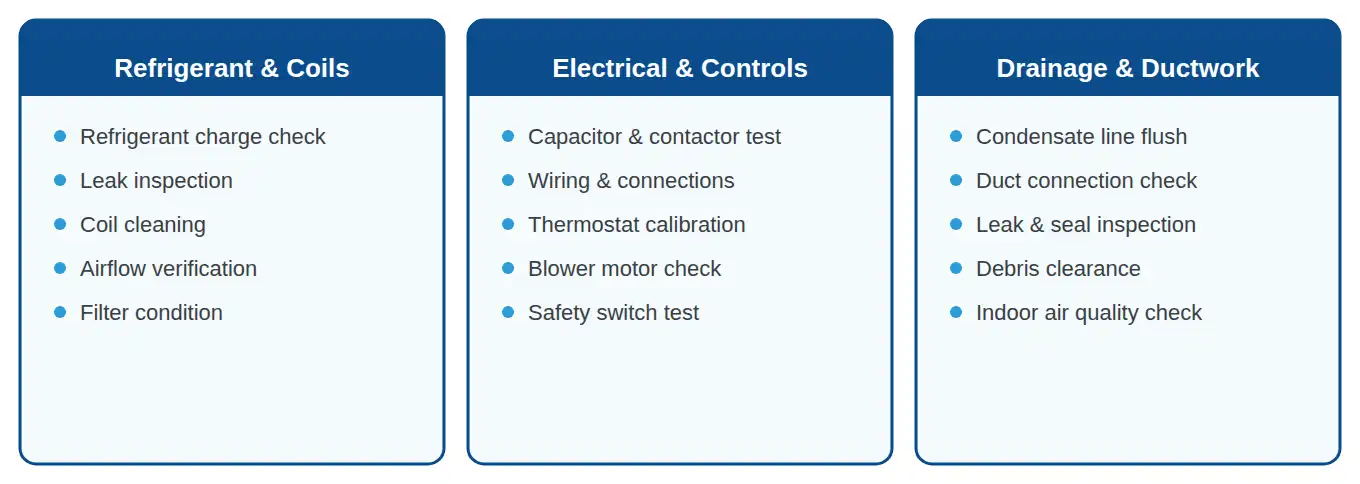
- Refrigerant charge and coil inspection to catch leaks or efficiency loss from a full season of operation
- Electrical component testing — capacitors, contactors, wiring, and safety switches — for wear that builds gradually under continuous load
- Condensate drainage and ductwork inspection to catch clogs, leaks, or connection issues before they affect indoor air quality
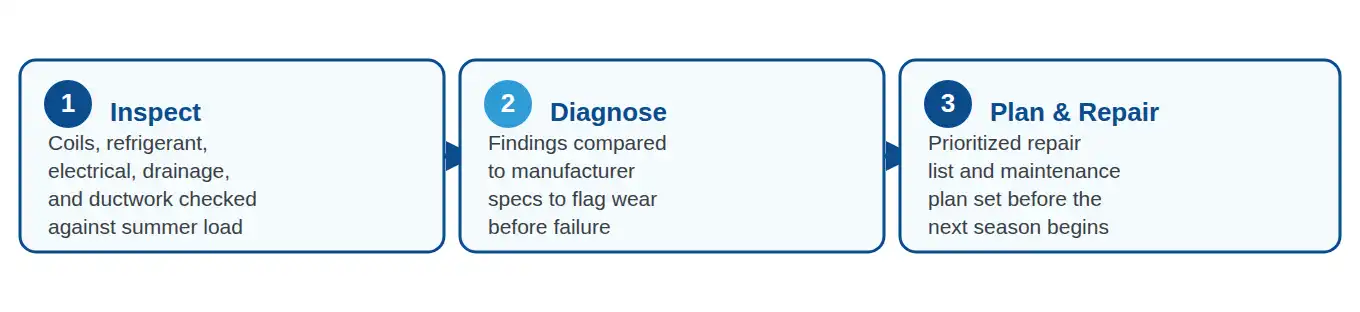
- A documented comparison against manufacturer specifications, not just a pass/fail visual check
- A prioritized list of findings, so repairs can be scheduled before they become emergencies
Refrigerant, Coils, and Airflow: What to Inspect
Refrigerant and coil inspection after summer means checking charge levels against manufacturer specifications, since a system running low on refrigerant for months compounds efficiency loss and compressor strain rather than announcing itself immediately.
- Verify refrigerant charge against manufacturer specifications and inspect for signs of a slow leak
- Clean evaporator and condenser coils, since a season of dirt and debris buildup insulates the coil and forces the compressor to work harder
- Check filter condition and confirm the MERV rating still matches the system’s specification
- Verify airflow at supply and return points to catch developing blockages
Electrical Components and Controls: What to Test
Electrical testing after summer means checking the components that absorbed months of continuous cycling — capacitors, contactors, and safety switches — since these wear gradually and rarely fail with advance warning.
- Test capacitors and contactors for wear from repeated cycling under summer load
- Inspect wiring and electrical connections for looseness or heat damage
- Calibrate thermostats and confirm controls are still reading accurately
- Check blower motor operation and lubrication
- Verify safety switches and interlocks are functioning correctly
Drainage, Ductwork, and Indoor Air Quality: What to Check
Drainage and ductwork inspection after summer means flushing condensate lines and checking duct connections, since months of continuous condensation and airflow are exactly when clogs, leaks, and connection gaps develop.
- Flush condensate drain lines to clear the buildup that accumulates over a full cooling season
- Inspect accessible ductwork for leaks, disconnected sections, or debris accumulation
- Check duct connections at the air handler and major branch points
- Assess whether the duct system would benefit from sealing to restore lost efficiency
Warning Signs You Shouldn’t Wait to Address
Rising utility bills, uneven temperatures between rooms, short cycling, and unusual noises are the clearest signs a commercial HVAC system needs attention now rather than at the next scheduled visit.
- Rising utility bills without a change in usage patterns often point to declining efficiency from a coil, refrigerant, or airflow issue
- Uneven temperatures between rooms or zones usually indicate a specific mechanical cause, not just normal variation
- Short cycling — a system turning on and off more frequently than normal — strains components and shortens equipment life
- Unusual noises such as banging, squealing, or grinding signal a developing mechanical problem
If an assessment turns up any of these, commercial HVAC repair or commercial AC repair can address the specific issue before it escalates into a larger failure.
Turning Assessment Findings Into a Plan
A post-summer assessment is only useful if its findings turn into action — a repair scheduled, a component replaced, or a maintenance plan adjusted before the next cooling season puts the same stress back on the system.
For findings that point to aging equipment rather than a simple repair, this is also a natural checkpoint for capital planning: comparing the cost of continued repairs against a renovation or retrofit, or confirming whether existing equipment issues are covered under a warranty service plan. For everything else, folding assessment findings into a commercial HVAC maintenance plan or maintenance contract means the next post-summer assessment starts from a stronger baseline instead of the same list of deferred issues.