Every August, a predictable pattern repeats across South Florida’s commercial properties. Systems that limped through June and July finally give out under the deepest heat of the year, and operators discover that the odds they were playing were never in their favour. For commercial building owners and facility directors across South Florida, August is the month where deferred decisions come due, service availability tightens, and every gamble on an unserviced system carries its highest possible stakes.
The house always wins in August. The only question is whether your building is the house or the bettor.
The Odds Are Worse in August Than Any Other Month
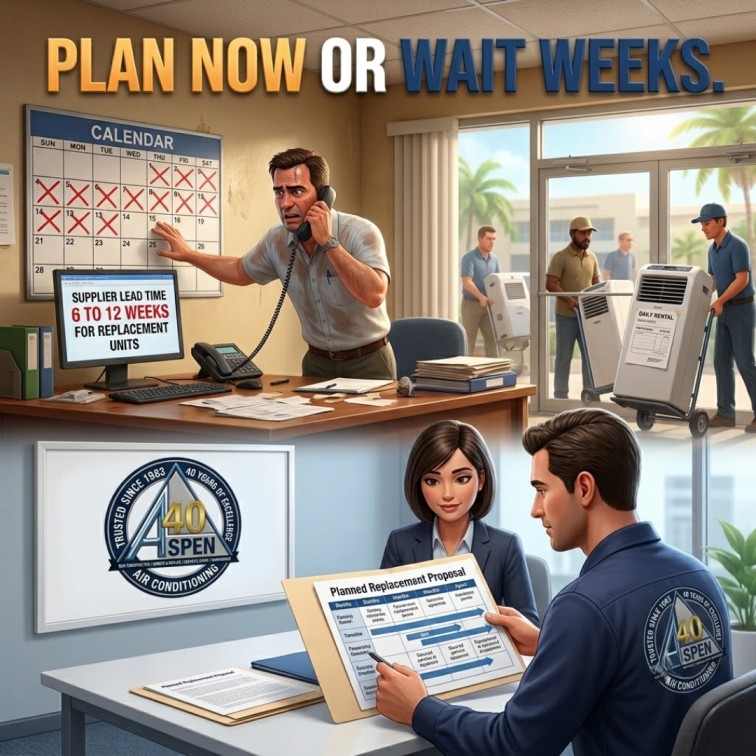
The financial mathematics of an August failure are stacked against the unprepared. As detailed in Downey Plumbing’s analysis of summer commercial AC failures, emergency commercial HVAC service during peak summer demand typically costs 50 to 100 per cent more than scheduled service, and lead times for replacement rooftop units can stretch six to twelve weeks. A complete failure in August can mean operating without reliable cooling for the remainder of the season, with research showing employee cognitive performance declining measurably once indoor temperatures pass 26 to 27 degrees Celsius.
Those figures describe a market at capacity. Every contractor is booked, every parts supplier is stretched, and every operator who waited is now competing for the same scarce resources. Clients with established service relationships through Aspen AC’s commercial programmes receive scheduling priority precisely because that relationship was built before the emergency, not during it.
Why Late Summer Finds the Weak Point Every Time
August failures are rarely random. Commercial systems fail under maximum thermal stress, and by late summer they have been carrying that stress without relief for months. According to Air Repair Pros’ overview of commercial HVAC failure causes, extended extreme heat accelerates wear on compressors, capacitors, and fan motors, deferred tune ups allow refrigerant levels to drift and coils to foul unchecked, and aging equipment past its fifteen to twenty year service life creates unpredictable failure risk that compounds under peak load.
A component that was marginal in May does not announce itself politely. It holds on until the hottest week of the year, then fails when the system is working hardest and the building can least absorb the disruption. That timing is not bad luck. It is physics meeting neglect.
The Warning Signs Are Already Visible
Systems heading toward an August breakdown almost always signal it first. Guidance from McCormick and Allum’s commercial AC summer survival guide identifies the indicators worth acting on immediately: unusual noises, inconsistent temperatures between zones, rising energy bills without usage changes, moisture pooling near units, and odours suggesting mould or electrical stress. Each of these represents a repairable condition today and a potential shutdown next week.
Prevention guidance published for August specific cooling failures reinforces the same conclusion: long operating cycles, clogged filters, and dirty condenser coils are the conditions that turn late summer heat into system failure, and all of them are addressable through routine professional service. Aspen AC’s experienced commercial technicians resolve these conditions on scheduled visits across South Florida every week of the season.
Repair, Replace, or Roll the Dice
For operators running older equipment, August also forces the repair versus replace question at the worst possible moment. As outlined in Pacific Appliance Repair’s commercial repair and replacement guide, the decision depends on unit age, maintenance history, repair cost relative to replacement, refrigerant type, and how much downtime a business can tolerate, with permitting for commercial rooftop replacements adding weeks to any timeline. Making that evaluation calmly in a planned window is a business decision. Making it during an August emergency is damage control.
The operators who avoid that scenario are the ones who assess equipment condition before the deepest heat arrives, using documented service history to plan capital decisions on their own schedule. Aspen AC’s commercial resources help South Florida operators build exactly that kind of informed planning position.
Take the Gamble Off the Table With Aspen AC
August rewards preparation and punishes assumptions, and no commercial operator in South Florida needs to learn that lesson the expensive way. Aspen AC has been removing the guesswork from commercial cooling since 1983, with the service depth, technical professionalism, and regional experience to keep buildings reliable through the harshest weeks of the year. Contact our commercial team and replace the gamble with a plan.
In August, luck is not a maintenance strategy.